
Homework Answers
Add Answer to:
numerical analysis problem
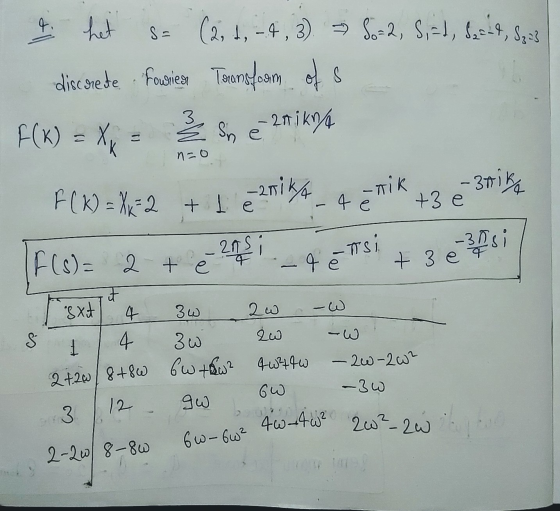
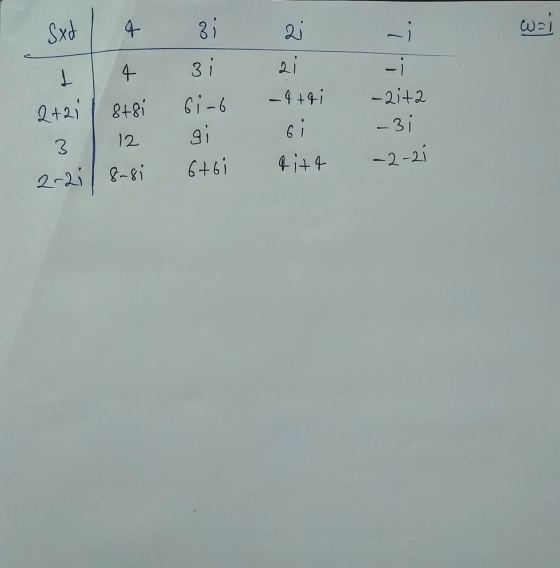
4. Let s = (2,1, -4,3). Find the discrete Fourier transform F(s) of...
2. Discrete Fourier Transform.(/25) 1. N-th roots of unity are defined as solutions to the equation:...
 2. Discrete Fourier Transform.(/25) 1. N-th roots of unity are defined as solutions to the equation: w = 1. There are exactly N distinct N-th roots of unity. Let w be a primitive root of unity, for example w = exp(2 i/N). Show the following: N, if N divides m k=0 10, otherwise N -1 N wmk 2. Fix and integer N > 2. Let f = (f(0), ..., f(N − 1)) a vector (func- tion) f : [N] →...
2TT sinn (1) a) Let x1 [n] = πη Find the Discrete Time Fourier transform of...
 2TT sinn (1) a) Let x1 [n] = πη Find the Discrete Time Fourier transform of this signal and plot it with all its critical values. (you can use only transform tables from the book). b) Now, define xzlv) = (**) GHS) Using transform properties, find the Discrete Time Fourier transform of x2[n] and plot it with all its critical values. In your calculations be sure to show your steps ! 2TT sinn sinn sinwon c) Let y[n] [( )...
Discrete-time fourier transform
The discrete-time Fourier transform (DTFT) representation is given by: ?[?] = 1 ∫? ?(???)?????? Where 2? −? ∞?(???) = ∑ ?[?]?−????=−∞ Compute and plot the frequency spectrum of the Fourier transform for the discrete-time signal: −2 ? = −3, 1, 3?[?] = {3 ? = −4, −2, −1, 0, 2 , 4 , 50 ??ℎ??????
1. Use the Fourier Transform to solve the following problem with W1 21 (a) Find the Fourier Trans...
 1. Use the Fourier Transform to solve the following problem with W1 21 (a) Find the Fourier Transform of u by applying F to the equation and initial condition; denote this function U(w, t). (b) Find u u(z, t) by taking the inverse transform of the U(w, t) you found in part (a).
1. Use the Fourier Transform to solve the following problem with W1 21 (a) Find the Fourier Transform of u by applying F to the equation and...
1. Use the Fourier Transform to solve the following problem with W1 21 (a) Find the Fourier Transform of u by applying F to the equation and initial condition; denote this function U(w, t). (b) Find u u(z, t) by taking the inverse transform of the U(w, t) you found in part (a).
1. Use the Fourier Transform to solve the following problem with W1 21 (a) Find the Fourier Transform of u by applying F to the equation and...
Question 3 Fourier transform] Find the Fourier transform of the following functions. (i) f(z) = H...
 Question 3 Fourier transform] Find the Fourier transform of the following functions. (i) f(z) = H (t-k)e-4. (ii) f(x) = 5e-4H21 (im)(xe 0, otherwise. IV) f(x) = Fourier transform
Question 3 Fourier transform] Find the Fourier transform of the following functions. (i) f(z) = H (t-k)e-4. (ii) f(x) = 5e-4H21 (im)(xe 0, otherwise. IV) f(x) = Fourier transform
Question 3 Fourier transform] Find the Fourier transform of the following functions. (i) f(z) = H (t-k)e-4. (ii) f(x) = 5e-4H21 (im)(xe 0, otherwise. IV) f(x) = Fourier transform
The Fourier transform of f(t), F(W) is as follows: F(W) = F[f(t)] vendºsce-iat de Find the...
 The Fourier transform of f(t), F(W) is as follows: F(W) = F[f(t)] vendºsce-iat de Find the Fourier transform of f(t): 0 < \t] =1 = 1t| 10 t = 0,|t| > 1 (1) f(t) = {i (2) f(t) = {2 (t2 0 < t < 1 lo |t| > 1
(a) (i) What is the relationship between DTFT (Discrete Fourier Transform) and the z- Transform?! (ii)...
 (a) (i) What is the relationship between DTFT (Discrete Fourier Transform) and the z- Transform?! (ii) x[n] = a[n-M + 1].u[-n] 1. Sketch x[n]. 2. Find the 2-transform X(z) of x[n]. 3. Find the DTFT X(w) of x[n]. 4. Sketch |X(w) vs w. Indicate all the important values on your diagram.
fourier analysis 2. (a) Find the Fourier sine transform of b) Write f(x) as an inverse...
 fourier analysis
2. (a) Find the Fourier sine transform of b) Write f(x) as an inverse sine transform Hint: Don't directly calculate F,[f (x)(w). Begin with showing the representation sin wxdw. x >0 ㄧㄨ and then interchanging x and w in the representation. Now look at it carefully, what does the equation tell you?
fourier analysis
2. (a) Find the Fourier sine transform of b) Write f(x) as an inverse sine transform Hint: Don't directly calculate F,[f (x)(w). Begin with showing the representation sin wxdw. x >0 ㄧㄨ and then interchanging x and w in the representation. Now look at it carefully, what does the equation tell you?
Useful Formula: Fourier Transform: F[f(t)] = F(w) sof(t)e-jw dt Inverse Fourier Transform: F-1[F(w)] = f (t)...
 Useful Formula: Fourier Transform: F[f(t)] = F(w) sof(t)e-jw dt Inverse Fourier Transform: F-1[F(w)] = f (t) = 24., F(w)ejwidw Time Transformation property of Fourier Transform: f(at – to). FC)e=itoch Laplace Transform: L[f(t)] = F(s) = $© f(t)e-st dt Shifting property: L[f(t – to)u(t – to)] = e-toSF(s) e [tuce) = 1 and c [u(e) = ) Using the convolution property of Fourier Transform to find the following convolution: sinc(t) * sinc (4t) [Hint: sinc(t) or rect(w/2)] TC .
2 part a and b , 3 part a and b 7 marks 2. Consider the Fourier transform pair a) Use the appropriate Fourier transform properties to find the Fourier transform of te-lti 5 marks) b) Use the r...
 2 part a and b , 3 part a and b
7 marks 2. Consider the Fourier transform pair a) Use the appropriate Fourier transform properties to find the Fourier transform of te-lti 5 marks) b) Use the results from part (a) and the duality property to determine the Fourier transform of 4t f(t) = (1 +t2)2 [15 marks 3. For the discrete time system shown in fig. 1 a) Determine the transfer function Hint: The best starting point is...
2 part a and b , 3 part a and b
7 marks 2. Consider the Fourier transform pair a) Use the appropriate Fourier transform properties to find the Fourier transform of te-lti 5 marks) b) Use the results from part (a) and the duality property to determine the Fourier transform of 4t f(t) = (1 +t2)2 [15 marks 3. For the discrete time system shown in fig. 1 a) Determine the transfer function Hint: The best starting point is...
 2. Discrete Fourier Transform.(/25) 1. N-th roots of unity are defined as solutions to the equation: w = 1. There are exactly N distinct N-th roots of unity. Let w be a primitive root of unity, for example w = exp(2 i/N). Show the following: N, if N divides m k=0 10, otherwise N -1 N wmk 2. Fix and integer N > 2. Let f = (f(0), ..., f(N − 1)) a vector (func- tion) f : [N] →...
 2TT sinn (1) a) Let x1 [n] = πη Find the Discrete Time Fourier transform of this signal and plot it with all its critical values. (you can use only transform tables from the book). b) Now, define xzlv) = (**) GHS) Using transform properties, find the Discrete Time Fourier transform of x2[n] and plot it with all its critical values. In your calculations be sure to show your steps ! 2TT sinn sinn sinwon c) Let y[n] [( )...
 1. Use the Fourier Transform to solve the following problem with W1 21 (a) Find the Fourier Transform of u by applying F to the equation and initial condition; denote this function U(w, t). (b) Find u u(z, t) by taking the inverse transform of the U(w, t) you found in part (a).
1. Use the Fourier Transform to solve the following problem with W1 21 (a) Find the Fourier Transform of u by applying F to the equation and...
1. Use the Fourier Transform to solve the following problem with W1 21 (a) Find the Fourier Transform of u by applying F to the equation and initial condition; denote this function U(w, t). (b) Find u u(z, t) by taking the inverse transform of the U(w, t) you found in part (a).
1. Use the Fourier Transform to solve the following problem with W1 21 (a) Find the Fourier Transform of u by applying F to the equation and...
 Question 3 Fourier transform] Find the Fourier transform of the following functions. (i) f(z) = H (t-k)e-4. (ii) f(x) = 5e-4H21 (im)(xe 0, otherwise. IV) f(x) = Fourier transform
Question 3 Fourier transform] Find the Fourier transform of the following functions. (i) f(z) = H (t-k)e-4. (ii) f(x) = 5e-4H21 (im)(xe 0, otherwise. IV) f(x) = Fourier transform
Question 3 Fourier transform] Find the Fourier transform of the following functions. (i) f(z) = H (t-k)e-4. (ii) f(x) = 5e-4H21 (im)(xe 0, otherwise. IV) f(x) = Fourier transform
 The Fourier transform of f(t), F(W) is as follows: F(W) = F[f(t)] vendºsce-iat de Find the Fourier transform of f(t): 0 < \t] =1 = 1t| 10 t = 0,|t| > 1 (1) f(t) = {i (2) f(t) = {2 (t2 0 < t < 1 lo |t| > 1
 (a) (i) What is the relationship between DTFT (Discrete Fourier Transform) and the z- Transform?! (ii) x[n] = a[n-M + 1].u[-n] 1. Sketch x[n]. 2. Find the 2-transform X(z) of x[n]. 3. Find the DTFT X(w) of x[n]. 4. Sketch |X(w) vs w. Indicate all the important values on your diagram.
 fourier analysis
2. (a) Find the Fourier sine transform of b) Write f(x) as an inverse sine transform Hint: Don't directly calculate F,[f (x)(w). Begin with showing the representation sin wxdw. x >0 ㄧㄨ and then interchanging x and w in the representation. Now look at it carefully, what does the equation tell you?
fourier analysis
2. (a) Find the Fourier sine transform of b) Write f(x) as an inverse sine transform Hint: Don't directly calculate F,[f (x)(w). Begin with showing the representation sin wxdw. x >0 ㄧㄨ and then interchanging x and w in the representation. Now look at it carefully, what does the equation tell you?
 Useful Formula: Fourier Transform: F[f(t)] = F(w) sof(t)e-jw dt Inverse Fourier Transform: F-1[F(w)] = f (t) = 24., F(w)ejwidw Time Transformation property of Fourier Transform: f(at – to). FC)e=itoch Laplace Transform: L[f(t)] = F(s) = $© f(t)e-st dt Shifting property: L[f(t – to)u(t – to)] = e-toSF(s) e [tuce) = 1 and c [u(e) = ) Using the convolution property of Fourier Transform to find the following convolution: sinc(t) * sinc (4t) [Hint: sinc(t) or rect(w/2)] TC .
 2 part a and b , 3 part a and b
7 marks 2. Consider the Fourier transform pair a) Use the appropriate Fourier transform properties to find the Fourier transform of te-lti 5 marks) b) Use the results from part (a) and the duality property to determine the Fourier transform of 4t f(t) = (1 +t2)2 [15 marks 3. For the discrete time system shown in fig. 1 a) Determine the transfer function Hint: The best starting point is...
2 part a and b , 3 part a and b
7 marks 2. Consider the Fourier transform pair a) Use the appropriate Fourier transform properties to find the Fourier transform of te-lti 5 marks) b) Use the results from part (a) and the duality property to determine the Fourier transform of 4t f(t) = (1 +t2)2 [15 marks 3. For the discrete time system shown in fig. 1 a) Determine the transfer function Hint: The best starting point is...
Most questions answered within 3 hours.
-
Where is the error in this code sequence?
String s1 = "Hello";
String s2 = "ello";...
asked 10 months ago -
Financial data for Joel de Paris, Inc., for last year
follow:
Joel de Paris, Inc.
Balance...
asked 10 months ago -
Consider this reaction:
Al2(SO4)3 (aq)+ BaCl3
(aq) Al2Cl6 (aq)- +
3BaSO4(s) . What is the...
asked 10 months ago -
Suppose that Savneet is considering increasing her
recent random sample from 20 car rentals to 40...
asked 10 months ago -
Trucks arrive at an unloading terminal at an average rate of 120
per hour.
Trucks arrive...
asked 10 months ago -
Why are methanol and ethanol completely soluble in water while
octanol is not very little soluble....
asked 10 months ago -
A facilities manager at a university reads in a research report
that the mean amount of...
asked 10 months ago -
When the CuSO4 is rehydrated by adding water to the anhydrous
compound, is this an endothermic...
asked 10 months ago -
A ray of sunlight is passing from diamond into crown glass; the
angle of incidence is...
asked 10 months ago -
A block of mass 0.249 kg is placed on top of a light, vertical
spring of...
asked 10 months ago -
how do the kidneys compensate in the presences of acidosis
a) trigger hyperventilate
b) reserve acid...
asked 10 months ago -
Question 501 pts
The rental rate of capital to the firm increases. Which of the
following...
asked 10 months ago