
Homework Answers
Add Answer to:
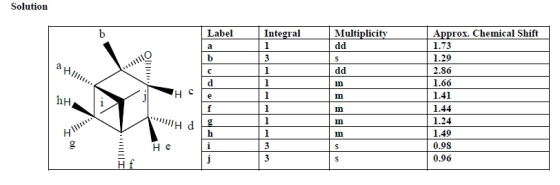
Label the protons on each of the following molecules. Don't forget to check for diastereotopic protons....
Please include the following information allow with the molecular structure of the unknown compound: 1. IR-Include...
 Please include the following information allow with the
molecular structure of the unknown compound:
1. IR-Include the major peaks and indicate the stretch
wavenumber and what bond it is.
2. UV-VIs- If there is a lambda max given, please briefly
indicate what structural element is contributing to it.
3. HNMR-Include proton label, chemical shift, multiplicity, and
integration.
4. CNMR- include the carbon label and the chemical shift.
Some additional information about the unknown compound:
Iodoform Test: Clear solution
Chromic Acid...
Please include the following information allow with the
molecular structure of the unknown compound:
1. IR-Include the major peaks and indicate the stretch
wavenumber and what bond it is.
2. UV-VIs- If there is a lambda max given, please briefly
indicate what structural element is contributing to it.
3. HNMR-Include proton label, chemical shift, multiplicity, and
integration.
4. CNMR- include the carbon label and the chemical shift.
Some additional information about the unknown compound:
Iodoform Test: Clear solution
Chromic Acid...
1. Interpreting the Table 1. For the following exercise, reference Figure 13.8 in your textbook or...
 1. Interpreting the Table 1. For the following exercise, reference Figure 13.8 in your textbook or e-book, and watch the video for that figure in the e-book, For each labelled proton, indicate the ppm range you would expect to find it in for an NMR spectrum. Don't over-think it, just use the chart at this point (Note: In many cases, especially in biochemistry, there will be many complicating factors - here we are just looking at the simple model). CH...
 Please include the following information allow with the
molecular structure of the unknown compound:
1. IR-Include the major peaks and indicate the stretch
wavenumber and what bond it is.
2. UV-VIs- If there is a lambda max given, please briefly
indicate what structural element is contributing to it.
3. HNMR-Include proton label, chemical shift, multiplicity, and
integration.
4. CNMR- include the carbon label and the chemical shift.
Some additional information about the unknown compound:
Iodoform Test: Clear solution
Chromic Acid...
Please include the following information allow with the
molecular structure of the unknown compound:
1. IR-Include the major peaks and indicate the stretch
wavenumber and what bond it is.
2. UV-VIs- If there is a lambda max given, please briefly
indicate what structural element is contributing to it.
3. HNMR-Include proton label, chemical shift, multiplicity, and
integration.
4. CNMR- include the carbon label and the chemical shift.
Some additional information about the unknown compound:
Iodoform Test: Clear solution
Chromic Acid...
 1. Interpreting the Table 1. For the following exercise, reference Figure 13.8 in your textbook or e-book, and watch the video for that figure in the e-book, For each labelled proton, indicate the ppm range you would expect to find it in for an NMR spectrum. Don't over-think it, just use the chart at this point (Note: In many cases, especially in biochemistry, there will be many complicating factors - here we are just looking at the simple model). CH...
Most questions answered within 3 hours.
-
Where is the error in this code sequence?
String s1 = "Hello";
String s2 = "ello";...
asked 11 months ago -
Financial data for Joel de Paris, Inc., for last year
follow:
Joel de Paris, Inc.
Balance...
asked 11 months ago -
Consider this reaction:
Al2(SO4)3 (aq)+ BaCl3
(aq) Al2Cl6 (aq)- +
3BaSO4(s) . What is the...
asked 11 months ago -
Suppose that Savneet is considering increasing her
recent random sample from 20 car rentals to 40...
asked 11 months ago -
Trucks arrive at an unloading terminal at an average rate of 120
per hour.
Trucks arrive...
asked 11 months ago -
Why are methanol and ethanol completely soluble in water while
octanol is not very little soluble....
asked 11 months ago -
A facilities manager at a university reads in a research report
that the mean amount of...
asked 11 months ago -
When the CuSO4 is rehydrated by adding water to the anhydrous
compound, is this an endothermic...
asked 11 months ago -
A ray of sunlight is passing from diamond into crown glass; the
angle of incidence is...
asked 11 months ago -
A block of mass 0.249 kg is placed on top of a light, vertical
spring of...
asked 11 months ago -
how do the kidneys compensate in the presences of acidosis
a) trigger hyperventilate
b) reserve acid...
asked 11 months ago -
Question 501 pts
The rental rate of capital to the firm increases. Which of the
following...
asked 11 months ago