Help pls
The tarp is 1.5 feet by 1.5 feet. Initially, you start with 2 liters of water in the tank. The daily rainfall is given in the chart in question 4. Before you can solve for the volume of daily water in Liters, how many unit conversions do you need? What are they? Then rewrite your equation in terms of givens, D and initial with all units in liters
Homework Answers
Request Answer!
We need at least 10 more requests to produce the answer.
0 / 10 have requested this problem solution
The more requests, the faster the answer.
2. (10 points) An aquarium has a 1000 L tank containing 400 L of salt water with a concentra- tio...
 2. (10 points) An aquarium has a 1000 L tank containing 400 L of salt water with a concentra- tion of 210 grams per liter. A salt water solution with a concentration of 470 grams per liter is pumped into the tank at a rate of 5 liters per minute. The well-mixed solution is drained from the tank at a rate of 3 liters per minute. Additionally, the tank is uncovered, so fresh water evaporates from the tank at a...
problem 1) Find the differential equation describing the amount of salt,Qb, in the tank for times...
 problem 1) Find the differential equation describing the
amount of salt,Qb, in the tank for times t in the interval t>=T.
Then solve to obtain Qb(t) for t>= T
A Water Tank Problem with Discontinuous Source A water tank contains V > 0 liters of pure water and Qo grams of salt. At time t = 0 we start pouring water into the tank with a rate r >0 liters per minute with a salt concentration of q> 0 grams...
problem 1) Find the differential equation describing the
amount of salt,Qb, in the tank for times t in the interval t>=T.
Then solve to obtain Qb(t) for t>= T
A Water Tank Problem with Discontinuous Source A water tank contains V > 0 liters of pure water and Qo grams of salt. At time t = 0 we start pouring water into the tank with a rate r >0 liters per minute with a salt concentration of q> 0 grams...
A Water Tank Problem with Discontinuous Source A water tank contains V, > 0 liters of...
 A Water Tank Problem with Discontinuous Source A water tank contains V, > 0 liters of pure water and Qo grams of salt. At time t = 0 we start pouring water into the tank with a rate r > 0 liters per minute with a salt concentration of q> 0 grams per litter, and we let the well-stirred water leave the tank at the same rate. After T > 0 minutes the process is stopped and fresh water is...
Part V: Solve Question 2 Part VI: Solve Questions 2 & 3 Part V (30 points each): Solve ONE of the following. and solve an IVP in order to receive any credit. In each problem you must complete...
 Part V: Solve Question 2
Part VI: Solve Questions 2 & 3
Part V (30 points each): Solve ONE of the following. and solve an IVP in order to receive any credit. In each problem you must completely set up 1. A 1000 liter tank initially contains 600 liters of salt water with 50 grams of salt dissolved in it. Salt water flows into the tank at a rate of 2 liters/hr with a concentration of 6 grams/liter and a...
Part V: Solve Question 2
Part VI: Solve Questions 2 & 3
Part V (30 points each): Solve ONE of the following. and solve an IVP in order to receive any credit. In each problem you must completely set up 1. A 1000 liter tank initially contains 600 liters of salt water with 50 grams of salt dissolved in it. Salt water flows into the tank at a rate of 2 liters/hr with a concentration of 6 grams/liter and a...
4 Water enters a circular, constant area tank through a horizontal pipe at a volume flowrate of Q- 0.35 ft/sec. Water e...
 4 Water enters a circular, constant area tank through a horizontal pipe at a volume flowrate of Q- 0.35 ft/sec. Water exits the tank through a 2 inch diameter hole with exit velocity Vexi(2gh) where h is the vertical distance from the exit hole to the water surface a) Draw a neat, detailed control volume directly on the drawing of the water tank below. Carefully identify all control surfaces b) Develop a differential equation that can be solved for h...
Need help with this Fluid Mechanics question. Please help me to solve step by step. Thank...
 Need help with this Fluid Mechanics question. Please help me to
solve step by step. Thank you!
Initial mass, Mo 4.27 A pressurized tank of water is mounted on a cart as shown. A jet issues from a nozzle in the tank at a constant speed and propels the cart along a horizontal track. The initial mass of the cart and tank is 100 kg, and the nozzle area is 0.005 m2. Determine the jet speed required to accelerate the...
Need help with this Fluid Mechanics question. Please help me to
solve step by step. Thank you!
Initial mass, Mo 4.27 A pressurized tank of water is mounted on a cart as shown. A jet issues from a nozzle in the tank at a constant speed and propels the cart along a horizontal track. The initial mass of the cart and tank is 100 kg, and the nozzle area is 0.005 m2. Determine the jet speed required to accelerate the...
Part B - Practice the steps for a one-step problem Once you've identified the initial and...
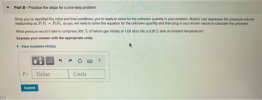 Part B - Practice the steps for a one-step problem Once you've identified the initial and final conditions, you're ready to solve for the unknown quantity in your problem. Boyle's Law expresses the pressure-volume relationship as PV P V2, so you will need to solve this equation for the unknown quantity and then plug in your known values to calculate the unknown. What pressure would it take to compress 300. L of helium gas initially at 1.00 atm into a...
anyone can help me to solve this all problems? thank you so much ? 11. A...
 anyone can help me to solve this all problems? thank
you so much ?
11. A water tank is in the form of a sphere. It is filled with water to a depth of 30 cm. the inner diameter of the tank is 45 cm, what is the volume of water in it in liters? A.18.25 liters C 28.49 liters B. 21.61 liters D.35.34 liters 12. A rectangle ABCD is given such that AB is 5 units of measure while...
anyone can help me to solve this all problems? thank
you so much ?
11. A water tank is in the form of a sphere. It is filled with water to a depth of 30 cm. the inner diameter of the tank is 45 cm, what is the volume of water in it in liters? A.18.25 liters C 28.49 liters B. 21.61 liters D.35.34 liters 12. A rectangle ABCD is given such that AB is 5 units of measure while...
Data: 1.0 atm = 1.01 × 10⁵Pa; R = 8.314 J/mol·K; k = 1.38 × 10⁻²³...
 Data: 1.0 atm = 1.01 × 10⁵Pa; R = 8.314 J/mol·K; k =
1.38 × 10⁻²³ J/K
An ideal gas at 22 °C is in a sealed rigid cubic container with a volume of 113 cm at a pressure of 1.00 atm. It is heated by 55 °C to 77 °C. a) Draw a diagram. Label quantities for the initial situation with a subscript “1”, and quantities in the final situation with a subscript “2”. b) How many moles are...
Data: 1.0 atm = 1.01 × 10⁵Pa; R = 8.314 J/mol·K; k =
1.38 × 10⁻²³ J/K
An ideal gas at 22 °C is in a sealed rigid cubic container with a volume of 113 cm at a pressure of 1.00 atm. It is heated by 55 °C to 77 °C. a) Draw a diagram. Label quantities for the initial situation with a subscript “1”, and quantities in the final situation with a subscript “2”. b) How many moles are...
Part C- Practice the steps for a multi-step problem Sometimes the problem will give the initial...
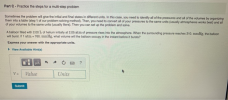 Part C- Practice the steps for a multi-step problem Sometimes the problem will give the initial and final states in different units. In this case, you need to identify all of the pressures and all of the volumes by organizing them into a table (step 1 of our problem-solving method). Then, you need to convert all of your pressures to the same units (usually atmospheres works best) and all of your volumes to the same units (usually liters). Then you...
 2. (10 points) An aquarium has a 1000 L tank containing 400 L of salt water with a concentra- tion of 210 grams per liter. A salt water solution with a concentration of 470 grams per liter is pumped into the tank at a rate of 5 liters per minute. The well-mixed solution is drained from the tank at a rate of 3 liters per minute. Additionally, the tank is uncovered, so fresh water evaporates from the tank at a...
 problem 1) Find the differential equation describing the
amount of salt,Qb, in the tank for times t in the interval t>=T.
Then solve to obtain Qb(t) for t>= T
A Water Tank Problem with Discontinuous Source A water tank contains V > 0 liters of pure water and Qo grams of salt. At time t = 0 we start pouring water into the tank with a rate r >0 liters per minute with a salt concentration of q> 0 grams...
problem 1) Find the differential equation describing the
amount of salt,Qb, in the tank for times t in the interval t>=T.
Then solve to obtain Qb(t) for t>= T
A Water Tank Problem with Discontinuous Source A water tank contains V > 0 liters of pure water and Qo grams of salt. At time t = 0 we start pouring water into the tank with a rate r >0 liters per minute with a salt concentration of q> 0 grams...
 A Water Tank Problem with Discontinuous Source A water tank contains V, > 0 liters of pure water and Qo grams of salt. At time t = 0 we start pouring water into the tank with a rate r > 0 liters per minute with a salt concentration of q> 0 grams per litter, and we let the well-stirred water leave the tank at the same rate. After T > 0 minutes the process is stopped and fresh water is...
 Part V: Solve Question 2
Part VI: Solve Questions 2 & 3
Part V (30 points each): Solve ONE of the following. and solve an IVP in order to receive any credit. In each problem you must completely set up 1. A 1000 liter tank initially contains 600 liters of salt water with 50 grams of salt dissolved in it. Salt water flows into the tank at a rate of 2 liters/hr with a concentration of 6 grams/liter and a...
Part V: Solve Question 2
Part VI: Solve Questions 2 & 3
Part V (30 points each): Solve ONE of the following. and solve an IVP in order to receive any credit. In each problem you must completely set up 1. A 1000 liter tank initially contains 600 liters of salt water with 50 grams of salt dissolved in it. Salt water flows into the tank at a rate of 2 liters/hr with a concentration of 6 grams/liter and a...
 4 Water enters a circular, constant area tank through a horizontal pipe at a volume flowrate of Q- 0.35 ft/sec. Water exits the tank through a 2 inch diameter hole with exit velocity Vexi(2gh) where h is the vertical distance from the exit hole to the water surface a) Draw a neat, detailed control volume directly on the drawing of the water tank below. Carefully identify all control surfaces b) Develop a differential equation that can be solved for h...
 Need help with this Fluid Mechanics question. Please help me to
solve step by step. Thank you!
Initial mass, Mo 4.27 A pressurized tank of water is mounted on a cart as shown. A jet issues from a nozzle in the tank at a constant speed and propels the cart along a horizontal track. The initial mass of the cart and tank is 100 kg, and the nozzle area is 0.005 m2. Determine the jet speed required to accelerate the...
Need help with this Fluid Mechanics question. Please help me to
solve step by step. Thank you!
Initial mass, Mo 4.27 A pressurized tank of water is mounted on a cart as shown. A jet issues from a nozzle in the tank at a constant speed and propels the cart along a horizontal track. The initial mass of the cart and tank is 100 kg, and the nozzle area is 0.005 m2. Determine the jet speed required to accelerate the...
 Part B - Practice the steps for a one-step problem Once you've identified the initial and final conditions, you're ready to solve for the unknown quantity in your problem. Boyle's Law expresses the pressure-volume relationship as PV P V2, so you will need to solve this equation for the unknown quantity and then plug in your known values to calculate the unknown. What pressure would it take to compress 300. L of helium gas initially at 1.00 atm into a...
 anyone can help me to solve this all problems? thank
you so much ?
11. A water tank is in the form of a sphere. It is filled with water to a depth of 30 cm. the inner diameter of the tank is 45 cm, what is the volume of water in it in liters? A.18.25 liters C 28.49 liters B. 21.61 liters D.35.34 liters 12. A rectangle ABCD is given such that AB is 5 units of measure while...
anyone can help me to solve this all problems? thank
you so much ?
11. A water tank is in the form of a sphere. It is filled with water to a depth of 30 cm. the inner diameter of the tank is 45 cm, what is the volume of water in it in liters? A.18.25 liters C 28.49 liters B. 21.61 liters D.35.34 liters 12. A rectangle ABCD is given such that AB is 5 units of measure while...
 Data: 1.0 atm = 1.01 × 10⁵Pa; R = 8.314 J/mol·K; k =
1.38 × 10⁻²³ J/K
An ideal gas at 22 °C is in a sealed rigid cubic container with a volume of 113 cm at a pressure of 1.00 atm. It is heated by 55 °C to 77 °C. a) Draw a diagram. Label quantities for the initial situation with a subscript “1”, and quantities in the final situation with a subscript “2”. b) How many moles are...
Data: 1.0 atm = 1.01 × 10⁵Pa; R = 8.314 J/mol·K; k =
1.38 × 10⁻²³ J/K
An ideal gas at 22 °C is in a sealed rigid cubic container with a volume of 113 cm at a pressure of 1.00 atm. It is heated by 55 °C to 77 °C. a) Draw a diagram. Label quantities for the initial situation with a subscript “1”, and quantities in the final situation with a subscript “2”. b) How many moles are...
 Part C- Practice the steps for a multi-step problem Sometimes the problem will give the initial and final states in different units. In this case, you need to identify all of the pressures and all of the volumes by organizing them into a table (step 1 of our problem-solving method). Then, you need to convert all of your pressures to the same units (usually atmospheres works best) and all of your volumes to the same units (usually liters). Then you...
Most questions answered within 3 hours.
-
Where is the error in this code sequence?
String s1 = "Hello";
String s2 = "ello";...
asked 10 months ago -
Financial data for Joel de Paris, Inc., for last year
follow:
Joel de Paris, Inc.
Balance...
asked 10 months ago -
Consider this reaction:
Al2(SO4)3 (aq)+ BaCl3
(aq) Al2Cl6 (aq)- +
3BaSO4(s) . What is the...
asked 10 months ago -
Suppose that Savneet is considering increasing her
recent random sample from 20 car rentals to 40...
asked 10 months ago -
Trucks arrive at an unloading terminal at an average rate of 120
per hour.
Trucks arrive...
asked 10 months ago -
Why are methanol and ethanol completely soluble in water while
octanol is not very little soluble....
asked 10 months ago -
A facilities manager at a university reads in a research report
that the mean amount of...
asked 10 months ago -
When the CuSO4 is rehydrated by adding water to the anhydrous
compound, is this an endothermic...
asked 10 months ago -
A ray of sunlight is passing from diamond into crown glass; the
angle of incidence is...
asked 10 months ago -
A block of mass 0.249 kg is placed on top of a light, vertical
spring of...
asked 10 months ago -
how do the kidneys compensate in the presences of acidosis
a) trigger hyperventilate
b) reserve acid...
asked 10 months ago -
Question 501 pts
The rental rate of capital to the firm increases. Which of the
following...
asked 10 months ago