
Homework Answers
For a non-inverting Scmitt trigger VHL and VLH formula are as given below:
 ---------(i)
and
 ---------(ii)
Where Vsat is the positive rail saturation voltage and V- is the voltage at inverting pin of the op amp. ( Refer the figure below)

Given VHL = 0 V and VLH = 5 V. Adding equations (i) and (ii) we get

substituting VHL and VLH we get

 -------------(iii)
subtracting equation (ii) from (i) we get

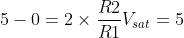
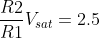
Assuming Vsat = 8 volts ( considering the drop in the op amp) we get

Thus if R2 = 5 kilo Ohms R1 = 16 kilo Ohms.
Substituting in equation (iii) we get

or

We use resistor divider to get the required V- voltage. If R3 and R4 make up the resistor divider as shown

Then V- is given by

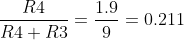
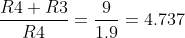



Thus if R4 = 1 kilo ohms R3 = 3.7 kilo ohms ( approximately ).
With these values the non-inverting schmitt trigger circuit looks as follows
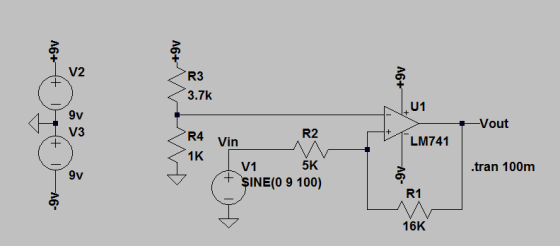
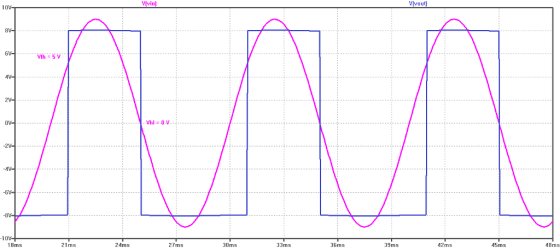
Note that the input source is just a test sine wave of amplitude 9 volts. The output of the circuit is given below:
Next we design an op- amp integrator.

By the concept of virtual short, current through resistor R is

In this case we want I < 1 mA. Vin comes from the schmitt trigger with amplitude 8 volts thus


So R should be greater than or equal to 8 kilo ohm. Lets take R = 10 kilo Ohms.
We want a change of voltage of 5 volts at the output of integrator when an input of 8 volts drive it in a time of 10 us. The output of integrator is given by
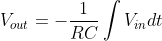
We want the output to change by 5 volts in 10 us when input is 8 volts. Using these values



Rigging up the circuit along with the schmitt trigger we get the circuit given below.
 Note that in the
schematic LM741 is used but it is not recommended for such a high
frequency application. For demonstration the frequency is lowered
by using 1.6 uF capacitor instead of 1.6 nF. The plot below depicts
the output. The purpose of using LM741 was its a common op amp and
is available everywhere.
Note that in the
schematic LM741 is used but it is not recommended for such a high
frequency application. For demonstration the frequency is lowered
by using 1.6 uF capacitor instead of 1.6 nF. The plot below depicts
the output. The purpose of using LM741 was its a common op amp and
is available everywhere.

I hope it helps. For any doubts or queries that you have, leave a comment below, I'll be happy to help. All the best. :)
Add Answer to:
Design 1. Design a non-inverting Schmitt Trigger with switching points of VHL 0V and VH 5V...
For the op-amp in the non-inverting Schmitt trigger below, assume VoH = -VOL = 5V. Determine...
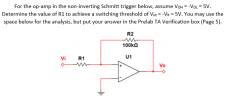 For the op-amp in the non-inverting Schmitt trigger below, assume VoH = -VOL = 5V. Determine the value of R1 to achieve a switching threshold of Vut = -Vit = 5V. You may use the space below for the analysis, but put your answer in the Prelab TA Verification box (Page 5). R2 100kg Vi R1 U1
(a) Design a inverting Schmitt trigger circuit to be used as a zero crossing detector with transition voltages about ±25...
 (a) Design a inverting Schmitt trigger circuit
to be used as a zero crossing detector with transition voltages
about ±25 mV. Assume the saturation voltages for the op–amp are ±13
V. Draw the voltage transfer characteristic (VTC), i.e., vout vs.
vin.
(b) Design an astable multivibrator to produce
a square signal with a frequency of 1 kHz using C=0.01 µF, R1 = 30
kΩ, and R2 = 20 kΩ. Sketch the circuit waveforms (vo, v +, and v −)
assuming...
(a) Design a inverting Schmitt trigger circuit
to be used as a zero crossing detector with transition voltages
about ±25 mV. Assume the saturation voltages for the op–amp are ±13
V. Draw the voltage transfer characteristic (VTC), i.e., vout vs.
vin.
(b) Design an astable multivibrator to produce
a square signal with a frequency of 1 kHz using C=0.01 µF, R1 = 30
kΩ, and R2 = 20 kΩ. Sketch the circuit waveforms (vo, v +, and v −)
assuming...
 For the op-amp in the non-inverting Schmitt trigger below, assume VoH = -VOL = 5V. Determine the value of R1 to achieve a switching threshold of Vut = -Vit = 5V. You may use the space below for the analysis, but put your answer in the Prelab TA Verification box (Page 5). R2 100kg Vi R1 U1
 (a) Design a inverting Schmitt trigger circuit
to be used as a zero crossing detector with transition voltages
about ±25 mV. Assume the saturation voltages for the op–amp are ±13
V. Draw the voltage transfer characteristic (VTC), i.e., vout vs.
vin.
(b) Design an astable multivibrator to produce
a square signal with a frequency of 1 kHz using C=0.01 µF, R1 = 30
kΩ, and R2 = 20 kΩ. Sketch the circuit waveforms (vo, v +, and v −)
assuming...
(a) Design a inverting Schmitt trigger circuit
to be used as a zero crossing detector with transition voltages
about ±25 mV. Assume the saturation voltages for the op–amp are ±13
V. Draw the voltage transfer characteristic (VTC), i.e., vout vs.
vin.
(b) Design an astable multivibrator to produce
a square signal with a frequency of 1 kHz using C=0.01 µF, R1 = 30
kΩ, and R2 = 20 kΩ. Sketch the circuit waveforms (vo, v +, and v −)
assuming...
Most questions answered within 3 hours.
-
Where is the error in this code sequence?
String s1 = "Hello";
String s2 = "ello";...
asked 10 months ago -
Financial data for Joel de Paris, Inc., for last year
follow:
Joel de Paris, Inc.
Balance...
asked 10 months ago -
Consider this reaction:
Al2(SO4)3 (aq)+ BaCl3
(aq) Al2Cl6 (aq)- +
3BaSO4(s) . What is the...
asked 10 months ago -
Suppose that Savneet is considering increasing her
recent random sample from 20 car rentals to 40...
asked 10 months ago -
Trucks arrive at an unloading terminal at an average rate of 120
per hour.
Trucks arrive...
asked 10 months ago -
Why are methanol and ethanol completely soluble in water while
octanol is not very little soluble....
asked 10 months ago -
A facilities manager at a university reads in a research report
that the mean amount of...
asked 10 months ago -
When the CuSO4 is rehydrated by adding water to the anhydrous
compound, is this an endothermic...
asked 10 months ago -
A ray of sunlight is passing from diamond into crown glass; the
angle of incidence is...
asked 10 months ago -
A block of mass 0.249 kg is placed on top of a light, vertical
spring of...
asked 10 months ago -
how do the kidneys compensate in the presences of acidosis
a) trigger hyperventilate
b) reserve acid...
asked 10 months ago -
Question 501 pts
The rental rate of capital to the firm increases. Which of the
following...
asked 10 months ago