![(ii) R= [0, 1] x [0, 1] C R2 olsun. f: RR fonksiyonu f(x,y) = 2-Y eğer (2, y) + (0,0) ise (x+y)3 0 eğer (x,y) = (0,0) ise şek](http://img.homeworklib.com/questions/4c4a1560-a47d-11eb-8610-77ebdac83a6d.png?x-oss-process=image/resize,w_560)
Homework Answers
![I = Sofian Abs. 10,] x[0,1] I- dyda os 0 -y (1+y) ndy 32 + y) } dre let x+y= t dy = at limits will be to set Y+ I x+1 sk (tr](http://img.homeworklib.com/questions/ff395b50-a47d-11eb-aa0d-b9ff4db2e18e.png?x-oss-process=image/resize,w_560)
Add Answer to:
(ii) R= [0, 1] x [0, 1] C R2 olsun. f: RR fonksiyonu f(x,y) = 2-Y...
2. Consider the function f : R2 → R defined below. r3уг_ if (x,y) (0,0) f(x,y)...
 2. Consider the function f : R2 → R defined below. r3уг_ if (x,y) (0,0) f(x,y) = if (x, y) (0, 0) (a) Prove that f is continuous at (0,0) (b) Calculate the partial derivatives (0,0) and (0,0) directly from the definition of partial derivatives. (c) Prove that f is not differentiable at (0,0).
Consider f : [0, 1] x [0, 1] C R2 + R defined by f(x,y) =...
 Consider f : [0, 1] x [0, 1] C R2 + R defined by f(x,y) = ſi if y is rational 2x if y is irrational Show that f is not integrable over R by the following steps: in (a) For each n > 1, find a Sn:= Eosi,jan f(a 6? b., in [0, 1] for 0 < i, j < n such that the Riemann sum converges as n + 0.[10 pts] n 1 n2 n i, ja (b)...
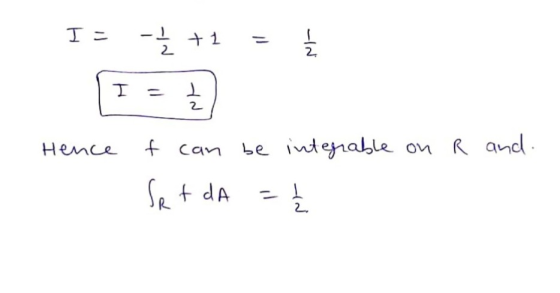
1. Let f : [0, 1]2 → R be given by: 1 f(x,y) -»-< if x...
 1. Let f : [0, 1]2 → R be given by: 1 f(x,y) -»-< if x = 0 if x + y Show that f is integrable on [0, 1]2 and compute the value of the integral.
2. Define f : RR by - y 1(x) = { "2+2 (ay) (0,0); (z,y) =...
 2. Define f : RR by - y 1(x) = { "2+2 (ay) (0,0); (z,y) = (0,0). (i) Isf continuous at (0,0)? Justify your answer. (ii) Show that Daf(3,0) = x for all x and D.f(0,y) = -y for all y (iii) D2f(0,0) + D2,1f(0,0). (iv) Is f differentiable at (0,0)? Justify your answer.
(4) Define the function f : R -»R* by x-1/2 r> 0 f(x) +oo, (a) Prove that f is measurable (with respect to the Lebes...
 (4) Define the function f : R -»R* by x-1/2 r> 0 f(x) +oo, (a) Prove that f is measurable (with respect to the Lebesgue measurable sets) (b) Prove that f is integrable on I = [0, 1] and compute the value of f du
(4) Define the function f : R -»R* by x-1/2 r> 0 f(x) +oo, (a) Prove that f is measurable (with respect to the Lebesgue measurable sets) (b) Prove that f is integrable on I...
(4) Define the function f : R -»R* by x-1/2 r> 0 f(x) +oo, (a) Prove that f is measurable (with respect to the Lebesgue measurable sets) (b) Prove that f is integrable on I = [0, 1] and compute the value of f du
(4) Define the function f : R -»R* by x-1/2 r> 0 f(x) +oo, (a) Prove that f is measurable (with respect to the Lebesgue measurable sets) (b) Prove that f is integrable on I...
if (r.y) (0,0), 0,f (, y) (0, 0) 2. Consider f : IR2 -R defined by f(r,y)-+ (a) Show by explicit computation that the directional derivative exists at (x, y)- (0,0) for all oi rections u є R2 with 1...
 if (r.y) (0,0), 0,f (, y) (0, 0) 2. Consider f : IR2 -R defined by f(r,y)-+ (a) Show by explicit computation that the directional derivative exists at (x, y)- (0,0) for all oi rections u є R2 with 1 11-1, but that its value %(0.0) (Vf(0,0).u), fr at least one sucli u. (b) Show that the partial derivatives of f are not continuous at (0,0)
if (r.y) (0,0), 0,f (, y) (0, 0) 2. Consider f : IR2 -R...
if (r.y) (0,0), 0,f (, y) (0, 0) 2. Consider f : IR2 -R defined by f(r,y)-+ (a) Show by explicit computation that the directional derivative exists at (x, y)- (0,0) for all oi rections u є R2 with 1 11-1, but that its value %(0.0) (Vf(0,0).u), fr at least one sucli u. (b) Show that the partial derivatives of f are not continuous at (0,0)
if (r.y) (0,0), 0,f (, y) (0, 0) 2. Consider f : IR2 -R...
We are given the function f : [0, 4] → R defined by f(x) = 0...
 We are given the function f : [0, 4] → R defined by f(x) = 0 for all x # 2 and f(2) = 2. Using the definition of the integral prove that f is (Darboux) integrable in (0,4].
We are given the function f : [0, 4] → R defined by f(x) = 0...
 We are given the function f : [0, 4] → R defined by f(x) = 0 for all x # 2 and f(2) = 2. Using the definition of the integral prove that f is (Darboux) integrable in (0,4].
(4) Define the function f : R -> R* by ,--1/2 f(x) x< 0. +oo, |(a) Prove that f is measurable (with respect to th...
 (4) Define the function f : R -> R* by ,--1/2 f(x) x< 0. +oo, |(a) Prove that f is measurable (with respect to the Lebesgue measurable sets). (b) Prove that f is integrable on I 0, 1and compute the value of = f du
(4) Define the function f : R -> R* by ,--1/2 f(x) x
(4) Define the function f : R -> R* by ,--1/2 f(x) x< 0. +oo, |(a) Prove that f is measurable (with respect to the Lebesgue measurable sets). (b) Prove that f is integrable on I 0, 1and compute the value of = f du
(4) Define the function f : R -> R* by ,--1/2 f(x) x
8.) (minimum along lines does not mean minimum) Define f: R2 and, if (a, y)0, R by f(0,0) (a) Pro...
 8.) (minimum along lines does not mean minimum) Define f: R2 and, if (a, y)0, R by f(0,0) (a) Prove that f is continuous at (0,0). Hint: show that 4r4y2 < (z4 + y2)2. (b) Let & be an arbitrary line through the origin. Prove that the restriction of f [0, π) and t E R. (c) Show that f does not have a local minimum at (0,0). Hint: consider f(1,12). to ( has a strict local minimum at (0,0)....
 2. Consider the function f : R2 → R defined below. r3уг_ if (x,y) (0,0) f(x,y) = if (x, y) (0, 0) (a) Prove that f is continuous at (0,0) (b) Calculate the partial derivatives (0,0) and (0,0) directly from the definition of partial derivatives. (c) Prove that f is not differentiable at (0,0).
 Consider f : [0, 1] x [0, 1] C R2 + R defined by f(x,y) = ſi if y is rational 2x if y is irrational Show that f is not integrable over R by the following steps: in (a) For each n > 1, find a Sn:= Eosi,jan f(a 6? b., in [0, 1] for 0 < i, j < n such that the Riemann sum converges as n + 0.[10 pts] n 1 n2 n i, ja (b)...
 1. Let f : [0, 1]2 → R be given by: 1 f(x,y) -»-< if x = 0 if x + y Show that f is integrable on [0, 1]2 and compute the value of the integral.
 2. Define f : RR by - y 1(x) = { "2+2 (ay) (0,0); (z,y) = (0,0). (i) Isf continuous at (0,0)? Justify your answer. (ii) Show that Daf(3,0) = x for all x and D.f(0,y) = -y for all y (iii) D2f(0,0) + D2,1f(0,0). (iv) Is f differentiable at (0,0)? Justify your answer.
 (4) Define the function f : R -»R* by x-1/2 r> 0 f(x) +oo, (a) Prove that f is measurable (with respect to the Lebesgue measurable sets) (b) Prove that f is integrable on I = [0, 1] and compute the value of f du
(4) Define the function f : R -»R* by x-1/2 r> 0 f(x) +oo, (a) Prove that f is measurable (with respect to the Lebesgue measurable sets) (b) Prove that f is integrable on I...
(4) Define the function f : R -»R* by x-1/2 r> 0 f(x) +oo, (a) Prove that f is measurable (with respect to the Lebesgue measurable sets) (b) Prove that f is integrable on I = [0, 1] and compute the value of f du
(4) Define the function f : R -»R* by x-1/2 r> 0 f(x) +oo, (a) Prove that f is measurable (with respect to the Lebesgue measurable sets) (b) Prove that f is integrable on I...
 if (r.y) (0,0), 0,f (, y) (0, 0) 2. Consider f : IR2 -R defined by f(r,y)-+ (a) Show by explicit computation that the directional derivative exists at (x, y)- (0,0) for all oi rections u є R2 with 1 11-1, but that its value %(0.0) (Vf(0,0).u), fr at least one sucli u. (b) Show that the partial derivatives of f are not continuous at (0,0)
if (r.y) (0,0), 0,f (, y) (0, 0) 2. Consider f : IR2 -R...
if (r.y) (0,0), 0,f (, y) (0, 0) 2. Consider f : IR2 -R defined by f(r,y)-+ (a) Show by explicit computation that the directional derivative exists at (x, y)- (0,0) for all oi rections u є R2 with 1 11-1, but that its value %(0.0) (Vf(0,0).u), fr at least one sucli u. (b) Show that the partial derivatives of f are not continuous at (0,0)
if (r.y) (0,0), 0,f (, y) (0, 0) 2. Consider f : IR2 -R...
 We are given the function f : [0, 4] → R defined by f(x) = 0 for all x # 2 and f(2) = 2. Using the definition of the integral prove that f is (Darboux) integrable in (0,4].
 We are given the function f : [0, 4] → R defined by f(x) = 0 for all x # 2 and f(2) = 2. Using the definition of the integral prove that f is (Darboux) integrable in (0,4].
 (4) Define the function f : R -> R* by ,--1/2 f(x) x< 0. +oo, |(a) Prove that f is measurable (with respect to the Lebesgue measurable sets). (b) Prove that f is integrable on I 0, 1and compute the value of = f du
(4) Define the function f : R -> R* by ,--1/2 f(x) x
(4) Define the function f : R -> R* by ,--1/2 f(x) x< 0. +oo, |(a) Prove that f is measurable (with respect to the Lebesgue measurable sets). (b) Prove that f is integrable on I 0, 1and compute the value of = f du
(4) Define the function f : R -> R* by ,--1/2 f(x) x
 8.) (minimum along lines does not mean minimum) Define f: R2 and, if (a, y)0, R by f(0,0) (a) Prove that f is continuous at (0,0). Hint: show that 4r4y2 < (z4 + y2)2. (b) Let & be an arbitrary line through the origin. Prove that the restriction of f [0, π) and t E R. (c) Show that f does not have a local minimum at (0,0). Hint: consider f(1,12). to ( has a strict local minimum at (0,0)....
Most questions answered within 3 hours.
-
Where is the error in this code sequence?
String s1 = "Hello";
String s2 = "ello";...
asked 11 months ago -
Financial data for Joel de Paris, Inc., for last year
follow:
Joel de Paris, Inc.
Balance...
asked 11 months ago -
Consider this reaction:
Al2(SO4)3 (aq)+ BaCl3
(aq) Al2Cl6 (aq)- +
3BaSO4(s) . What is the...
asked 11 months ago -
Suppose that Savneet is considering increasing her
recent random sample from 20 car rentals to 40...
asked 11 months ago -
Trucks arrive at an unloading terminal at an average rate of 120
per hour.
Trucks arrive...
asked 11 months ago -
Why are methanol and ethanol completely soluble in water while
octanol is not very little soluble....
asked 11 months ago -
A facilities manager at a university reads in a research report
that the mean amount of...
asked 11 months ago -
When the CuSO4 is rehydrated by adding water to the anhydrous
compound, is this an endothermic...
asked 11 months ago -
A ray of sunlight is passing from diamond into crown glass; the
angle of incidence is...
asked 11 months ago -
A block of mass 0.249 kg is placed on top of a light, vertical
spring of...
asked 11 months ago -
how do the kidneys compensate in the presences of acidosis
a) trigger hyperventilate
b) reserve acid...
asked 11 months ago -
Question 501 pts
The rental rate of capital to the firm increases. Which of the
following...
asked 11 months ago