
Homework Answers
Request Answer!
We need at least 10 more requests to produce the answer.
0 / 10 have requested this problem solution
The more requests, the faster the answer.
Add Answer to:
Your answer is partially correct. Try again. A 75.6-kg person, running horizontally with a velocity of...
Question 1 Your answer is partially correct. Try again A 54.7-kg person, running horizontally with a...
 Question 1 Your answer is partially correct. Try again A 54.7-kg person, running horizontally with a velocity of +2.54 m/s, jumps onto a 18.5-kg sled that is initially at rest. (a) Ignoring the effects of friction during the collision, find the velocity of the sled and person as they move away. (b) The sled and person coast 30.0 m on level snow before coming to rest. What is the coefficient of kinetic friction between the sled and the snow? (a)...
Chapter 07, Problem 44 GO Your answer is partially correct. Try again A 57.1-kg person, running...
 Chapter 07, Problem 44 GO Your answer is partially correct. Try again A 57.1-kg person, running horizontally with a velocity of +3.77 m/s, jumps onto a 13.1-kg sled that is initially at rest. (a) Ignoring the effects of friction What is the coefficient of kinetic friction between the sled and the sno away. (b) The sled and person coast 30.0 m on level snow before coming to rest. (a) 3.25 m/s Number Units (b) Number 0.0179 No units Units
A 51.9-kg person, running horizontally with a velocity of +3.43 m/s, jumps onto a 14.2-kg sled...
A 51.9-kg person, running horizontally with a velocity of +3.43 m/s, jumps onto a 14.2-kg sled that is initially at rest. (a) Ignoring the effects of friction during the collision, find the velocity of the sled and person as they move away. (b) The sled and person coast 30.0 m on level snow before coming to rest. What is the coefficient of kinetic friction between the sled and the snow?
A 67.6-kg person, running horizontally with a velocity of +4.85 m/s, jumps onto a 19.1-kg sled...
A 67.6-kg person, running horizontally with a velocity of +4.85 m/s, jumps onto a 19.1-kg sled that is initially at rest. (a) Ignoring the effects of friction during the collision, find the velocity of the sled and person as they move away. (b) The sled and person coast 30.0 m on level snow before coming to rest. What is the coefficient of kinetic friction between the sled and the snow?
Chapter 07, Problem 44 GO A 70.0-kg person, running horizontally with a velocity of +2.49 m/s, jumps onto a 19.3-kg sle...
 Chapter 07, Problem 44 GO A 70.0-kg person, running horizontally with a velocity of +2.49 m/s, jumps onto a 19.3-kg sled that is initially at rest. (a) Ignoring the effects of friction during the collision, find the velocity of the sled and person as they move away. (b) The sled and person coast 30.0 m on level snow before coming to rest. What is the coefficient of kinetic friction between the sled and the snow? (a) Number (b) Number Units...
Problems: 32 Points Total A 55.0-kg person, running horizontally with a velocity of 6.0 m/s, jumps...
 Problems: 32 Points Total A 55.0-kg person, running horizontally with a velocity of 6.0 m/s, jumps onto a 9.0-kg sled that is initially at rest 17. Ignoring the effects of friction during the collision, find the velocity of the sled and person after the collision A) 1.7m's B) 2.3 m/s C) 3.1 m/s? D) 4.9 m/s E) 5.2 m/s F) 6.3 m/s 18. The sled and person coast 35.8 mon level snow before coming to rest. Use the work energy...
Your answer is partially correct. Try again. A 6.98-9 bullet is moving horizontally with a velocity...
 Your answer is partially correct. Try again. A 6.98-9 bullet is moving horizontally with a velocity of +364 m/s, where the sign + indicates that it is moving to the right (see part a of the drawing). The bullet is approaching two blocks resting on a horizontal frictionless surface. Air resistance is negligible. The bullet passes completely through the first block (an inelastic collision) and embeds itself in the second one, as indicated in part b. Note that both blocks...
At the end of the race a person with a mass of 45.0 kg jumps out...
 At the end of the race a person with a mass of 45.0 kg jumps out in front of the 240.0kg bobsled which is going 12.0 m/s horizontally. Initially the person is at rest. The person sticks to the front of the bobsled after the collision. What is the initial momentum of the sled, persons system? What is the momentum of the system after the collision?) What is the final velocity of the sled and person. What is the change...
Chapter 07, Problem 36 GO Your answer is partially correct. Try again. Object A is moving...
 Chapter 07, Problem 36 GO Your answer is partially correct. Try again. Object A is moving due east, while object B is moving due north. They collide and stick together in a completely inelastic collision Momentum is conserved. Object A has a mass of mA = 16.6 kg and an initial velocity of VOA 7.80 m/s, due east. Object B, however, has a mass of mB = 28.2 kg and an initial velocity of V08-5.83 m/s, due north. Find the...
Your answer is partially correct. Try again. A scaffold of mass 67 kg and length 5.3...
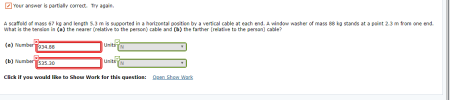 Your answer is partially correct. Try again. A scaffold of mass 67 kg and length 5.3 m is supported in a horizontal position by a vertical cable at each end. A window washer of mass 88 kg stands at a point 2.3 m from one end. What is the tension in (a) the nearer (relative to the person) cable and (b) the farther relative to the person) cable? (a) Number 1934.88 (b) Number 1535.30 x= (b) Number 535.30 Unitsy'n units...
 Question 1 Your answer is partially correct. Try again A 54.7-kg person, running horizontally with a velocity of +2.54 m/s, jumps onto a 18.5-kg sled that is initially at rest. (a) Ignoring the effects of friction during the collision, find the velocity of the sled and person as they move away. (b) The sled and person coast 30.0 m on level snow before coming to rest. What is the coefficient of kinetic friction between the sled and the snow? (a)...
 Chapter 07, Problem 44 GO Your answer is partially correct. Try again A 57.1-kg person, running horizontally with a velocity of +3.77 m/s, jumps onto a 13.1-kg sled that is initially at rest. (a) Ignoring the effects of friction What is the coefficient of kinetic friction between the sled and the sno away. (b) The sled and person coast 30.0 m on level snow before coming to rest. (a) 3.25 m/s Number Units (b) Number 0.0179 No units Units
 Chapter 07, Problem 44 GO A 70.0-kg person, running horizontally with a velocity of +2.49 m/s, jumps onto a 19.3-kg sled that is initially at rest. (a) Ignoring the effects of friction during the collision, find the velocity of the sled and person as they move away. (b) The sled and person coast 30.0 m on level snow before coming to rest. What is the coefficient of kinetic friction between the sled and the snow? (a) Number (b) Number Units...
 Problems: 32 Points Total A 55.0-kg person, running horizontally with a velocity of 6.0 m/s, jumps onto a 9.0-kg sled that is initially at rest 17. Ignoring the effects of friction during the collision, find the velocity of the sled and person after the collision A) 1.7m's B) 2.3 m/s C) 3.1 m/s? D) 4.9 m/s E) 5.2 m/s F) 6.3 m/s 18. The sled and person coast 35.8 mon level snow before coming to rest. Use the work energy...
 Your answer is partially correct. Try again. A 6.98-9 bullet is moving horizontally with a velocity of +364 m/s, where the sign + indicates that it is moving to the right (see part a of the drawing). The bullet is approaching two blocks resting on a horizontal frictionless surface. Air resistance is negligible. The bullet passes completely through the first block (an inelastic collision) and embeds itself in the second one, as indicated in part b. Note that both blocks...
 At the end of the race a person with a mass of 45.0 kg jumps out in front of the 240.0kg bobsled which is going 12.0 m/s horizontally. Initially the person is at rest. The person sticks to the front of the bobsled after the collision. What is the initial momentum of the sled, persons system? What is the momentum of the system after the collision?) What is the final velocity of the sled and person. What is the change...
 Chapter 07, Problem 36 GO Your answer is partially correct. Try again. Object A is moving due east, while object B is moving due north. They collide and stick together in a completely inelastic collision Momentum is conserved. Object A has a mass of mA = 16.6 kg and an initial velocity of VOA 7.80 m/s, due east. Object B, however, has a mass of mB = 28.2 kg and an initial velocity of V08-5.83 m/s, due north. Find the...
 Your answer is partially correct. Try again. A scaffold of mass 67 kg and length 5.3 m is supported in a horizontal position by a vertical cable at each end. A window washer of mass 88 kg stands at a point 2.3 m from one end. What is the tension in (a) the nearer (relative to the person) cable and (b) the farther relative to the person) cable? (a) Number 1934.88 (b) Number 1535.30 x= (b) Number 535.30 Unitsy'n units...
Most questions answered within 3 hours.
-
Where is the error in this code sequence?
String s1 = "Hello";
String s2 = "ello";...
asked 11 months ago -
Financial data for Joel de Paris, Inc., for last year
follow:
Joel de Paris, Inc.
Balance...
asked 11 months ago -
Consider this reaction:
Al2(SO4)3 (aq)+ BaCl3
(aq) Al2Cl6 (aq)- +
3BaSO4(s) . What is the...
asked 11 months ago -
Suppose that Savneet is considering increasing her
recent random sample from 20 car rentals to 40...
asked 11 months ago -
Trucks arrive at an unloading terminal at an average rate of 120
per hour.
Trucks arrive...
asked 11 months ago -
Why are methanol and ethanol completely soluble in water while
octanol is not very little soluble....
asked 11 months ago -
A facilities manager at a university reads in a research report
that the mean amount of...
asked 11 months ago -
When the CuSO4 is rehydrated by adding water to the anhydrous
compound, is this an endothermic...
asked 11 months ago -
A ray of sunlight is passing from diamond into crown glass; the
angle of incidence is...
asked 11 months ago -
A block of mass 0.249 kg is placed on top of a light, vertical
spring of...
asked 11 months ago -
how do the kidneys compensate in the presences of acidosis
a) trigger hyperventilate
b) reserve acid...
asked 11 months ago -
Question 501 pts
The rental rate of capital to the firm increases. Which of the
following...
asked 11 months ago