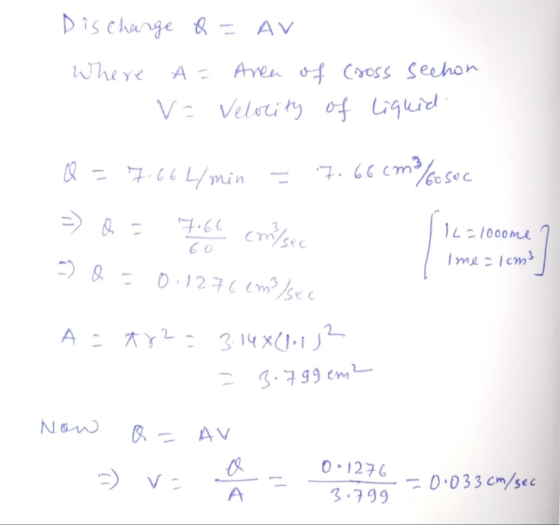
Blood is pumped from the heart at a rate of 7.66 L/min into the aorta (of...
Blood is pumped from the heart at a rate of 7.66 L/min into the aorta (of radius 1.1 cm). Determine the speed of blood (in cm/s) through the aorta.
Homework Answers
Add Answer to:
Blood is pumped from the heart at a rate of 7.66 L/min into the
aorta (of...
The aorta carries blood away from the heart at a speed of about 39 cm/s and...
 The aorta carries blood away from the heart at a speed of about 39 cm/s and has a radius of approximately 1.1 cm. The aorta branches eventually into a large number of tiny capillaries that distribute the blood to the various body organs. In a capillary, the blood speed is approximately 0.063 cm/s, and the radius is about 5.3 x 10 cm. Treat the blood as an incompressible fluid, and use these data to determine the approximate number of capillaries...
The aorta carries blood away from the heart at a speed of about 37 cm/s and...
 The
aorta carries blood away from the heart at a speed of about 37 cm/s
and has a radius of approximately 1.2 cm....
FULL SCREEN PRINTER VERSION BLACK NEE Chapter 11, Problem 059 ya The aorta carries blood away from the heart at a speed of about 37 cm/s and has a radius of approximately 1.2 cm. The aorta branches eventually into a large number of tiny capillaries that distribute the blood to the various body organs. In a capillary,...
The
aorta carries blood away from the heart at a speed of about 37 cm/s
and has a radius of approximately 1.2 cm....
FULL SCREEN PRINTER VERSION BLACK NEE Chapter 11, Problem 059 ya The aorta carries blood away from the heart at a speed of about 37 cm/s and has a radius of approximately 1.2 cm. The aorta branches eventually into a large number of tiny capillaries that distribute the blood to the various body organs. In a capillary,...
The heart pumps blood with an average volume flow rate of 80 cm3 /s into the...
The heart pumps blood with an average volume flow rate of 80 cm3 /s into the aorta. The radius of the aorta is 0.75cm. a) What is the cross-sectional area of the aorta (in cm 2 )? b) What is the average speed of the blood flowing through the aorta, in cm/s? c) What is this speed in m/s?
---- The aorta of a Vulcan is not much different from a human, and their blue...
 ---- The aorta of a Vulcan is not much different from a human, and their blue blood flows through them at 20 cm/s. The volume rate of blue blood flow through their aorta is Trav. If the radius of the cylindrical aorta is 14 mm, what is the volume rate of blood flow in a Vulcan in L/min? (1000 L = 1 m3) 7.4 L/min 16.8 L/min 527.8 L/min 7.4 x 10⁸ L/min 27 PM g
The aorta pumps blood away from the heart at about 40 cm/s and has a radius...
The aorta pumps blood away from the heart at about 40 cm/s and has a radius of about 1.0 cm. It then branches into many capillaries, each with a radius of about 5×10⁻⁴ cm carrying blood at a speed of 0.10 cm/s. How many capillaries are there? a- 1.6×10⁹ b- 16 c 8.0×10⁵ d- 1.6×10⁵
The radius of the aorta is about 1.1 cm , and the blood passing through it...
The radius of the aorta is about 1.1 cm , and the blood passing through it has a speed of about 48 cm/s . Coefficient of viscosity for the whole blood (37∘) is η = 4×10⁻³Pa⋅s.Calculate the pressure drop per cm along the aorta.
The blood pressure at your heart is approximately 100 mm of Hg. As blood is pumped...
The blood pressure at your heart is approximately 100 mm of Hg. As blood is pumped from the left ventricle of your heart, it flows through the aorta, a single large blood vessel with a diameter of about 2.5 cm. The speed of blood flow in the aorta is about 60 cm/s. Any change in pressure as blood flows in the aorta is due to the change in height: the vessel is large enough that viscous drag is not a...
1. The aorta is the largest artery in the body. Where the aorta leaves the heart,...
1. The aorta is the largest artery in the body. Where the aorta leaves the heart, it has a diameter of about 3.2cm (that's a radius of 0.016m, area of 0.0008 m^2). The blood flow speed through the aorta near the heart is about 0.30 m/s. a) Calculate the flow rate in the aorta in m^3/s b) by the time the aorta reaches the abdomen the diameter is smaller, only about 2.4cm (that's a radius of 0.012m, area of 0.0004m^2)....
Problem 7. (The speed of blood) The aorta (the main blood vessel coming out of the...
 Problem 7. (The speed of blood) The aorta (the main blood vessel coming out of the heart) has a radius of about 1.0 cm and the total cross section of the major arteries is about 20 cm². The density of blood is 1.05 g/cm3. A. Given that the velocity of blood pumping through the aorta is about 48 cm/s, what is the total current of the blood passing through the aorta (in grams of blood per second)? B. If all...
A blue whale’s heart pumps ∼20 liters of blood per second through its aorta, which has...
A blue whale’s heart pumps ∼20 liters of blood per second through its aorta, which has a diameter of 23 cm. A researcher wants to study the hydrodynamics of blood flow through the aorta. She decides to build a half-sized scale model of the aorta and flow water at room temperature through it. Calculate the flow speed in the actual aorta. What flow speed should she choose for the water in the model in order to correctly match the hydrodynamic...
 The aorta carries blood away from the heart at a speed of about 39 cm/s and has a radius of approximately 1.1 cm. The aorta branches eventually into a large number of tiny capillaries that distribute the blood to the various body organs. In a capillary, the blood speed is approximately 0.063 cm/s, and the radius is about 5.3 x 10 cm. Treat the blood as an incompressible fluid, and use these data to determine the approximate number of capillaries...
 The
aorta carries blood away from the heart at a speed of about 37 cm/s
and has a radius of approximately 1.2 cm....
FULL SCREEN PRINTER VERSION BLACK NEE Chapter 11, Problem 059 ya The aorta carries blood away from the heart at a speed of about 37 cm/s and has a radius of approximately 1.2 cm. The aorta branches eventually into a large number of tiny capillaries that distribute the blood to the various body organs. In a capillary,...
The
aorta carries blood away from the heart at a speed of about 37 cm/s
and has a radius of approximately 1.2 cm....
FULL SCREEN PRINTER VERSION BLACK NEE Chapter 11, Problem 059 ya The aorta carries blood away from the heart at a speed of about 37 cm/s and has a radius of approximately 1.2 cm. The aorta branches eventually into a large number of tiny capillaries that distribute the blood to the various body organs. In a capillary,...
 ---- The aorta of a Vulcan is not much different from a human, and their blue blood flows through them at 20 cm/s. The volume rate of blue blood flow through their aorta is Trav. If the radius of the cylindrical aorta is 14 mm, what is the volume rate of blood flow in a Vulcan in L/min? (1000 L = 1 m3) 7.4 L/min 16.8 L/min 527.8 L/min 7.4 x 10⁸ L/min 27 PM g
 Problem 7. (The speed of blood) The aorta (the main blood vessel coming out of the heart) has a radius of about 1.0 cm and the total cross section of the major arteries is about 20 cm². The density of blood is 1.05 g/cm3. A. Given that the velocity of blood pumping through the aorta is about 48 cm/s, what is the total current of the blood passing through the aorta (in grams of blood per second)? B. If all...
Most questions answered within 3 hours.
-
Where is the error in this code sequence?
String s1 = "Hello";
String s2 = "ello";...
asked 11 months ago -
Financial data for Joel de Paris, Inc., for last year
follow:
Joel de Paris, Inc.
Balance...
asked 11 months ago -
Consider this reaction:
Al2(SO4)3 (aq)+ BaCl3
(aq) Al2Cl6 (aq)- +
3BaSO4(s) . What is the...
asked 11 months ago -
Suppose that Savneet is considering increasing her
recent random sample from 20 car rentals to 40...
asked 11 months ago -
Trucks arrive at an unloading terminal at an average rate of 120
per hour.
Trucks arrive...
asked 11 months ago -
Why are methanol and ethanol completely soluble in water while
octanol is not very little soluble....
asked 11 months ago -
A facilities manager at a university reads in a research report
that the mean amount of...
asked 11 months ago -
When the CuSO4 is rehydrated by adding water to the anhydrous
compound, is this an endothermic...
asked 11 months ago -
A ray of sunlight is passing from diamond into crown glass; the
angle of incidence is...
asked 11 months ago -
A block of mass 0.249 kg is placed on top of a light, vertical
spring of...
asked 11 months ago -
how do the kidneys compensate in the presences of acidosis
a) trigger hyperventilate
b) reserve acid...
asked 11 months ago -
Question 501 pts
The rental rate of capital to the firm increases. Which of the
following...
asked 11 months ago