What mass of gold is produced when 7.20 A of current are passed through a gold solution for 37.0 min ?
Express your answer with the appropriate units.

Homework Answers

Add Answer to:
What mass of gold is produced when 7.20 A of current are passed
through a gold...
Metal plating is done by passing current through a metal solution. For example, an item can...
Metal plating is done by passing current through a metal solution. For example, an item can become gold plated by attaching the item to a power source and submerging it into a Au3+ solution. The item itself serves as the cathode, at which the Au3+ ions are reduced to Au(s) . A piece of solid gold is used as the anode and is also connected to the power source, thus completing the circuit. Figure of 0 Part A Part complete...
1302 - 4.3 - Gold Electroplating - Copy © 20 of 20 m Review Constants 1...
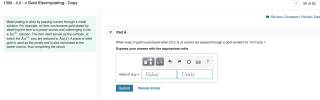 1302 - 4.3 - Gold Electroplating - Copy © 20 of 20 m Review Constants 1 Periodic Tabl Part A Metal plating is done by passing current through a metal solution. For example, an item can become gold plated by attaching the item to a power source and submerging it into a Au3+ solution. The item itself serves as the cathode, at which the Au'+ ions are reduced to Au(s). A piece of solid gold is used as the anode...
Metal plating is done by passing current through a metal solution. For example, an item can...
Metal plating is done by passing current through a metal solution. For example, an item can become gold plated by attaching the item to a power source and submerging it into a Au3+Au3+ solution. The item itself serves as the cathode, at which the Au3+Au3+ions are reduced to Au(s)Au(s). A piece of solid gold is used as the anode and is also connected to the power source, thus completing the circuit. What mass of gold is produced when 16.2 A...
Metal plating is done by passing current through a metal solution. For example, an item can...
Metal plating is done by passing current through a metal solution. For example, an item can become gold plated by attaching the item to a power source and submerging it into a Au3+ solution. The item itself serves as the cathode, at which the Au3+ ions are reduced to Au(s). A piece of solid gold is used as the anode and is also connected to the power source, thus completing the circuit. What mass of gold is produced when 20.0...
Review Constants 1 Periodic Table Part A Metal plating is done by passing current through a...
 Review Constants 1 Periodic Table Part A Metal plating is done by passing current through a metal solution. For example, an item can become gold plated by attaching the item to a power source and submerging it into a Au' solution. The item itself serves as the cathode, at which the Au't ions are reduced to Au(s). A piece of solid gold is used as the anode and is also connected to the power source, thus completing the circuit. What...
When electricity (the flow of electrons) is passed through a solution, it causes an oxidation-reduction (redox)...
 When electricity (the flow of electrons) is passed through a solution, it causes an oxidation-reduction (redox) reaction to occur. If the solution contains a metal cation such as Ag+, the flow of electrons will reduce the silver ion, causing solid silver to plate onto the electrode. The amount of metal plated depends on the number of electrons passed. The total charge of a mole of electrons is 96,485 coulombs (C) and 1 ampere (A) = 1 coulomb/second (C/s) Part A...
What mass of gold is produced when 7.60 A of current are passed through a gold...
What mass of gold is produced when 7.60 A of current are passed through a gold solution for 13.0 min ?
Part A and B Please show all of the steps Analysis of Electroplating When electricity (the flow of electrons) is...
 Part A and B
Please show all of the steps
Analysis of Electroplating When electricity (the flow of electrons) is passed through a solution, it causes an oxidation-reduction (redox) reaction to occur. If the solution contains a metal cation such as Ag+, the flow of electrons will reduce the silver ion, causing solid silver to plate onto the electrode. The amount of metal plated depends on the number of electrons passed. The total charge of a mole of electrons is...
Part A and B
Please show all of the steps
Analysis of Electroplating When electricity (the flow of electrons) is passed through a solution, it causes an oxidation-reduction (redox) reaction to occur. If the solution contains a metal cation such as Ag+, the flow of electrons will reduce the silver ion, causing solid silver to plate onto the electrode. The amount of metal plated depends on the number of electrons passed. The total charge of a mole of electrons is...
Draw a labelled diagram of the apparatus that includes the anode, the cathode, the electrolyte, t...
 Draw a labelled diagram of the apparatus that includes the anode, the cathode, the electrolyte, the direction of ion flow and the direction of electron flow provided by the power source. 28. Answer (4 Marks) Cu 29. Write and identify the half-reactions and net reaction. Answer (3 Marks) Cathode Half-Reaction Anode Half-Reaction Net Reaction 30. Calculate the theoretical potential difference of this cell. Answer (2 Mark) Chemistry so Unit C Module 6 S Besides deposition of Cu(s), what other empirical...
10nA current passed through AgNO3 solution for 80 minutes. Both electrodes were made of gold. The...
10nA current passed through AgNO3 solution for 80 minutes. Both electrodes were made of gold. The cathode solution (total weight 40.28 g) was titrated with 86 ml of 0.02 M KSCN. Anode solution of same weight was titrated with 112 ml of the same solution of KSCN. What is thesilver ion transport number?
 1302 - 4.3 - Gold Electroplating - Copy © 20 of 20 m Review Constants 1 Periodic Tabl Part A Metal plating is done by passing current through a metal solution. For example, an item can become gold plated by attaching the item to a power source and submerging it into a Au3+ solution. The item itself serves as the cathode, at which the Au'+ ions are reduced to Au(s). A piece of solid gold is used as the anode...
 Review Constants 1 Periodic Table Part A Metal plating is done by passing current through a metal solution. For example, an item can become gold plated by attaching the item to a power source and submerging it into a Au' solution. The item itself serves as the cathode, at which the Au't ions are reduced to Au(s). A piece of solid gold is used as the anode and is also connected to the power source, thus completing the circuit. What...
 When electricity (the flow of electrons) is passed through a solution, it causes an oxidation-reduction (redox) reaction to occur. If the solution contains a metal cation such as Ag+, the flow of electrons will reduce the silver ion, causing solid silver to plate onto the electrode. The amount of metal plated depends on the number of electrons passed. The total charge of a mole of electrons is 96,485 coulombs (C) and 1 ampere (A) = 1 coulomb/second (C/s) Part A...
 Part A and B
Please show all of the steps
Analysis of Electroplating When electricity (the flow of electrons) is passed through a solution, it causes an oxidation-reduction (redox) reaction to occur. If the solution contains a metal cation such as Ag+, the flow of electrons will reduce the silver ion, causing solid silver to plate onto the electrode. The amount of metal plated depends on the number of electrons passed. The total charge of a mole of electrons is...
Part A and B
Please show all of the steps
Analysis of Electroplating When electricity (the flow of electrons) is passed through a solution, it causes an oxidation-reduction (redox) reaction to occur. If the solution contains a metal cation such as Ag+, the flow of electrons will reduce the silver ion, causing solid silver to plate onto the electrode. The amount of metal plated depends on the number of electrons passed. The total charge of a mole of electrons is...
 Draw a labelled diagram of the apparatus that includes the anode, the cathode, the electrolyte, the direction of ion flow and the direction of electron flow provided by the power source. 28. Answer (4 Marks) Cu 29. Write and identify the half-reactions and net reaction. Answer (3 Marks) Cathode Half-Reaction Anode Half-Reaction Net Reaction 30. Calculate the theoretical potential difference of this cell. Answer (2 Mark) Chemistry so Unit C Module 6 S Besides deposition of Cu(s), what other empirical...
Most questions answered within 3 hours.
-
Where is the error in this code sequence?
String s1 = "Hello";
String s2 = "ello";...
asked 11 months ago -
Financial data for Joel de Paris, Inc., for last year
follow:
Joel de Paris, Inc.
Balance...
asked 11 months ago -
Consider this reaction:
Al2(SO4)3 (aq)+ BaCl3
(aq) Al2Cl6 (aq)- +
3BaSO4(s) . What is the...
asked 11 months ago -
Suppose that Savneet is considering increasing her
recent random sample from 20 car rentals to 40...
asked 11 months ago -
Trucks arrive at an unloading terminal at an average rate of 120
per hour.
Trucks arrive...
asked 11 months ago -
Why are methanol and ethanol completely soluble in water while
octanol is not very little soluble....
asked 11 months ago -
A facilities manager at a university reads in a research report
that the mean amount of...
asked 11 months ago -
When the CuSO4 is rehydrated by adding water to the anhydrous
compound, is this an endothermic...
asked 11 months ago -
A ray of sunlight is passing from diamond into crown glass; the
angle of incidence is...
asked 11 months ago -
A block of mass 0.249 kg is placed on top of a light, vertical
spring of...
asked 11 months ago -
how do the kidneys compensate in the presences of acidosis
a) trigger hyperventilate
b) reserve acid...
asked 11 months ago -
Question 501 pts
The rental rate of capital to the firm increases. Which of the
following...
asked 11 months ago