A 0.25 ?? object moves due east at 2.1 ?/?. What force is needed to cause...
-
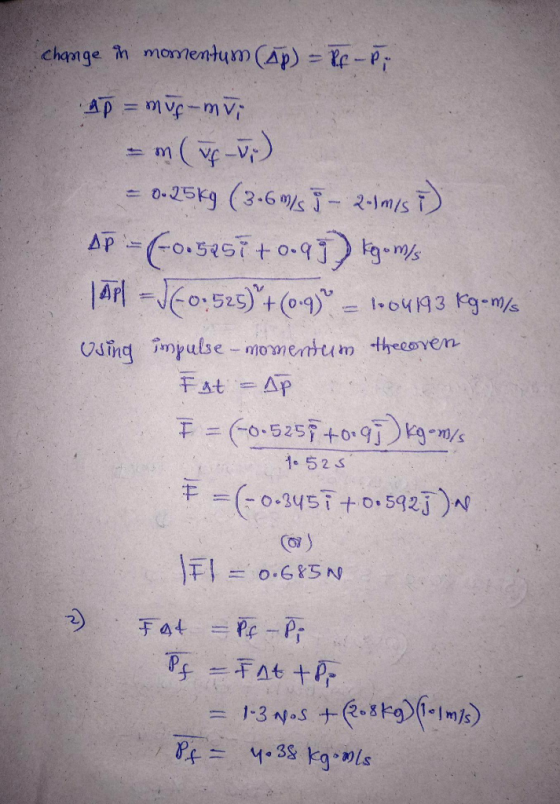
A 0.25 ?? object moves due east at 2.1 ?/?. What force is needed to cause it to move due north at 3.6 ?/? in 1.52 ??
-
An object of mass 2.8 ?? moves at 1.1 ?/? in the +? direction. If an impulse of 1.3 ? ∙ ? ?3 is applied, what is its final momentum?
Homework Answers
Add Answer to:
A 0.25 ?? object moves due east at 2.1 ?/?. What force is needed
to cause...
Object A is moving due east, while object B is moving due north. They collide and...
Object A is moving due east, while object B is moving due north. They collide and stick together in a completely inelastic collision. Momentum is conserved. Object A has a mass of mA = 16.5 kg and an initial velocity of v0A = 8.20 m/s, due east. Object B, however, has a mass of mB = 27.5 kg and an initial velocity of v0B = 5.00 m/s, due north. Find the direction of the final velocity of the two-object system...
Object A is moving due east, while object B is moving due north. They collide and...
Object A is moving due east, while object B is moving due north. They collide and stick together in a completely inelastic collision. Momentum is conserved. Object A has a mass of mA = 16.8 kg and an initial velocity of = 7.37 m/s, due east. Object B, however, has a mass of mB = 29.0 kg and an initial velocity of = 5.03 m/s, due north. Find the (a) magnitude and (b) direction of the total momentum of the...
Object A is moving due east, while object B is moving due north. They collide and...
Object A is moving due east, while object B is moving due north. They collide and stick together in a completely inelastic collision. Momentum is conserved. Object A has a mass of mA = 18.0 kg and an initial velocity of v0A = 8.00 m/s, due east. Object B, however, has a mass of mB = 30.0 kg and an initial velocity of v0B = 5.00 m/s, due north. Find the magnitude of the final velocity of the two-object system...
Chapter 07, Problem 36 GO Object A is moving due east, while object is moving due...
 Chapter 07, Problem 36 GO Object A is moving due east, while object is moving due north. They collide and stick together in a completely inelastic collision. Momentum is conserved. Object A has a mass of ms -16.2 kg and an initial velocity of Tox - 7.34 m/s, due cast. Object B, however, has a mass of m -28.3 kg and an initial velocity of Pop - 5.40 m/s, due north. Find the (a) magnitude and (b) direction of the...
A hockey puck of mass 158 g is sliding due east on a frictionless table with...
A hockey puck of mass 158 g is sliding due east on a frictionless table with a speed of 14 m/s. Suddenly, a constant force of magnitude 3.5 N and direction due north is applied to the puck for 1.2 s. Find the north and east components of the momentum (in kg · m/s) at the end of the 1.2 s interval. (Indicate the directions with the signs of your answers.) pnorth= peast=
PHYSICS 30 MOMENTUM AND IMPULSE Q9 ASSIGNMENT A. MOMENTUM AND IMPULSE a. C. 1. Use the...
 PHYSICS 30 MOMENTUM AND IMPULSE Q9 ASSIGNMENT A. MOMENTUM AND IMPULSE a. C. 1. Use the concept of Impulse to describe one advantage of seatbelts. 2. A 5.00 kg mass is moving with a velocity of 3.50 m/s. A force of 4.00 N acts on the object increasing its velocity (in the same direction) to 12.5 m/s. Determine Change in momentum b. Impulse the mass experiences Time interval that the force was applied for 3. A 15.0 kg object is...
An object has an initial momentum of 57.4 kgm/s to the right. A force is then...
An object has an initial momentum of 57.4 kgm/s to the right. A force is then exerted on the object in the opposite direction over a period of time which, resulting in its final momentum of 22.5 kgm/s to the left. What is the impulse acting on this object? Enter the units as N*s and assume right to be the positive direction.
Three forces act on a moving object. One force has a magnitude of 78.6 N and...
Three forces act on a moving object. One force has a magnitude of 78.6 N and is directed due north. Another has a magnitude of 55.3 N and is directed due west. What must be (a) the magnitude and (b) the direction of the third force, such that the object continues to move with a constant velocity? Express your answer as a positive angle south of east.
(a) What is the direction of the force on a wire carrying a current due east...
 (a) What is the direction of the force on a wire carrying a current due east in a location where the Earth's field is due north? Both are parallel to the ground. up (b) Calculate the force per meter (in N/m) if the wire carries 15.0 A and the field strength is 5.50 x 10-ST. (Enter the magnitude.) 8.25e-04 ✔ N/m (c) What diameter (in m) iron wire would have its weight supported by this force? (The density of iron...
PHYS 1710.102 : Group Work #3 2. Pushing a Puck A hockey puck of mass 180...
 PHYS 1710.102 : Group Work #3 2. Pushing a Puck A hockey puck of mass 180 g is sliding due East on a frictionless table with a speed of 10.0m/s. Suddenly, a constant force of magnitude 5.00 N directed due North is applied to the puck for 0.75s. Find the North and East components of the momentum at the end of the time interval. v, (10 m/s)east F (5.0 N)north What is the final velocity (magnitude and direction)?
 Chapter 07, Problem 36 GO Object A is moving due east, while object is moving due north. They collide and stick together in a completely inelastic collision. Momentum is conserved. Object A has a mass of ms -16.2 kg and an initial velocity of Tox - 7.34 m/s, due cast. Object B, however, has a mass of m -28.3 kg and an initial velocity of Pop - 5.40 m/s, due north. Find the (a) magnitude and (b) direction of the...
 PHYSICS 30 MOMENTUM AND IMPULSE Q9 ASSIGNMENT A. MOMENTUM AND IMPULSE a. C. 1. Use the concept of Impulse to describe one advantage of seatbelts. 2. A 5.00 kg mass is moving with a velocity of 3.50 m/s. A force of 4.00 N acts on the object increasing its velocity (in the same direction) to 12.5 m/s. Determine Change in momentum b. Impulse the mass experiences Time interval that the force was applied for 3. A 15.0 kg object is...
 (a) What is the direction of the force on a wire carrying a current due east in a location where the Earth's field is due north? Both are parallel to the ground. up (b) Calculate the force per meter (in N/m) if the wire carries 15.0 A and the field strength is 5.50 x 10-ST. (Enter the magnitude.) 8.25e-04 ✔ N/m (c) What diameter (in m) iron wire would have its weight supported by this force? (The density of iron...
 PHYS 1710.102 : Group Work #3 2. Pushing a Puck A hockey puck of mass 180 g is sliding due East on a frictionless table with a speed of 10.0m/s. Suddenly, a constant force of magnitude 5.00 N directed due North is applied to the puck for 0.75s. Find the North and East components of the momentum at the end of the time interval. v, (10 m/s)east F (5.0 N)north What is the final velocity (magnitude and direction)?
Most questions answered within 3 hours.
-
Where is the error in this code sequence?
String s1 = "Hello";
String s2 = "ello";...
asked 11 months ago -
Financial data for Joel de Paris, Inc., for last year
follow:
Joel de Paris, Inc.
Balance...
asked 11 months ago -
Consider this reaction:
Al2(SO4)3 (aq)+ BaCl3
(aq) Al2Cl6 (aq)- +
3BaSO4(s) . What is the...
asked 11 months ago -
Suppose that Savneet is considering increasing her
recent random sample from 20 car rentals to 40...
asked 11 months ago -
Trucks arrive at an unloading terminal at an average rate of 120
per hour.
Trucks arrive...
asked 11 months ago -
Why are methanol and ethanol completely soluble in water while
octanol is not very little soluble....
asked 11 months ago -
A facilities manager at a university reads in a research report
that the mean amount of...
asked 11 months ago -
When the CuSO4 is rehydrated by adding water to the anhydrous
compound, is this an endothermic...
asked 11 months ago -
A ray of sunlight is passing from diamond into crown glass; the
angle of incidence is...
asked 11 months ago -
A block of mass 0.249 kg is placed on top of a light, vertical
spring of...
asked 11 months ago -
how do the kidneys compensate in the presences of acidosis
a) trigger hyperventilate
b) reserve acid...
asked 11 months ago -
Question 501 pts
The rental rate of capital to the firm increases. Which of the
following...
asked 11 months ago