
Homework Answers
Request Answer!
We need at least 10 more requests to produce the answer.
0 / 10 have requested this problem solution
The more requests, the faster the answer.
Add Answer to:
1) Consider a uniform system of extremely relativistic (i.e., &p=cp) Bose gas with N particles in...
Question 4: (i) Write down the form of the Bose-Einstein distribution and discuss the phenomenon ...
 Question 4: (i) Write down the form of the Bose-Einstein distribution and discuss the phenomenon of Bose-Einstein condensation for a boson gas in three dimensions. In particular, carefully explain why the chemical potential becomes very close to the energy of the lowest single- particle state at sufficiently low temperature and describe how that changes the usual approach of replacing a discrete sum over energies with a continuum integral. Discuss how the occupation of the lowest single-particle state changes as a...
Ideal Bose gas (a) Consider a 2D ideal Bose gas with density of state D (e)...
 Ideal Bose gas (a) Consider a 2D ideal Bose gas with density of state D (e) = DoL2, show that Bose- Einstein condensation is not possible in such a gas. (b) Consider a 4D ideal Bose gas with density of state D(e) = DOL6, find the Bose- Einstein condensation temperature in terms of Do, n = N/La, and a dimensionless integral FM A = (6) ex 1 12
Ideal Bose gas (a) Consider a 2D ideal Bose gas with density...
Ideal Bose gas (a) Consider a 2D ideal Bose gas with density of state D (e) = DoL2, show that Bose- Einstein condensation is not possible in such a gas. (b) Consider a 4D ideal Bose gas with density of state D(e) = DOL6, find the Bose- Einstein condensation temperature in terms of Do, n = N/La, and a dimensionless integral FM A = (6) ex 1 12
Ideal Bose gas (a) Consider a 2D ideal Bose gas with density...
Consider a two-dimensional (2D) Bose gas at finite but low T confined in a square box...
 Consider a two-dimensional (2D) Bose gas at finite but low T
confined in a square box potential with side lengths L and area A =
L^2.
2. Consider a two-dimensional (2D) Bose gas at finite but low T confined in a square box potential with side lengths L and area A = L2. Using the density of states function as you found above, derive an expression for the 2D phase space density and argue why Bose-Einstein condensation does not occur...
Consider a two-dimensional (2D) Bose gas at finite but low T
confined in a square box potential with side lengths L and area A =
L^2.
2. Consider a two-dimensional (2D) Bose gas at finite but low T confined in a square box potential with side lengths L and area A = L2. Using the density of states function as you found above, derive an expression for the 2D phase space density and argue why Bose-Einstein condensation does not occur...
Consider an 3-dimensional ideal bose gas system whose dispersion relation is given by a) Find the mean occupation numb...
Consider an 3-dimensional ideal bose gas system whose dispersion relation is given by a) Find the mean occupation number of quantum state with a wave vector b) Find the total number of particles at excited states and internal energy at temperature and express it in terms of Bose-Einstein integral and thermal wave length h2k2 E hw 2m We were unable to transcribe this imageWe were unable to transcribe this imageU (T We were unable to transcribe this imagegn(z; h2 1/2...
Problem 3: (40 points) One-dimensional relativistic gas: Here we consider a non-interacting gas of N relativistic...
 Problem 3: (40 points) One-dimensional relativistic gas: Here we consider a non-interacting gas of N relativistic particles in one dimension. The gas is confined in a container of length L, i.e., the coordinate of each particle is limited to 0 <q < L. The energy of the ith particle is given by ε = c (a) Calculate the single particle partition function Z(T,L) for given energy E and particle number N. [12 points] (b) Calculate the average energy E and...
Statistical_Mechanics 2 20 points) 2D ideal Fermi gas 24 Consider an ideal Fermi gas in 2D....
 Statistical_Mechanics
2 20 points) 2D ideal Fermi gas 24 Consider an ideal Fermi gas in 2D. It is contained in an area of dimensions L x L. The particle mass is m. (a) Find the density of states D(e) N/L2 (b) Find the Fermi energy as a function of the particle density n = (c) Find the total energy as a function of the Fermi energy ef. (d) Find the chemical potential u as a function of n and T....
Statistical_Mechanics
2 20 points) 2D ideal Fermi gas 24 Consider an ideal Fermi gas in 2D. It is contained in an area of dimensions L x L. The particle mass is m. (a) Find the density of states D(e) N/L2 (b) Find the Fermi energy as a function of the particle density n = (c) Find the total energy as a function of the Fermi energy ef. (d) Find the chemical potential u as a function of n and T....
for relativistic particles, the single particle density of states was given by g(E) =(g_sV E/ 2π^2h^3...
 for relativistic particles, the single particle density of
states was given by
g(E) =(g_sV E/ 2π^2h^3 c^3) E
≥ mc^2. For an ideal gas of relativistic fermions at zero
temperature, show that the Fermi energy is
EF =
(Usually the zero point energy is not important, and so people
often subtract it off, quoting the result above minus mc^2. For
instance, this is what you need to do to match with the
non-relativistic result.) At very high densities, the second term...
for relativistic particles, the single particle density of
states was given by
g(E) =(g_sV E/ 2π^2h^3 c^3) E
≥ mc^2. For an ideal gas of relativistic fermions at zero
temperature, show that the Fermi energy is
EF =
(Usually the zero point energy is not important, and so people
often subtract it off, quoting the result above minus mc^2. For
instance, this is what you need to do to match with the
non-relativistic result.) At very high densities, the second term...
11/05 For non-relativistic half-spin particles in a Fermi gas moving in 3D, determine the constant C if the fermi energy for number density n = N/V where the density of states is for volume V and wa...
11/05 For non-relativistic half-spin particles in a Fermi gas moving in 3D, determine the constant C if the fermi energy for number density n = N/V where the density of states is for volume V and wavenumber k. Now determine whether atoms, atoms and atoms are bosons or fermions (I don't think you can just multiply the number of electrons by the half-spin, how else would you do it?). We were unable to transcribe this image2 dn V We were...
QUESTION (1) BOSE GAS: This one is to help you with the various manipulations. 1(a) The...
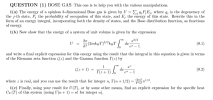 QUESTION (1) BOSE GAS: This one is to help you with the various manipulations. 1(a) The energy of a spinless 3-dimensional Bose gas is given by U = ig;P;E;, where g; is the degeneracy of the j-th state, P; the probability of occupation of this state, and E; the energy of this state. Rewrite this in the form of an energy integral, incorporating both the density of states, and the Bose distribution function, as functions of energy. 1(b) Now show...
2. Bosons in a s.h.o. Consider a gas of bosons in a 3D harmonic potential, with...
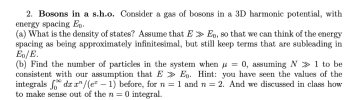 2. Bosons in a s.h.o. Consider a gas of bosons in a 3D harmonic potential, with energy spacing o (a) What is the density of states? Assume that EEo, so that we can think of the energy spacing as being approximately infinitesimal, but still keep terms that are subleading in Eo E (b) Find the number of particles in the system when u - 0, assuming N » 1 to be consistent with our assumption that E Hint: you have...
 Question 4: (i) Write down the form of the Bose-Einstein distribution and discuss the phenomenon of Bose-Einstein condensation for a boson gas in three dimensions. In particular, carefully explain why the chemical potential becomes very close to the energy of the lowest single- particle state at sufficiently low temperature and describe how that changes the usual approach of replacing a discrete sum over energies with a continuum integral. Discuss how the occupation of the lowest single-particle state changes as a...
 Ideal Bose gas (a) Consider a 2D ideal Bose gas with density of state D (e) = DoL2, show that Bose- Einstein condensation is not possible in such a gas. (b) Consider a 4D ideal Bose gas with density of state D(e) = DOL6, find the Bose- Einstein condensation temperature in terms of Do, n = N/La, and a dimensionless integral FM A = (6) ex 1 12
Ideal Bose gas (a) Consider a 2D ideal Bose gas with density...
Ideal Bose gas (a) Consider a 2D ideal Bose gas with density of state D (e) = DoL2, show that Bose- Einstein condensation is not possible in such a gas. (b) Consider a 4D ideal Bose gas with density of state D(e) = DOL6, find the Bose- Einstein condensation temperature in terms of Do, n = N/La, and a dimensionless integral FM A = (6) ex 1 12
Ideal Bose gas (a) Consider a 2D ideal Bose gas with density...
 Consider a two-dimensional (2D) Bose gas at finite but low T
confined in a square box potential with side lengths L and area A =
L^2.
2. Consider a two-dimensional (2D) Bose gas at finite but low T confined in a square box potential with side lengths L and area A = L2. Using the density of states function as you found above, derive an expression for the 2D phase space density and argue why Bose-Einstein condensation does not occur...
Consider a two-dimensional (2D) Bose gas at finite but low T
confined in a square box potential with side lengths L and area A =
L^2.
2. Consider a two-dimensional (2D) Bose gas at finite but low T confined in a square box potential with side lengths L and area A = L2. Using the density of states function as you found above, derive an expression for the 2D phase space density and argue why Bose-Einstein condensation does not occur...
 Problem 3: (40 points) One-dimensional relativistic gas: Here we consider a non-interacting gas of N relativistic particles in one dimension. The gas is confined in a container of length L, i.e., the coordinate of each particle is limited to 0 <q < L. The energy of the ith particle is given by ε = c (a) Calculate the single particle partition function Z(T,L) for given energy E and particle number N. [12 points] (b) Calculate the average energy E and...
 Statistical_Mechanics
2 20 points) 2D ideal Fermi gas 24 Consider an ideal Fermi gas in 2D. It is contained in an area of dimensions L x L. The particle mass is m. (a) Find the density of states D(e) N/L2 (b) Find the Fermi energy as a function of the particle density n = (c) Find the total energy as a function of the Fermi energy ef. (d) Find the chemical potential u as a function of n and T....
Statistical_Mechanics
2 20 points) 2D ideal Fermi gas 24 Consider an ideal Fermi gas in 2D. It is contained in an area of dimensions L x L. The particle mass is m. (a) Find the density of states D(e) N/L2 (b) Find the Fermi energy as a function of the particle density n = (c) Find the total energy as a function of the Fermi energy ef. (d) Find the chemical potential u as a function of n and T....
 for relativistic particles, the single particle density of
states was given by
g(E) =(g_sV E/ 2π^2h^3 c^3) E
≥ mc^2. For an ideal gas of relativistic fermions at zero
temperature, show that the Fermi energy is
EF =
(Usually the zero point energy is not important, and so people
often subtract it off, quoting the result above minus mc^2. For
instance, this is what you need to do to match with the
non-relativistic result.) At very high densities, the second term...
for relativistic particles, the single particle density of
states was given by
g(E) =(g_sV E/ 2π^2h^3 c^3) E
≥ mc^2. For an ideal gas of relativistic fermions at zero
temperature, show that the Fermi energy is
EF =
(Usually the zero point energy is not important, and so people
often subtract it off, quoting the result above minus mc^2. For
instance, this is what you need to do to match with the
non-relativistic result.) At very high densities, the second term...
 QUESTION (1) BOSE GAS: This one is to help you with the various manipulations. 1(a) The energy of a spinless 3-dimensional Bose gas is given by U = ig;P;E;, where g; is the degeneracy of the j-th state, P; the probability of occupation of this state, and E; the energy of this state. Rewrite this in the form of an energy integral, incorporating both the density of states, and the Bose distribution function, as functions of energy. 1(b) Now show...
 2. Bosons in a s.h.o. Consider a gas of bosons in a 3D harmonic potential, with energy spacing o (a) What is the density of states? Assume that EEo, so that we can think of the energy spacing as being approximately infinitesimal, but still keep terms that are subleading in Eo E (b) Find the number of particles in the system when u - 0, assuming N » 1 to be consistent with our assumption that E Hint: you have...
Most questions answered within 3 hours.
-
Where is the error in this code sequence?
String s1 = "Hello";
String s2 = "ello";...
asked 10 months ago -
Financial data for Joel de Paris, Inc., for last year
follow:
Joel de Paris, Inc.
Balance...
asked 10 months ago -
Consider this reaction:
Al2(SO4)3 (aq)+ BaCl3
(aq) Al2Cl6 (aq)- +
3BaSO4(s) . What is the...
asked 10 months ago -
Suppose that Savneet is considering increasing her
recent random sample from 20 car rentals to 40...
asked 10 months ago -
Trucks arrive at an unloading terminal at an average rate of 120
per hour.
Trucks arrive...
asked 10 months ago -
Why are methanol and ethanol completely soluble in water while
octanol is not very little soluble....
asked 10 months ago -
A facilities manager at a university reads in a research report
that the mean amount of...
asked 10 months ago -
When the CuSO4 is rehydrated by adding water to the anhydrous
compound, is this an endothermic...
asked 10 months ago -
A ray of sunlight is passing from diamond into crown glass; the
angle of incidence is...
asked 10 months ago -
A block of mass 0.249 kg is placed on top of a light, vertical
spring of...
asked 10 months ago -
how do the kidneys compensate in the presences of acidosis
a) trigger hyperventilate
b) reserve acid...
asked 10 months ago -
Question 501 pts
The rental rate of capital to the firm increases. Which of the
following...
asked 10 months ago