Convert the member function to static member function class MyClass { int x ; public: void...
Convert the member function to static member function
class MyClass {
int x ;
public:
void set(int x) {
this->x = x ;
}
}
2) Convert the member function into non-inline function.
class Basketball {
int home ;
int visitor ;
public:
void setHome(int score) {
home = score;
}
void setVistor(int score) {
vistor = score ; }
} ;
Homework Answers
1)
// Screenshot of the code
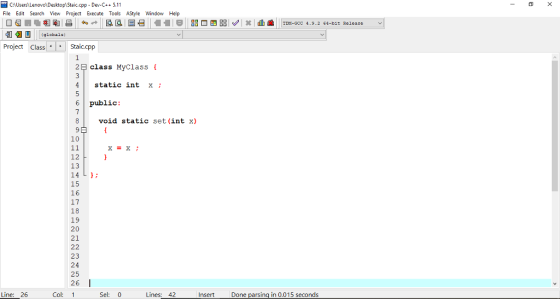
// code to copy
class MyClass {
static int x ;
public:
void static set(int x)
{
x = x ;
}
};
2)
// Screenshot of the code
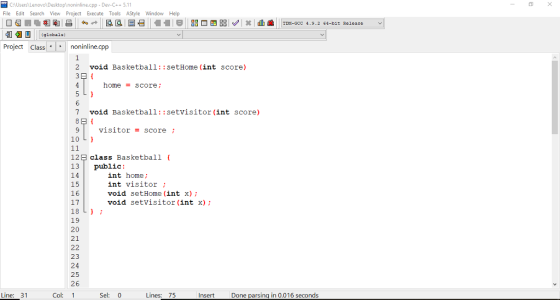
// code to copy
void Basketball::setHome(int score)
{
home = score;
}
void Basketball::setVisitor(int score)
{
visitor = score ;
}
class Basketball {
public:
int home;
int visitor ;
void setHome(int x);
void setVisitor(int x);
} ;
Add Answer to:
Convert the member function to static member function
class MyClass {
int x ;
public:
void...
Explain in detail what the code below does: public class MyClass { public static void...
Explain in detail what the code below does: public class MyClass { public static void main(String args[]) { System.out.println(isUniqueChars("something")); } public static boolean isUniqueChars(String str) { int checker = 0; for (int i = 0; i < str.length(); ++i) { int val = str.charAt(i) - 'a'; if ((checker & (1 << val)) > 0) return false; checker |= (1 << val); } return true;...
What is the missing keyword in the program below? public class Batman { public static int...
What is the missing keyword in the program below? public class Batman { public static int minFunction(int n1, int n2) { int min; if (n1 > n2) min = n2; else min = n1; return min; //This is the value that will be returned from the minFunction method. //The value after the keyword return must match the return type from the method header. Ours is OK because they are both int. } // end the public method named minFunction }...
which is incorrect? struct myStruct { int i; double d; }; class myClass { public: int...
which is incorrect? struct myStruct { int i; double d; }; class myClass { public: int i; double d; }; myStruct a; a.i = 3; myClass b; b.i = 3; a) All these statements will compile with no problem. b) A structure member is accessed using the index operator [ ], with the member name as index. [ ] c) A class is a type similar to a structure type that normally has member functions as well as member variables....
Analyze the following code: public class Test { private int t; public static void main(String[] args)...
 Analyze the following code: public class Test { private int t; public static void main(String[] args) { int x; System.out.println(t); } } t is non-static and it cannot be referenced in a static context in the main method. The program compiles and runs fine. The variable t is not initialized and therefore causes errors. The variable x is not initialized and therefore causes errors.
Analyze the following code: public class Test { private int t; public static void main(String[] args)...
 Analyze the following code: public class Test { private int t; public static void main(String[] args) { int x; System.out.println(t); } } The variable t is private and therefore cannot be accessed in the main method. The program compiles and runs fine. t is non-static and it cannot be referenced in a static context in the main method. The variablet is not initialized and therefore causes errors. The variable x is not initialized and therefore causes errors.
In the following program: public class Problem2{ public static int sample(int x, int y){ int z; .........
In the following program: public class Problem2{ public static int sample(int x, int y){ int z; ...... } public static void main(String[] args) { int a, b; ...... sample(a,b); } } (1) What is the return type of sample? (2) What are the local variables of sample? (3) What are the parameters of sample? (4) What are the arguments of sample? (5) Is sample a per-object method? Or a per-class method? (6) Is sample a public method, or private method?
must provide the following public interface: public static void insertSort(int [] arr); public static void selectSort(int...
must provide the following public interface: public static void insertSort(int [] arr); public static void selectSort(int [] arr); public static void quickSort(int [] arr); public static void mergeSort(int [] arr); The quick sort and merge sort must be implemented by using recursive thinking. So the students may provide the following private static methods: //merge method //merge two sorted portions of given array arr, namely, from start to middle //and from middle + 1 to end into one sorted portion, namely,...
c. [3 marks] Given the following definition of the class MyClass, class MyClass { String s...
 c. [3 marks] Given the following definition of the class MyClass, class MyClass { String s int z Myclass(int y) { z = y } } fill in the blanks (labelled i., ii. and iii.) in the definition of the method main, of the class StringProcessing, with i. a declaration of a variable named obj of type MyClass, initialised with a MyClass object so that its instance variable z has a value of 20, ii. an assignment of the instance...
public class FirstLastNameEvent { public final static int ppg = 35; public final static int cutoff...
public class FirstLastNameEvent { public final static int ppg = 35; public final static int cutoff = 50; private String eventNumber; private int guestNumber; private int price; public void setEventNumber(String eventNumber) { this.eventNumber = eventNumber; } public void setGuestNumber(int guestNumber) { this.guestNumber = guestNumber * ppg; } public String getEventNumber() { return eventNumber; } public int getGuestNumber() { return guestNumber; } public int getPrice() { return price; } } Using Assignment #3’s code:(the code above) Modify the ‘public static void...
ndicate the correct answers bases on the following code: public class IdentifyMyParts { public static final...
ndicate the correct answers bases on the following code: public class IdentifyMyParts { public static final int X = 7; public int y ; public void display(){.......} } public static void main(){string [] args){ IdentifyMyParts Obj1; Obj1.X=8; Obj1.y=20; } a. IdentifyMyParts is a class b. X is a instance method c. y is an instance variable d. Obj1.X=100; e. Obj1.y=200; f. display() is a member function
 Analyze the following code: public class Test { private int t; public static void main(String[] args) { int x; System.out.println(t); } } t is non-static and it cannot be referenced in a static context in the main method. The program compiles and runs fine. The variable t is not initialized and therefore causes errors. The variable x is not initialized and therefore causes errors.
 Analyze the following code: public class Test { private int t; public static void main(String[] args) { int x; System.out.println(t); } } The variable t is private and therefore cannot be accessed in the main method. The program compiles and runs fine. t is non-static and it cannot be referenced in a static context in the main method. The variablet is not initialized and therefore causes errors. The variable x is not initialized and therefore causes errors.
 c. [3 marks] Given the following definition of the class MyClass, class MyClass { String s int z Myclass(int y) { z = y } } fill in the blanks (labelled i., ii. and iii.) in the definition of the method main, of the class StringProcessing, with i. a declaration of a variable named obj of type MyClass, initialised with a MyClass object so that its instance variable z has a value of 20, ii. an assignment of the instance...
Most questions answered within 3 hours.
-
Where is the error in this code sequence?
String s1 = "Hello";
String s2 = "ello";...
asked 10 months ago -
Financial data for Joel de Paris, Inc., for last year
follow:
Joel de Paris, Inc.
Balance...
asked 10 months ago -
Consider this reaction:
Al2(SO4)3 (aq)+ BaCl3
(aq) Al2Cl6 (aq)- +
3BaSO4(s) . What is the...
asked 10 months ago -
Suppose that Savneet is considering increasing her
recent random sample from 20 car rentals to 40...
asked 10 months ago -
Trucks arrive at an unloading terminal at an average rate of 120
per hour.
Trucks arrive...
asked 10 months ago -
Why are methanol and ethanol completely soluble in water while
octanol is not very little soluble....
asked 10 months ago -
A facilities manager at a university reads in a research report
that the mean amount of...
asked 10 months ago -
When the CuSO4 is rehydrated by adding water to the anhydrous
compound, is this an endothermic...
asked 10 months ago -
A ray of sunlight is passing from diamond into crown glass; the
angle of incidence is...
asked 10 months ago -
A block of mass 0.249 kg is placed on top of a light, vertical
spring of...
asked 10 months ago -
how do the kidneys compensate in the presences of acidosis
a) trigger hyperventilate
b) reserve acid...
asked 10 months ago -
Question 501 pts
The rental rate of capital to the firm increases. Which of the
following...
asked 10 months ago