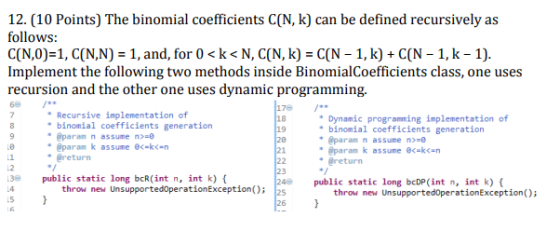
The binomial coefficients C(N, k) can be defined recursively as follows: C(N,0)=1, C(N,N) = 1, and, for 0 < k < N, C(N, k) = C(N − 1, k) + C(N − 1, k − 1). Implement the following two methods inside BinomialCoefficients class, one uses recursion and the other one uses dynamic programming.
Homework Answers
Request Answer!
We need at least 10 more requests to produce the answer.
0 / 10 have requested this problem solution
The more requests, the faster the answer.
Add Answer to:
The binomial coefficients C(N, k) can be defined recursively as
follows: C(N,0)=1, C(N,N) = 1, and,...
Write a C program solution to implement a recursive version of binomial coefficients. Note - the...
Write a C program solution to implement a recursive version of binomial coefficients. Note - the binomial coefficients B(n, k) satisfy the recursive formula B(n, k) = B(n − 1, k − 1) + B(n − 1, k). Together with the initial conditions B(n, 0) = B(n, n) = 1 the formula can be used to calculate all binomial coefficients
Modify Algorithm 3.2 (Binomial Coefficient Using Dynamic Programming) so that it uses only a one-dimensional array...
 Modify Algorithm 3.2 (Binomial Coefficient Using Dynamic Programming) so that it uses only a one-dimensional array indexed from 0 to k. Algorithm 3.2 Binomial Coefficient Using Dynamic Programming Problem: Compute the binomial coefficient. Inputs: nonnegative integers n and k, where ks n. Outputs: bin2, the binomial coefficient (2) int bin2 (int n, int k) index i, j; int B[0..n][0..k]; for (i = 0; i <= n; i++) for (i = 0; j <= minimum( i,); ++) if (j == 0...
Haloo , i have java program , Java Program , dynamic program Given a knapsack with capacity B∈N and -n- objects with profits p0, ..., p n-1 and weights w0, ..., wn-1. It is also necessary to find a su...
Haloo , i have java program , Java Program , dynamic program Given a knapsack with capacity B∈N and -n- objects with profits p0, ..., p n-1 and weights w0, ..., wn-1. It is also necessary to find a subset I ⊆ {0, ..., n-1} such that the profit of the selected objects is maximized without exceeding the capacity. However, we have another limitation: the number of objects must not exceed a given k ∈ N Example: For the items...
//implement the binomial heap please import java.util.LinkedList; import java.util.NoSuchElementException; /** * Binomial Heap Implementation * *...
//implement the binomial heap please import java.util.LinkedList; import java.util.NoSuchElementException; /** * Binomial Heap Implementation * * @author First Last * @since ${date} */ public class BinomialHeap<T extends Comparable<? super T>> implements binomialHeapInterface<T> { private static final int DEFAULT = 5; // default size for the binomial heap public Node<T>[] forest; private int n; private boolean isMaxHeap; /** * Node Class for nodes in Binomial Heap */ protected class Node<T> { private T value; private int degree; private LinkedList<Node<T>> children; /**...
(A and C) Exercise 1.14. If n and k are integers, define the binomial coeffi- cient...
 (A and C)
Exercise 1.14. If n and k are integers, define the binomial coeffi- cient (m), read n choose k, by n! if 0 <k <n, = 0 otherwise. k!(n - k)! (a) Prove that ("#") = (m) + (-2) for all integers n and k. (b) By definition, () = 1 if k = 0 and 0 otherwise. The recursion relation in (a) gives a computational procedure, Pascal's triangle, for calculating binomial coefficients for small n. Start with...
(A and C)
Exercise 1.14. If n and k are integers, define the binomial coeffi- cient (m), read n choose k, by n! if 0 <k <n, = 0 otherwise. k!(n - k)! (a) Prove that ("#") = (m) + (-2) for all integers n and k. (b) By definition, () = 1 if k = 0 and 0 otherwise. The recursion relation in (a) gives a computational procedure, Pascal's triangle, for calculating binomial coefficients for small n. Start with...
Create an ArrayListReview class with one generic type to do the following • Creates an array...
Create an ArrayListReview class with one generic type to do the following • Creates an array list filled with the generic type of the ArrayListReview class, and inserts new elements into the specified location index-i in the list. (5 points) • Create a method inside the class to implement the calculation of Fibonacci numbers. Use System.nanoTime to find out how much time it takes to get fab(50). Create a method inside the class to check if an array list is...
I hope someone can explain this exercise to me. Thanks +++++++++++++ Programming Exercise Try to think...
I hope someone can explain this exercise to me. Thanks +++++++++++++ Programming Exercise Try to think about how to implement KWArrayList class. Please implement the following constructor and methods: public KWArrayList() public boolean add(E anEntry) public E get(int index) { public E set(int index, E newValue) public E remove(int index) private void reallocate() public int size() public int indexOf(Object item) Study the code for ArrayList implementation (enclosed in the folder) and work on the following exercise Provide a constructor...
The prime factorization of a number is the unique list of prime numbers that, when multiplied,...
The prime factorization of a number is the unique list of prime numbers that, when multiplied, gives the number. For example, the prime factorization of 60 is 2 ∗ 2 ∗ 3 ∗ 5. In this problem you must write code to recursively find and return the prime factorization of the given number. You must print these in ascending sorted order with spaces in between. For example, if your input is: 120 then you should print the following output: 2...
I need help with the Implementation of an Ordered List (Template Files) public interface Ordered...
I need help with the Implementation of an Ordered List (Template Files) public interface OrderedStructure { public abstract int size(); public abstract boolean add( Comparable obj ) throws IllegalArgumentException; public abstract Object get( int pos ) throws IndexOutOfBoundsException; public abstract void remove( int pos ) throws IndexOutOfBoundsException; public abstract void merge( OrderedList other ); } import java.util.NoSuchElementException; public class OrderedList implements OrderedStructure { // Implementation of the doubly linked nodes (nested-class) private static class Node { private Comparable value; private...
Question 3 (15%) Function f(n) can be recursively defined as follows. f(n)- f(n -1)+4 f(n-2) f(0)...
Question 3 (15%) Function f(n) can be recursively defined as follows. f(n)- f(n -1)+4 f(n-2) f(0) 0 and f(1) = 1 (a) Write clear pseudo code to calculate f(n). (10 points
 Modify Algorithm 3.2 (Binomial Coefficient Using Dynamic Programming) so that it uses only a one-dimensional array indexed from 0 to k. Algorithm 3.2 Binomial Coefficient Using Dynamic Programming Problem: Compute the binomial coefficient. Inputs: nonnegative integers n and k, where ks n. Outputs: bin2, the binomial coefficient (2) int bin2 (int n, int k) index i, j; int B[0..n][0..k]; for (i = 0; i <= n; i++) for (i = 0; j <= minimum( i,); ++) if (j == 0...
 (A and C)
Exercise 1.14. If n and k are integers, define the binomial coeffi- cient (m), read n choose k, by n! if 0 <k <n, = 0 otherwise. k!(n - k)! (a) Prove that ("#") = (m) + (-2) for all integers n and k. (b) By definition, () = 1 if k = 0 and 0 otherwise. The recursion relation in (a) gives a computational procedure, Pascal's triangle, for calculating binomial coefficients for small n. Start with...
(A and C)
Exercise 1.14. If n and k are integers, define the binomial coeffi- cient (m), read n choose k, by n! if 0 <k <n, = 0 otherwise. k!(n - k)! (a) Prove that ("#") = (m) + (-2) for all integers n and k. (b) By definition, () = 1 if k = 0 and 0 otherwise. The recursion relation in (a) gives a computational procedure, Pascal's triangle, for calculating binomial coefficients for small n. Start with...
Most questions answered within 3 hours.
-
Where is the error in this code sequence?
String s1 = "Hello";
String s2 = "ello";...
asked 10 months ago -
Financial data for Joel de Paris, Inc., for last year
follow:
Joel de Paris, Inc.
Balance...
asked 10 months ago -
Consider this reaction:
Al2(SO4)3 (aq)+ BaCl3
(aq) Al2Cl6 (aq)- +
3BaSO4(s) . What is the...
asked 10 months ago -
Suppose that Savneet is considering increasing her
recent random sample from 20 car rentals to 40...
asked 10 months ago -
Trucks arrive at an unloading terminal at an average rate of 120
per hour.
Trucks arrive...
asked 10 months ago -
Why are methanol and ethanol completely soluble in water while
octanol is not very little soluble....
asked 10 months ago -
A facilities manager at a university reads in a research report
that the mean amount of...
asked 10 months ago -
When the CuSO4 is rehydrated by adding water to the anhydrous
compound, is this an endothermic...
asked 10 months ago -
A ray of sunlight is passing from diamond into crown glass; the
angle of incidence is...
asked 10 months ago -
A block of mass 0.249 kg is placed on top of a light, vertical
spring of...
asked 10 months ago -
how do the kidneys compensate in the presences of acidosis
a) trigger hyperventilate
b) reserve acid...
asked 10 months ago -
Question 501 pts
The rental rate of capital to the firm increases. Which of the
following...
asked 10 months ago