Playing shortstop, you pick up a ground ball and throw it to second base. The ball...
Playing shortstop, you pick up a ground ball and throw it to second base. The ball is thrown horizontally, with a speed of 26 m/s, directly toward point A (Figure 4-16). When the ball reaches the second baseman 0.40 s later, it is caught at point B. (Neglect air resistance.) Figure 4-16
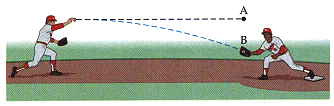
(a) How far were you from the second baseman? m
(b) What is the distance of vertical drop, AB? m
Homework Answers
(a)

(b)

Add Answer to:
Playing shortstop, you pick up a ground ball and throw it to
second base. The ball...
Playing shortstop, you pick up a ground ball and throw it to second base. The ball...
 Playing shortstop, you pick up a ground ball and throw it to second base. The ball is thrown horizontally, with a speed of 22m/s, directly toward point A (see the figure below). When the ball reaches the second baseman 0.45s later, it is caught at point B. (a) How far were you from the second baseman? (b) What is the distance of vertical drop, AB?
A major-league pitcher can throw a ball in excess of 41.0 m/s. If a ball is...
A major-league pitcher can throw a ball in excess of 41.0 m/s. If a ball is thrown horizontally at this speed, how much will it drop by the time it reaches a catcher who is 17.0 m away from the point of release? (Write on paper)
A second baseman tosses the ball to the first baseman, who catches it at the same...
A second baseman tosses the ball to the first baseman, who catches it at the same level from which it was thrown. The throw is made with an initial speed of 19.0 m/s at an angle of 33.0 ∘above the horizontal. Part a) What is the horizontal component of the ball's velocity just before it is caught? Part b) How long is the ball in the air?
A second baseman tosses the ball to the first baseman, who catches it at the same...
A second baseman tosses the ball to the first baseman, who catches it at the same level from which it was thrown. The throw is made with an initial speed of 18.0 m/s at an angle of 37.0 ∘above the horizontal. Let upward be the positive y direction. What is the ball's direction of motion just before it is caught?
Chapter 3, Problem 29 A major-league pitcher can throw a ball in excess of 41.0 m/s....
 Chapter 3, Problem 29 A major-league pitcher can throw a ball in excess of 41.0 m/s. If a ball is thrown horizontally at this speed, how much will it drop by the time it reaches a catcher who is 17.0 m away from the point of release? Number the tolerance is +/-200 Units
1. A tennis ball is struck and departs from the racket horizontally with a speed of...
1. A tennis ball is struck and departs from the racket horizontally with a speed of 27.5 m/s. The ball hits the court at a horizontal distance of 18.9 m from the racket. How far above the court is the tennis ball when it leaves the racket? 2. A major-league pitcher can throw a ball in excess of 41.8 m/s. If a ball is thrown horizontally at this speed, how much will it drop by the time it reaches a...
11. Suppose you throw a ball vertically downward with a speed of 49 m/s What would...
 11. Suppose you throw a ball vertically downward with a speed of 49 m/s What would be the speed of the ball one second later? 39 m/s. Show calculation: (g = 9.8 m/s) 49 m/s. ) 58.8 m/s. () 10 m/s. () 10 m/s2. 12. What distance will it have travelled after one second? Show calculation: 13. A rifle bullet is fired horizontally at the same instant another bullet is allowed to drop from rest at th Which bullet strikes...
You throw a ball from your window 14 meters above the ground. When the ball leaves...
You throw a ball from your window 14 meters above the ground. When the ball leaves your hand, it is moving at a speed of 20 m/s at an angle of 10 degree below the horizontal. Choosing a coordinate system such that its origin is located on your hand, the positive x axis is down and the positive y axis is right. Calculate how far horizontally from your hand, the ball lands.
You are standing on a cliff overlooking a lake and decide to throw a tennis ball...
You are standing on a cliff overlooking a lake and decide to throw a tennis ball to your friends in the water below. You throw the tennis ball with a velocity of 20.5 m/s at an angle of 39.5° above the horizontal. When the tennis ball leaves your hand it is 13.5 m above the water. How far does the tennis ball travel horizontally before it hits the water? In your calculations, neglect any effects of air resistance.
A ball is thrown towards a wall with an initial speed of 25.0 m/s, starting at...
 A ball is thrown towards a wall with an initial speed of 25.0
m/s, starting at 8.20 m above the ground. The height of the wall is
10.0 m and it is located 20.0 m from the launch point of the ball.
You may assume projectile motion for the ball. (SEE DIAGRAM IN
PICTURE BELOW)
a) When the ball passes directly above the wall, how high above
the wall is it? What is the velocity of the ball
when it...
A ball is thrown towards a wall with an initial speed of 25.0
m/s, starting at 8.20 m above the ground. The height of the wall is
10.0 m and it is located 20.0 m from the launch point of the ball.
You may assume projectile motion for the ball. (SEE DIAGRAM IN
PICTURE BELOW)
a) When the ball passes directly above the wall, how high above
the wall is it? What is the velocity of the ball
when it...
 Playing shortstop, you pick up a ground ball and throw it to second base. The ball is thrown horizontally, with a speed of 22m/s, directly toward point A (see the figure below). When the ball reaches the second baseman 0.45s later, it is caught at point B. (a) How far were you from the second baseman? (b) What is the distance of vertical drop, AB?
 Chapter 3, Problem 29 A major-league pitcher can throw a ball in excess of 41.0 m/s. If a ball is thrown horizontally at this speed, how much will it drop by the time it reaches a catcher who is 17.0 m away from the point of release? Number the tolerance is +/-200 Units
 11. Suppose you throw a ball vertically downward with a speed of 49 m/s What would be the speed of the ball one second later? 39 m/s. Show calculation: (g = 9.8 m/s) 49 m/s. ) 58.8 m/s. () 10 m/s. () 10 m/s2. 12. What distance will it have travelled after one second? Show calculation: 13. A rifle bullet is fired horizontally at the same instant another bullet is allowed to drop from rest at th Which bullet strikes...
 A ball is thrown towards a wall with an initial speed of 25.0
m/s, starting at 8.20 m above the ground. The height of the wall is
10.0 m and it is located 20.0 m from the launch point of the ball.
You may assume projectile motion for the ball. (SEE DIAGRAM IN
PICTURE BELOW)
a) When the ball passes directly above the wall, how high above
the wall is it? What is the velocity of the ball
when it...
A ball is thrown towards a wall with an initial speed of 25.0
m/s, starting at 8.20 m above the ground. The height of the wall is
10.0 m and it is located 20.0 m from the launch point of the ball.
You may assume projectile motion for the ball. (SEE DIAGRAM IN
PICTURE BELOW)
a) When the ball passes directly above the wall, how high above
the wall is it? What is the velocity of the ball
when it...
Most questions answered within 3 hours.
-
Where is the error in this code sequence?
String s1 = "Hello";
String s2 = "ello";...
asked 10 months ago -
Financial data for Joel de Paris, Inc., for last year
follow:
Joel de Paris, Inc.
Balance...
asked 10 months ago -
Consider this reaction:
Al2(SO4)3 (aq)+ BaCl3
(aq) Al2Cl6 (aq)- +
3BaSO4(s) . What is the...
asked 10 months ago -
Suppose that Savneet is considering increasing her
recent random sample from 20 car rentals to 40...
asked 10 months ago -
Trucks arrive at an unloading terminal at an average rate of 120
per hour.
Trucks arrive...
asked 10 months ago -
Why are methanol and ethanol completely soluble in water while
octanol is not very little soluble....
asked 10 months ago -
A facilities manager at a university reads in a research report
that the mean amount of...
asked 10 months ago -
When the CuSO4 is rehydrated by adding water to the anhydrous
compound, is this an endothermic...
asked 10 months ago -
A ray of sunlight is passing from diamond into crown glass; the
angle of incidence is...
asked 10 months ago -
A block of mass 0.249 kg is placed on top of a light, vertical
spring of...
asked 10 months ago -
how do the kidneys compensate in the presences of acidosis
a) trigger hyperventilate
b) reserve acid...
asked 10 months ago -
Question 501 pts
The rental rate of capital to the firm increases. Which of the
following...
asked 10 months ago