
Homework Answers
Add Answer to:
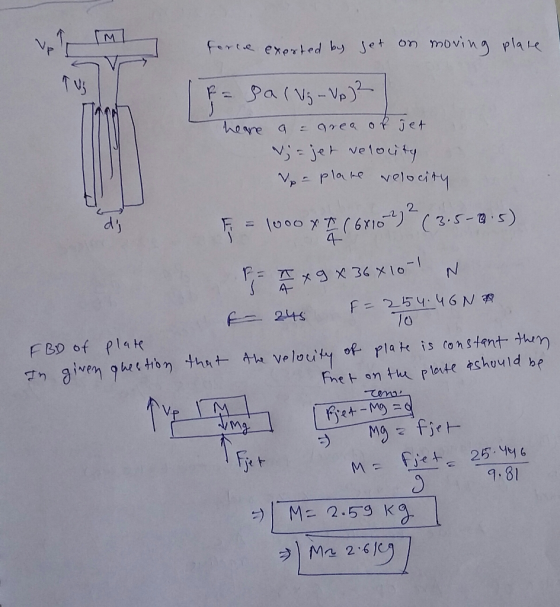
7- Water leaves a vertically-oriented jet of diameter dj and impinges on a plate as shown....
5.6 A 7.5 cm diameter jet of water is directed at a hole in a vertically...
 5.6 A 7.5 cm diameter jet of water is directed at a hole in a vertically supported plate Some of the water spreads as a film over the surface of the plate and the remainder leaves horizontally through the hole. The angle between the jet and the plate is 65° and the velocity within the jet is uniform and 10 m/s. Assume inviscid flow and neglect gravity forces. The density of water is 1000 kg/m a) What is the velocity...
A horizontal water jet impinges against the vertical back surface of a stationary cart. After striking...
A horizontal water jet impinges against the vertical back surface of a stationary cart. After striking the surface the water stream splatters off in all directions along the surface of the plate. The diameter of the nozzle exit is 6 cm and the water jet leaves the nozzle at 20 m/sec. If the mass of the cart is 400 kg and if there is no friction between its wheels and the ground calculate the acceleration of the cart when the...
13. A vertical jet of water leaves nozzle at speed of 10 m/s and diameter of...
 13. A vertical jet of water leaves nozzle at speed of 10 m/s and diameter of 20 mm. it suspends a plate having a mass of 1.5 kg as shown. What is the vertical distance h?
13. A vertical jet of water leaves nozzle at speed of 10 m/s and diameter of 20 mm. it suspends a plate having a mass of 1.5 kg as shown. What is the vertical distance h?
13. A vertical jet of water leaves nozzle at speed of 10 m/s and diameter of 20 mm. it suspends a plate having a mass of 1.5 kg as shown. What is the vertical distance h?
A water jet with a velocity of V; -8 m/s and jet diameter D; -10 cm...
 A water jet with a velocity of V; -8 m/s and jet diameter D; -10 cm impinges on a cup cavity. The water is turned 180° and exits, due to friction, at lower velocity of Ve= 4 m/s. Looking from the left, the exit jet is a circular annulus of outer radius (R) and thickness (h), flowing toward the viewer. The cup has a radius of curvature of R-10cm. Find the thickness of the exit jet (h=?cm) Oh=1.0 cm h...
A jet of water is shot vertically upward and hits a flat circular plate of mass...
 A jet of water is shot vertically upward and hits a flat
circular plate of mass M, as shown in the figure below. The
diameter of the exhaust is 5 in, the exhaust height is 5 ft, the
reservoir depth is 30 ft. If friction losses are neglected, the
flow rate (CFS) of the water exiting the jet is most nearly:
Reservoir Depth, Ft WATER RESERVOIR |4 Exhaust Diameter, in Exhaust Height Ft MASS DENSITY = ρ NOT TO SCALE
A jet of water is shot vertically upward and hits a flat
circular plate of mass M, as shown in the figure below. The
diameter of the exhaust is 5 in, the exhaust height is 5 ft, the
reservoir depth is 30 ft. If friction losses are neglected, the
flow rate (CFS) of the water exiting the jet is most nearly:
Reservoir Depth, Ft WATER RESERVOIR |4 Exhaust Diameter, in Exhaust Height Ft MASS DENSITY = ρ NOT TO SCALE
III A horizontal 4-cm-diameter jet of water strikes a vertical plate. Determine the velocity issuing from...
 III A horizontal 4-cm-diameter jet of water strikes a vertical plate. Determine the velocity issuing from the jet if a force of 700 N is needed to 1) Hold the plate stationary 2) Move the plate away from the jet at 8 m/s
Plate (30pts) A steady-state oil jet coming out of a nozzle with diameter D = 10...
 Plate (30pts) A steady-state oil jet coming out of a nozzle with diameter D = 10 cm at a velocity of 8 m/s strikes a circular plate (SGon=0.82). Determine the horizontal force F, in N, that is needed to hold the plate stationary. Neglect all effects of gravity and friction. Atmospheric pressure D; = 10 cm F Note: A control volume must be drawn and properly utilized in the solution for full credit. V;= 8 m/s
4. A water jet with a velocity of 20 m/s impacts on a splitter plate 50...
 4. A water jet with a velocity of 20 m/s impacts on a splitter plate 50 cm so that 1/5 of the water is deflected toward the bottom and 4/5 toward the top. The angle of the plate is 45 degree. Determine the force required to hold the plate stationary. Neglect the weight of the plate and water, and neglect viscous effects. A 0.1 m2 45°
A 6-cm-diameter vertical water jet is injected upward by a nozzle at a speed of 15...
 A 6-cm-diameter vertical water jet is injected upward by a nozzle at a speed of 15 m/s. Determine the maximum weight of a flat plate that can be supported by this water jet at a height of 2 m from the nozzle. Take the density of water to be 1000 kg/m3 The maximum weight of a flat plate that can be supported by the water jet is 52475 N. KPrev 8 of 8N
A 23-cm-diameter horizontal water jet with a speed of Vj = 20 m/s relative to the...
A 23-cm-diameter horizontal water jet with a speed of Vj = 20 m/s relative to the ground is deflected by a 40° cone moving to the left at Vc = 10 m/s. Determine the external force, F, needed to maintain the motion of the cone. Disregard the gravity and surface shear effects, and assume that the cross-sectional area of the water jet normal to the direction of motion remains constant throughout the flow. Take the density of water to be...
 5.6 A 7.5 cm diameter jet of water is directed at a hole in a vertically supported plate Some of the water spreads as a film over the surface of the plate and the remainder leaves horizontally through the hole. The angle between the jet and the plate is 65° and the velocity within the jet is uniform and 10 m/s. Assume inviscid flow and neglect gravity forces. The density of water is 1000 kg/m a) What is the velocity...
 13. A vertical jet of water leaves nozzle at speed of 10 m/s and diameter of 20 mm. it suspends a plate having a mass of 1.5 kg as shown. What is the vertical distance h?
13. A vertical jet of water leaves nozzle at speed of 10 m/s and diameter of 20 mm. it suspends a plate having a mass of 1.5 kg as shown. What is the vertical distance h?
13. A vertical jet of water leaves nozzle at speed of 10 m/s and diameter of 20 mm. it suspends a plate having a mass of 1.5 kg as shown. What is the vertical distance h?
 A water jet with a velocity of V; -8 m/s and jet diameter D; -10 cm impinges on a cup cavity. The water is turned 180° and exits, due to friction, at lower velocity of Ve= 4 m/s. Looking from the left, the exit jet is a circular annulus of outer radius (R) and thickness (h), flowing toward the viewer. The cup has a radius of curvature of R-10cm. Find the thickness of the exit jet (h=?cm) Oh=1.0 cm h...
 A jet of water is shot vertically upward and hits a flat
circular plate of mass M, as shown in the figure below. The
diameter of the exhaust is 5 in, the exhaust height is 5 ft, the
reservoir depth is 30 ft. If friction losses are neglected, the
flow rate (CFS) of the water exiting the jet is most nearly:
Reservoir Depth, Ft WATER RESERVOIR |4 Exhaust Diameter, in Exhaust Height Ft MASS DENSITY = ρ NOT TO SCALE
A jet of water is shot vertically upward and hits a flat
circular plate of mass M, as shown in the figure below. The
diameter of the exhaust is 5 in, the exhaust height is 5 ft, the
reservoir depth is 30 ft. If friction losses are neglected, the
flow rate (CFS) of the water exiting the jet is most nearly:
Reservoir Depth, Ft WATER RESERVOIR |4 Exhaust Diameter, in Exhaust Height Ft MASS DENSITY = ρ NOT TO SCALE
 III A horizontal 4-cm-diameter jet of water strikes a vertical plate. Determine the velocity issuing from the jet if a force of 700 N is needed to 1) Hold the plate stationary 2) Move the plate away from the jet at 8 m/s
 Plate (30pts) A steady-state oil jet coming out of a nozzle with diameter D = 10 cm at a velocity of 8 m/s strikes a circular plate (SGon=0.82). Determine the horizontal force F, in N, that is needed to hold the plate stationary. Neglect all effects of gravity and friction. Atmospheric pressure D; = 10 cm F Note: A control volume must be drawn and properly utilized in the solution for full credit. V;= 8 m/s
 4. A water jet with a velocity of 20 m/s impacts on a splitter plate 50 cm so that 1/5 of the water is deflected toward the bottom and 4/5 toward the top. The angle of the plate is 45 degree. Determine the force required to hold the plate stationary. Neglect the weight of the plate and water, and neglect viscous effects. A 0.1 m2 45°
 A 6-cm-diameter vertical water jet is injected upward by a nozzle at a speed of 15 m/s. Determine the maximum weight of a flat plate that can be supported by this water jet at a height of 2 m from the nozzle. Take the density of water to be 1000 kg/m3 The maximum weight of a flat plate that can be supported by the water jet is 52475 N. KPrev 8 of 8N
Most questions answered within 3 hours.
-
Where is the error in this code sequence?
String s1 = "Hello";
String s2 = "ello";...
asked 10 months ago -
Financial data for Joel de Paris, Inc., for last year
follow:
Joel de Paris, Inc.
Balance...
asked 10 months ago -
Consider this reaction:
Al2(SO4)3 (aq)+ BaCl3
(aq) Al2Cl6 (aq)- +
3BaSO4(s) . What is the...
asked 10 months ago -
Suppose that Savneet is considering increasing her
recent random sample from 20 car rentals to 40...
asked 10 months ago -
Trucks arrive at an unloading terminal at an average rate of 120
per hour.
Trucks arrive...
asked 10 months ago -
Why are methanol and ethanol completely soluble in water while
octanol is not very little soluble....
asked 10 months ago -
A facilities manager at a university reads in a research report
that the mean amount of...
asked 10 months ago -
When the CuSO4 is rehydrated by adding water to the anhydrous
compound, is this an endothermic...
asked 10 months ago -
A ray of sunlight is passing from diamond into crown glass; the
angle of incidence is...
asked 10 months ago -
A block of mass 0.249 kg is placed on top of a light, vertical
spring of...
asked 10 months ago -
how do the kidneys compensate in the presences of acidosis
a) trigger hyperventilate
b) reserve acid...
asked 10 months ago -
Question 501 pts
The rental rate of capital to the firm increases. Which of the
following...
asked 10 months ago