In the aromatic area of the proton NMR of methyl salicylate there is a doublet at 7.81 ppm. Which aromatic proton in the structure is responsible for this resonance?
In the aromatic area of the proton NMR of methyl salicylate there is a doublet at 7.81 ppm. Which aromatic proton in the structure is responsible for this resonance?

Homework Answers
The answer is attach below
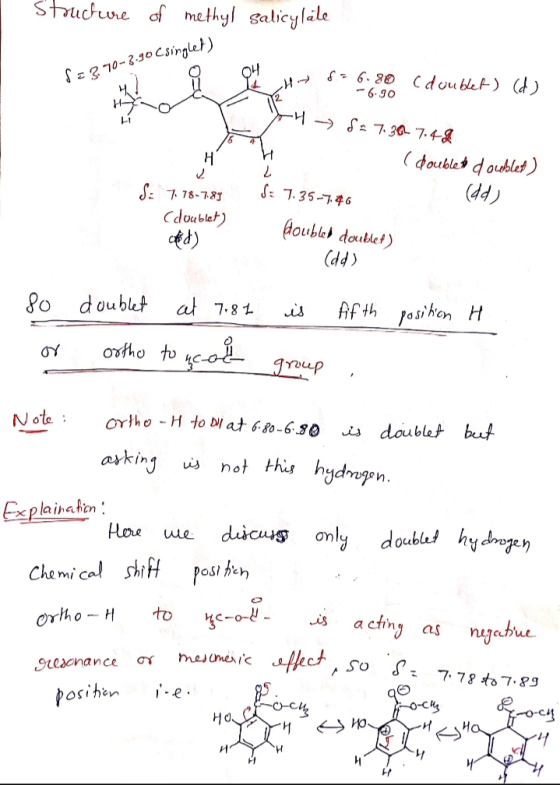
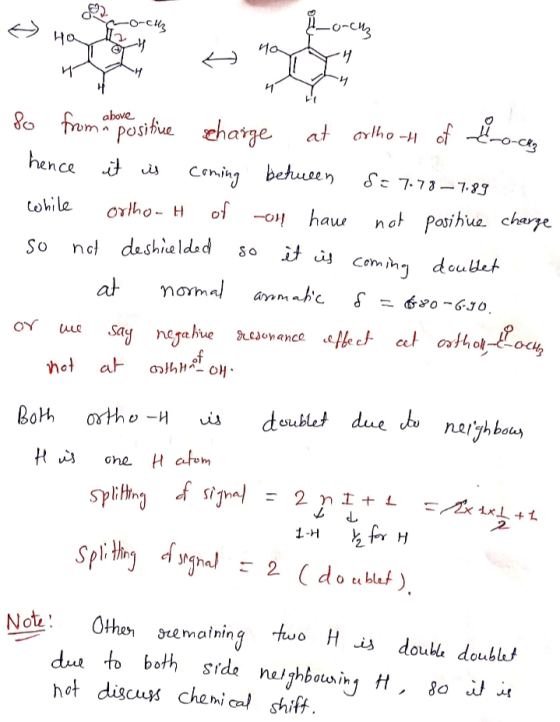
Hence ortho - H of H3C-O-C=O in the aromatic area of the proton NMR of methyl salicylate there is a doublet at 7.81 ppm.
Add Answer to:
In the aromatic area of the proton NMR of methyl salicylate there is a doublet at 7.81 ppm. Which aromatic proton in the structure is responsible for this resonance?
1.Which protons in methyl salicylate are resonsible for the resonance at 10.7 ppm? Which are responsible...
 1.Which protons in methyl salicylate are resonsible for the
resonance at 10.7 ppm? Which are responsible forthe resonance at
3.9 ppm?
2. Which carbon in methyl salicylate is respocsible for the
resonance at 170.6 ppm? Which is responsible for the resonance at
52.2 ppm?
3. In the aromatic area of the proton NMR of methyl salicylate
there is a doublet at 7.81 ppm. Which aromatic proton in the
structure is responsile for this resonance?
4. What is the major new...
1.Which protons in methyl salicylate are resonsible for the
resonance at 10.7 ppm? Which are responsible forthe resonance at
3.9 ppm?
2. Which carbon in methyl salicylate is respocsible for the
resonance at 170.6 ppm? Which is responsible for the resonance at
52.2 ppm?
3. In the aromatic area of the proton NMR of methyl salicylate
there is a doublet at 7.81 ppm. Which aromatic proton in the
structure is responsile for this resonance?
4. What is the major new...
Which proton(s) in methyl salicylate are responsible for the resonance at 10.7 ppm? Which are responsible for the resonance at 3.9 ppm?
 Which proton(s) in methyl salicylate are responsible for the resonance at 10.7 ppm? Which are responsible for the resonance at 3.9 ppm?
Which carbon in methyl salicylate is responsible for the resonance at 170.6 ppm? Which is responsible for the resonance at 52.2 ppm?
 Which carbon in methyl salicylate is responsible for the resonance at 170.6 ppm? Which is responsible for the resonance at 52.2 ppm?
1. In the H NMR of benzaldehyde, which proton is responsible for the resonance at 10.0...
 1. In the H NMR of benzaldehyde, which proton is responsible for
the resonance at 10.0 ppm? In the aromatic area there are three
sets of multiplets at 7.87, 7.61 and 7.51 that integrte for 2:1:2
protons respectively. Which protons are responsible for these
multiplets?
In the C NMR of benzaldehyde, which carbon is responsible for
the resonance at 192 ppm?
NMR Spectra H and C spectra of benzaldehyde and benzoin are shown below. CDCl 240 QE-300 180 220 160...
1. In the H NMR of benzaldehyde, which proton is responsible for
the resonance at 10.0 ppm? In the aromatic area there are three
sets of multiplets at 7.87, 7.61 and 7.51 that integrte for 2:1:2
protons respectively. Which protons are responsible for these
multiplets?
In the C NMR of benzaldehyde, which carbon is responsible for
the resonance at 192 ppm?
NMR Spectra H and C spectra of benzaldehyde and benzoin are shown below. CDCl 240 QE-300 180 220 160...
In the H1 NMR of isoamyl acetate, which protons are responsible for the triplet at 4.1 ppm? Which protons are responsible for the doublet at 0.93 ppm?
 In the H1 NMR of isoamyl acetate, which protons are responsible for the triplet at 4.1 ppm? Which protons are responsible for the doublet at 0.93 ppm?
Which carbon is responsible for the resonance at 172.2 ppm in the NMR of salicylic acid?
 Which carbon is responsible for the resonance at 172.2 ppm in the NMR of salicylic acid?
In the 13C NMR of isoamyl alcohol, which carbon is responsible for the resonance at 60.9 ppm? Which carbons are equivalent (give one signal) in the 13C NMR of isoamyl alcohol?
 In the 13C NMR of isoamyl alcohol, which carbon is responsible for the resonance at 60.9 ppm? Which carbons are equivalent (give one signal) in the 13C NMR of isoamyl alcohol?
2. Below are the aromatic regions for the proton NMR spectra for four isomers of dimethoxybenzaldehyde....
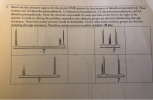 2. Below are the aromatic regions for the proton NMR spectra for four isomers of dimethoxybenzaldehyde. These isomers are: 2,4-dimethoxybenzaldehyde, 2,5-dimethoxybenzaldehyde, 2,6-dimethoxybenzaldehyde, and 3,4 dimethoxybenzaldehyde. Draw the structure responsible for each spectrum in the box to the right of the spectra. To help in solving this problem, remember that aldehyde groups are electron withdrawing through resonance. Therefore, nearby protons would be deshielded. On the other hand, methoxy groups are electron donating through resonance. Therefore, nearby protons would be shielded. (10...
Please find the unknown structure nmr for proton 5.0 PPM ル 14
 Please find the unknown structure nmr for proton
5.0 PPM ル 14
Please find the unknown structure nmr for proton
5.0 PPM ル 14
The room temperature proton NMR spectrum of cyclohexane shows a single resonance at ca. +1.43 ppm....
The room temperature proton NMR spectrum of cyclohexane shows a single resonance at ca. +1.43 ppm. As the temperature of the sample is lowered in the NMR probe this sharp signal broadens until -66 °C, then the signal splits into two signals that sharpen up on lowering to -100 °C with each set of signals showing a separate spin-spin coupling pattern. Explain the reasons for the above observations. Also, designate which are the equatorial and axial hydrogen at low temperature.
 1.Which protons in methyl salicylate are resonsible for the
resonance at 10.7 ppm? Which are responsible forthe resonance at
3.9 ppm?
2. Which carbon in methyl salicylate is respocsible for the
resonance at 170.6 ppm? Which is responsible for the resonance at
52.2 ppm?
3. In the aromatic area of the proton NMR of methyl salicylate
there is a doublet at 7.81 ppm. Which aromatic proton in the
structure is responsile for this resonance?
4. What is the major new...
1.Which protons in methyl salicylate are resonsible for the
resonance at 10.7 ppm? Which are responsible forthe resonance at
3.9 ppm?
2. Which carbon in methyl salicylate is respocsible for the
resonance at 170.6 ppm? Which is responsible for the resonance at
52.2 ppm?
3. In the aromatic area of the proton NMR of methyl salicylate
there is a doublet at 7.81 ppm. Which aromatic proton in the
structure is responsile for this resonance?
4. What is the major new...
 1. In the H NMR of benzaldehyde, which proton is responsible for
the resonance at 10.0 ppm? In the aromatic area there are three
sets of multiplets at 7.87, 7.61 and 7.51 that integrte for 2:1:2
protons respectively. Which protons are responsible for these
multiplets?
In the C NMR of benzaldehyde, which carbon is responsible for
the resonance at 192 ppm?
NMR Spectra H and C spectra of benzaldehyde and benzoin are shown below. CDCl 240 QE-300 180 220 160...
1. In the H NMR of benzaldehyde, which proton is responsible for
the resonance at 10.0 ppm? In the aromatic area there are three
sets of multiplets at 7.87, 7.61 and 7.51 that integrte for 2:1:2
protons respectively. Which protons are responsible for these
multiplets?
In the C NMR of benzaldehyde, which carbon is responsible for
the resonance at 192 ppm?
NMR Spectra H and C spectra of benzaldehyde and benzoin are shown below. CDCl 240 QE-300 180 220 160...
 2. Below are the aromatic regions for the proton NMR spectra for four isomers of dimethoxybenzaldehyde. These isomers are: 2,4-dimethoxybenzaldehyde, 2,5-dimethoxybenzaldehyde, 2,6-dimethoxybenzaldehyde, and 3,4 dimethoxybenzaldehyde. Draw the structure responsible for each spectrum in the box to the right of the spectra. To help in solving this problem, remember that aldehyde groups are electron withdrawing through resonance. Therefore, nearby protons would be deshielded. On the other hand, methoxy groups are electron donating through resonance. Therefore, nearby protons would be shielded. (10...
 Please find the unknown structure nmr for proton
5.0 PPM ル 14
Please find the unknown structure nmr for proton
5.0 PPM ル 14
Most questions answered within 3 hours.
-
Where is the error in this code sequence?
String s1 = "Hello";
String s2 = "ello";...
asked 11 months ago -
Financial data for Joel de Paris, Inc., for last year
follow:
Joel de Paris, Inc.
Balance...
asked 11 months ago -
Consider this reaction:
Al2(SO4)3 (aq)+ BaCl3
(aq) Al2Cl6 (aq)- +
3BaSO4(s) . What is the...
asked 11 months ago -
Suppose that Savneet is considering increasing her
recent random sample from 20 car rentals to 40...
asked 11 months ago -
Trucks arrive at an unloading terminal at an average rate of 120
per hour.
Trucks arrive...
asked 11 months ago -
Why are methanol and ethanol completely soluble in water while
octanol is not very little soluble....
asked 11 months ago -
A facilities manager at a university reads in a research report
that the mean amount of...
asked 11 months ago -
When the CuSO4 is rehydrated by adding water to the anhydrous
compound, is this an endothermic...
asked 11 months ago -
A ray of sunlight is passing from diamond into crown glass; the
angle of incidence is...
asked 11 months ago -
A block of mass 0.249 kg is placed on top of a light, vertical
spring of...
asked 11 months ago -
how do the kidneys compensate in the presences of acidosis
a) trigger hyperventilate
b) reserve acid...
asked 11 months ago -
Question 501 pts
The rental rate of capital to the firm increases. Which of the
following...
asked 11 months ago