I'm in serious need of help. I worked on the Qualitative Analysis of Cations Lab, Groups...
I'm in serious need of help. I worked on the Qualitative Analysis of Cations Lab, Groups I and II.
For group I, the possible Ions in a solution were Ag+1, Pb+2, Hg2+2. I was able to sucessfully percipitate out and confirm the presense of Silver.
For Group II, the possible Ions were Hg2+, PB2+, Bi2+, Cu2+.
The problem is I should have percipitated out three Cations and only found one. I know with certainty that I did not have Mercury at any time, as I never had a black percipitate in my solution, or left behind on the filtrate paper. I have a feeling that I acutally had Pb2+ in the group I, but the test tube I was using was old, and dirty so I may have mistaken cloudiness on my solution for an old test tube.
Based on this information, is there a way to determine what the possible Ions should habe been, knowing that I had AgCl?
Thanks!
Homework Answers
We know that Ag+ Pb+2 and Hg2+2 all the ions give ppt with HCl
Ag+ : it gives white ppt with HCl
Now due to dirty test tube you are getting confused with Pb and Ag
so just do one thing, add hot water to the precipitate, if it dissolves in it then it is PbCl2 ppt and not AgCl
If it is insoluble then it is not PbCl2 ppt.
Add Answer to:
I'm in serious need of help. I worked on the Qualitative
Analysis of Cations Lab, Groups...
Pre-Lab for Qualitative Analysis of Silver Group I Cations Lab 1. What are the ions that...
 Pre-Lab for Qualitative Analysis of Silver Group I Cations Lab 1. What are the ions that are considered Group I cations? 2. Based on the Activities Series of Elements, explain why Group I ions would form precipitates when a strong, concentrated acid (such as HCI) is added to them. 3. Pby, and K Cro, will react with each other to form a precipitate if the concentrations are high enough. Write the complete, balanced equation for the reaction of Pbs and...
Qualitative Analysis of Group I Cations: Precipitation and Separation of Group I lons Nam Partner's Name...
 Qualitative Analysis of Group I Cations: Precipitation and Separation of Group I lons Nam Partner's Name of any) Lab Section MWITH THE Advance Study Assignment 1. The reagent (chemical substance used) to precipitate the all the cations of Group _(symbol and molarity 2. Why do we add an additional drop of the precipitating to the Group I precipitate formed? 3. When we centrifuge why must we use a blank test tube (containing an equal volume of water) on the opposite...
I concluded that my unknown was Pb2+. since yellow precipitate formed. can you help me answer...
 I concluded that my unknown was Pb2+. since yellow
precipitate formed. can you help me answer the questions for the
Known and unknown report
Qualitative Analysis: Group I Cations 10 ORECTIVES A Leam some chemistry of Group I cations, R Analyze an unknown for Group I cations. THEORY AND DISCUSSION Group I cations are precipitated as insoluble chlorides: Ag, Pb, Hg2 +Cr-AgCl, PbCh, HgCla The colors of the following species will be helpful in the analysis for Group I cations....
I concluded that my unknown was Pb2+. since yellow
precipitate formed. can you help me answer the questions for the
Known and unknown report
Qualitative Analysis: Group I Cations 10 ORECTIVES A Leam some chemistry of Group I cations, R Analyze an unknown for Group I cations. THEORY AND DISCUSSION Group I cations are precipitated as insoluble chlorides: Ag, Pb, Hg2 +Cr-AgCl, PbCh, HgCla The colors of the following species will be helpful in the analysis for Group I cations....
Group I Cations A INTRODUCTION Most metal halides are soluble in water and dilute hydrochloric acid....
 Group I Cations A INTRODUCTION Most metal halides are soluble in water and dilute hydrochloric acid. The exceptions are silver ion, Ag mercurous ion, Hg,: and lead(II) ion, Pb. Consequently, the addition of HCI to a solution of metal cations leads to the selective precipitation of these three ions. While the theory behind the separation and identification of these ions has been outlined in the general discus- sion of the qualitative analysis scheme, some aspects of this chemistry need to...
I need help with questions 4 and 7 please 1 Cation Analysis Prelaboratory Questions DIXON No.2...
 I need help with questions 4 and 7 please
1 Cation Analysis Prelaboratory Questions DIXON No.2 HB 1. Ag, Hg2+, and Pb2+ belong to group I cations. What specific reaction do they all undergo? What is the distinctive observation for this reaction? The observation, that they will occur is that a white preciptate will form. They will react with dilluted HCl. 2. Describe the solubility of compounds AgCl, PbCl2, and HgCl, in a) room temperature water. AGCI PbCl₂ insluable HgzCl₂...
I need help with questions 4 and 7 please
1 Cation Analysis Prelaboratory Questions DIXON No.2 HB 1. Ag, Hg2+, and Pb2+ belong to group I cations. What specific reaction do they all undergo? What is the distinctive observation for this reaction? The observation, that they will occur is that a white preciptate will form. They will react with dilluted HCl. 2. Describe the solubility of compounds AgCl, PbCl2, and HgCl, in a) room temperature water. AGCI PbCl₂ insluable HgzCl₂...
I need help with the prelab and the flowchart. I’m totally clueless on the flowchart. For...
 I need help with the prelab and the flowchart. I’m totally
clueless on the flowchart.
For the prelab questions I have some answers but I don’t know
if they’re right. If they’re wrong, I would greatly appreciate an
explanation for the correct answer. I’m really trying to learn the
material but it’s hard now that classes are cancelled so I’m sorry
if these are dumb
1. PbCl ?
2. Ag+
3. ?
4. S1
Group 1, the Chloride Group BACKGROUND...
I need help with the prelab and the flowchart. I’m totally
clueless on the flowchart.
For the prelab questions I have some answers but I don’t know
if they’re right. If they’re wrong, I would greatly appreciate an
explanation for the correct answer. I’m really trying to learn the
material but it’s hard now that classes are cancelled so I’m sorry
if these are dumb
1. PbCl ?
2. Ag+
3. ?
4. S1
Group 1, the Chloride Group BACKGROUND...
I need help figuring out the flowchart and if I have the right answers for the...
 I need help figuring out the flowchart and if I have the right
answers for the prelab please and thank you!
Group I, the Chloride Group BACKGROUND The precipitating reagent for the chloride group is chloride ion in an acidic solution. Only three of the 18 metal ions form a precipitate with this reagent: silver ion (Ag'), mercury(I)ion (Hg). and lead ion (Pb). Since lead chloride is somewhat soluble, it is not completely precipitated here, and a low concentration of...
I need help figuring out the flowchart and if I have the right
answers for the prelab please and thank you!
Group I, the Chloride Group BACKGROUND The precipitating reagent for the chloride group is chloride ion in an acidic solution. Only three of the 18 metal ions form a precipitate with this reagent: silver ion (Ag'), mercury(I)ion (Hg). and lead ion (Pb). Since lead chloride is somewhat soluble, it is not completely precipitated here, and a low concentration of...
2 . Esther was given a blueish unknown Group III solution. She started her analysis by...
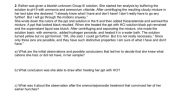 2 . Esther was given a blueish unknown Group III solution. She started her analysis by buffering the solution to pH 9 with ammonia and ammonium chloride. After centrifuging the resulting cloudy mixture in her test tube she declared: "I already know what I have and don't have! I don't really have to go any further! But I will go through the motions anyway. She wrote down the colors of the ppt and solution in the tt and then added...
Attached is the lab experiment. Here are the questions I need help with: 1. What is...
 Attached is the lab experiment. Here are the questions I need
help with:
1. What is the purpose of each of the following steps in this
experiment?
a. Adding solid NaCl to the reaction mixture
b. Repeated washings with water, sat'd NAHCO3, and brine
c. the pipet column chromatography
2. Which compound, cyclohexanol or cyclohexanone will have a
higher Rf on a TLC plate?
3. What is the advantage of using sodium hypochlorite as an
oxidant over CrO3 or Na2Cr2O7...
Attached is the lab experiment. Here are the questions I need
help with:
1. What is the purpose of each of the following steps in this
experiment?
a. Adding solid NaCl to the reaction mixture
b. Repeated washings with water, sat'd NAHCO3, and brine
c. the pipet column chromatography
2. Which compound, cyclohexanol or cyclohexanone will have a
higher Rf on a TLC plate?
3. What is the advantage of using sodium hypochlorite as an
oxidant over CrO3 or Na2Cr2O7...
How do I calculate the concentrations for my data sheet lab. I have not started my...
 How do I calculate the concentrations for my data sheet lab. I
have not started my lab yet but I just need to see how i would
calculate it with absorbance. Do i just use Beer's law or is there
any other method of solving the concentrations.
7. Weigh 1.45-1.55 g of copper(I) sulfate pentahydrate in a 50 mL beaker. 8. Dissolve the copper(II) sulfate pentahydrate in -15 mL of water 9. Add the aqueous solution of copper(II) to a...
How do I calculate the concentrations for my data sheet lab. I
have not started my lab yet but I just need to see how i would
calculate it with absorbance. Do i just use Beer's law or is there
any other method of solving the concentrations.
7. Weigh 1.45-1.55 g of copper(I) sulfate pentahydrate in a 50 mL beaker. 8. Dissolve the copper(II) sulfate pentahydrate in -15 mL of water 9. Add the aqueous solution of copper(II) to a...
 Pre-Lab for Qualitative Analysis of Silver Group I Cations Lab 1. What are the ions that are considered Group I cations? 2. Based on the Activities Series of Elements, explain why Group I ions would form precipitates when a strong, concentrated acid (such as HCI) is added to them. 3. Pby, and K Cro, will react with each other to form a precipitate if the concentrations are high enough. Write the complete, balanced equation for the reaction of Pbs and...
 Qualitative Analysis of Group I Cations: Precipitation and Separation of Group I lons Nam Partner's Name of any) Lab Section MWITH THE Advance Study Assignment 1. The reagent (chemical substance used) to precipitate the all the cations of Group _(symbol and molarity 2. Why do we add an additional drop of the precipitating to the Group I precipitate formed? 3. When we centrifuge why must we use a blank test tube (containing an equal volume of water) on the opposite...
 I concluded that my unknown was Pb2+. since yellow
precipitate formed. can you help me answer the questions for the
Known and unknown report
Qualitative Analysis: Group I Cations 10 ORECTIVES A Leam some chemistry of Group I cations, R Analyze an unknown for Group I cations. THEORY AND DISCUSSION Group I cations are precipitated as insoluble chlorides: Ag, Pb, Hg2 +Cr-AgCl, PbCh, HgCla The colors of the following species will be helpful in the analysis for Group I cations....
I concluded that my unknown was Pb2+. since yellow
precipitate formed. can you help me answer the questions for the
Known and unknown report
Qualitative Analysis: Group I Cations 10 ORECTIVES A Leam some chemistry of Group I cations, R Analyze an unknown for Group I cations. THEORY AND DISCUSSION Group I cations are precipitated as insoluble chlorides: Ag, Pb, Hg2 +Cr-AgCl, PbCh, HgCla The colors of the following species will be helpful in the analysis for Group I cations....
 Group I Cations A INTRODUCTION Most metal halides are soluble in water and dilute hydrochloric acid. The exceptions are silver ion, Ag mercurous ion, Hg,: and lead(II) ion, Pb. Consequently, the addition of HCI to a solution of metal cations leads to the selective precipitation of these three ions. While the theory behind the separation and identification of these ions has been outlined in the general discus- sion of the qualitative analysis scheme, some aspects of this chemistry need to...
 I need help with questions 4 and 7 please
1 Cation Analysis Prelaboratory Questions DIXON No.2 HB 1. Ag, Hg2+, and Pb2+ belong to group I cations. What specific reaction do they all undergo? What is the distinctive observation for this reaction? The observation, that they will occur is that a white preciptate will form. They will react with dilluted HCl. 2. Describe the solubility of compounds AgCl, PbCl2, and HgCl, in a) room temperature water. AGCI PbCl₂ insluable HgzCl₂...
I need help with questions 4 and 7 please
1 Cation Analysis Prelaboratory Questions DIXON No.2 HB 1. Ag, Hg2+, and Pb2+ belong to group I cations. What specific reaction do they all undergo? What is the distinctive observation for this reaction? The observation, that they will occur is that a white preciptate will form. They will react with dilluted HCl. 2. Describe the solubility of compounds AgCl, PbCl2, and HgCl, in a) room temperature water. AGCI PbCl₂ insluable HgzCl₂...
 I need help with the prelab and the flowchart. I’m totally
clueless on the flowchart.
For the prelab questions I have some answers but I don’t know
if they’re right. If they’re wrong, I would greatly appreciate an
explanation for the correct answer. I’m really trying to learn the
material but it’s hard now that classes are cancelled so I’m sorry
if these are dumb
1. PbCl ?
2. Ag+
3. ?
4. S1
Group 1, the Chloride Group BACKGROUND...
I need help with the prelab and the flowchart. I’m totally
clueless on the flowchart.
For the prelab questions I have some answers but I don’t know
if they’re right. If they’re wrong, I would greatly appreciate an
explanation for the correct answer. I’m really trying to learn the
material but it’s hard now that classes are cancelled so I’m sorry
if these are dumb
1. PbCl ?
2. Ag+
3. ?
4. S1
Group 1, the Chloride Group BACKGROUND...
 I need help figuring out the flowchart and if I have the right
answers for the prelab please and thank you!
Group I, the Chloride Group BACKGROUND The precipitating reagent for the chloride group is chloride ion in an acidic solution. Only three of the 18 metal ions form a precipitate with this reagent: silver ion (Ag'), mercury(I)ion (Hg). and lead ion (Pb). Since lead chloride is somewhat soluble, it is not completely precipitated here, and a low concentration of...
I need help figuring out the flowchart and if I have the right
answers for the prelab please and thank you!
Group I, the Chloride Group BACKGROUND The precipitating reagent for the chloride group is chloride ion in an acidic solution. Only three of the 18 metal ions form a precipitate with this reagent: silver ion (Ag'), mercury(I)ion (Hg). and lead ion (Pb). Since lead chloride is somewhat soluble, it is not completely precipitated here, and a low concentration of...
 2 . Esther was given a blueish unknown Group III solution. She started her analysis by buffering the solution to pH 9 with ammonia and ammonium chloride. After centrifuging the resulting cloudy mixture in her test tube she declared: "I already know what I have and don't have! I don't really have to go any further! But I will go through the motions anyway. She wrote down the colors of the ppt and solution in the tt and then added...
 Attached is the lab experiment. Here are the questions I need
help with:
1. What is the purpose of each of the following steps in this
experiment?
a. Adding solid NaCl to the reaction mixture
b. Repeated washings with water, sat'd NAHCO3, and brine
c. the pipet column chromatography
2. Which compound, cyclohexanol or cyclohexanone will have a
higher Rf on a TLC plate?
3. What is the advantage of using sodium hypochlorite as an
oxidant over CrO3 or Na2Cr2O7...
Attached is the lab experiment. Here are the questions I need
help with:
1. What is the purpose of each of the following steps in this
experiment?
a. Adding solid NaCl to the reaction mixture
b. Repeated washings with water, sat'd NAHCO3, and brine
c. the pipet column chromatography
2. Which compound, cyclohexanol or cyclohexanone will have a
higher Rf on a TLC plate?
3. What is the advantage of using sodium hypochlorite as an
oxidant over CrO3 or Na2Cr2O7...
 How do I calculate the concentrations for my data sheet lab. I
have not started my lab yet but I just need to see how i would
calculate it with absorbance. Do i just use Beer's law or is there
any other method of solving the concentrations.
7. Weigh 1.45-1.55 g of copper(I) sulfate pentahydrate in a 50 mL beaker. 8. Dissolve the copper(II) sulfate pentahydrate in -15 mL of water 9. Add the aqueous solution of copper(II) to a...
How do I calculate the concentrations for my data sheet lab. I
have not started my lab yet but I just need to see how i would
calculate it with absorbance. Do i just use Beer's law or is there
any other method of solving the concentrations.
7. Weigh 1.45-1.55 g of copper(I) sulfate pentahydrate in a 50 mL beaker. 8. Dissolve the copper(II) sulfate pentahydrate in -15 mL of water 9. Add the aqueous solution of copper(II) to a...
Most questions answered within 3 hours.
-
Where is the error in this code sequence?
String s1 = "Hello";
String s2 = "ello";...
asked 11 months ago -
Financial data for Joel de Paris, Inc., for last year
follow:
Joel de Paris, Inc.
Balance...
asked 11 months ago -
Consider this reaction:
Al2(SO4)3 (aq)+ BaCl3
(aq) Al2Cl6 (aq)- +
3BaSO4(s) . What is the...
asked 11 months ago -
Suppose that Savneet is considering increasing her
recent random sample from 20 car rentals to 40...
asked 11 months ago -
Trucks arrive at an unloading terminal at an average rate of 120
per hour.
Trucks arrive...
asked 11 months ago -
Why are methanol and ethanol completely soluble in water while
octanol is not very little soluble....
asked 11 months ago -
A facilities manager at a university reads in a research report
that the mean amount of...
asked 11 months ago -
When the CuSO4 is rehydrated by adding water to the anhydrous
compound, is this an endothermic...
asked 11 months ago -
A ray of sunlight is passing from diamond into crown glass; the
angle of incidence is...
asked 11 months ago -
A block of mass 0.249 kg is placed on top of a light, vertical
spring of...
asked 11 months ago -
how do the kidneys compensate in the presences of acidosis
a) trigger hyperventilate
b) reserve acid...
asked 11 months ago -
Question 501 pts
The rental rate of capital to the firm increases. Which of the
following...
asked 11 months ago