After the addition of aqueous acid, the product, vanillyl alcohol, precipitates out of the solution. Draw...
After the addition of aqueous acid, the product, vanillyl alcohol, precipitates out of the solution. Draw the structure of vanillyl alcohol. Explain why the alcohol is much less soluble in aqueous acid than the salt of vanillin.
Homework Answers

Add Answer to:
After the addition of aqueous acid, the product, vanillyl
alcohol, precipitates out of the solution. Draw...
In retrieving the compound (benzoic acid) from the aqueous phase, what is the reason for having...
In retrieving the compound (benzoic acid) from the aqueous phase, what is the reason for having precipitation after adding HCl in the aqueous phase? A) Carboxylate salt is less soluble in acid, so it forms precipitate after adding HCl. B) NaCl is formed after adding in HCl, and it is the precipitate. C) Carboxylate salt is neutralized after adding HCl, becomes less soluble in water and precipitates out.
Explain why benzocaine precipitates out of solution when a pH of 8 is achieved? Hint: It...
 Explain why benzocaine precipitates out of solution when a pH of 8 is achieved? Hint: It might be easier to approach this question from the other point of view - why is the benzocaine soluble in water before a pH of 8 is achieved? As part of the answer to this question, you must show me how benzocaine looks at an acidic pH and explain the relevance of this structure. In the box provided, draw what benzocaine looks like at...
1. Alcohol [1] is added to an aqueous solution of sulfuric acid, H,SO4. The solution was...
 1. Alcohol [1] is added to an aqueous solution of sulfuric acid, H,SO4. The solution was then heated. The product was purified to determine its structure. It was found that the product was alkene [2]. Draw the mechanism of the reaction. Show all steps with curved arrows that are necessary to form the product alkene [2]. OH H 0H H heat [2] [1] Consider the following reaction. A. Draw the mechanism of the reaction to predict ALL constitutional products. Show...
(2) After the addition of benzophenone to the mixture of bromobenzene and magnesium in diethyl ether,...
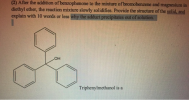 (2) After the addition of benzophenone to the mixture of bromobenzene and magnesium in diethyl ether, the reaction mixture slowly solidifies. Provide the structure of the solid, and explain with 10 words or less why the adduct precipitates out of solution. OH Triphenylmethanol is a
t ion The addition of an alcohol to an acid chloride is an example of alcoholysis (alcohol addition with bond brea...
 t ion The addition of an alcohol to an acid chloride is an example of alcoholysis (alcohol addition with bond breakage). Consider the acoholysi below and answer the questions that follow. ath attempt 4th attempt Part 1 (1 point) See Periodic Table O See Hi Show the tetrahedral intermediate that is formed after the nucleophilic addition of the alcohol to the acid chloride. Be sure to include all lone pair electrons and formal charges on your intermediate structure. 11/10/19 Part...
2. A structure of Luminol is shown with all functional groups protonated and their pka labeled....
 2. A structure of Luminol is shown with all functional groups protonated and their pka labeled. Use words and structures to answer a and b. Luminol pke 2 9 a. Acetic acid was added at the end of the reduction step to obtain a pH of - 3-4.2pts i. Draw the structure of the luminol at pH 3. ii. Refering to the structure in a.i.), explain why the luminol precipitates from the aqueous solution at this pH. NH₂ NH N-H...
An aqueous solution contains 0.376 M ammonia. Calculate the pH of the solution after the addition...
 An aqueous solution contains 0.376 M ammonia. Calculate the pH of the solution after the addition of 5.69x10⁻² moles of hydrobromic acid to 255 mL of this solution. (Assume that the volume does not change upon adding hydrobromic acid.) pH =
An aqueous solution contains 0.342 M ammonia. Calculate the pH of the solution after the addition...
 An aqueous solution contains 0.342 M ammonia. Calculate the pH of the solution after the addition of 5.28*10*2 moles of hydrochloric acid to 255 mL of this solution. (Assume that the volume does not change upon adding hydrochloric acid.) pH
An aqueous solution contains 0.422 M ammonia. Calculate the pH of the solution after the addition...
 An aqueous solution contains 0.422 M ammonia. Calculate the pH of the solution after the addition of 3.60x10⁻² moles of hydroiodic acid to 155 mL of this solution. (Assume that the volume does not change upon adding hydroiodic acid.) 2re pH-
An aqueous solution contains 0.377 M ammonia. Calculate the pH of the solution after the addition...
 An aqueous solution contains 0.377 M ammonia. Calculate the pH of the solution after the addition of 3.87*10-2 moles of hydroiodic acid to 225 mL of this solution. (Assume that the volume does not change upon adding hydroiodic acid.) pH =
 Explain why benzocaine precipitates out of solution when a pH of 8 is achieved? Hint: It might be easier to approach this question from the other point of view - why is the benzocaine soluble in water before a pH of 8 is achieved? As part of the answer to this question, you must show me how benzocaine looks at an acidic pH and explain the relevance of this structure. In the box provided, draw what benzocaine looks like at...
 1. Alcohol [1] is added to an aqueous solution of sulfuric acid, H,SO4. The solution was then heated. The product was purified to determine its structure. It was found that the product was alkene [2]. Draw the mechanism of the reaction. Show all steps with curved arrows that are necessary to form the product alkene [2]. OH H 0H H heat [2] [1] Consider the following reaction. A. Draw the mechanism of the reaction to predict ALL constitutional products. Show...
 (2) After the addition of benzophenone to the mixture of bromobenzene and magnesium in diethyl ether, the reaction mixture slowly solidifies. Provide the structure of the solid, and explain with 10 words or less why the adduct precipitates out of solution. OH Triphenylmethanol is a
 t ion The addition of an alcohol to an acid chloride is an example of alcoholysis (alcohol addition with bond breakage). Consider the acoholysi below and answer the questions that follow. ath attempt 4th attempt Part 1 (1 point) See Periodic Table O See Hi Show the tetrahedral intermediate that is formed after the nucleophilic addition of the alcohol to the acid chloride. Be sure to include all lone pair electrons and formal charges on your intermediate structure. 11/10/19 Part...
 2. A structure of Luminol is shown with all functional groups protonated and their pka labeled. Use words and structures to answer a and b. Luminol pke 2 9 a. Acetic acid was added at the end of the reduction step to obtain a pH of - 3-4.2pts i. Draw the structure of the luminol at pH 3. ii. Refering to the structure in a.i.), explain why the luminol precipitates from the aqueous solution at this pH. NH₂ NH N-H...
 An aqueous solution contains 0.376 M ammonia. Calculate the pH of the solution after the addition of 5.69x10⁻² moles of hydrobromic acid to 255 mL of this solution. (Assume that the volume does not change upon adding hydrobromic acid.) pH =
 An aqueous solution contains 0.342 M ammonia. Calculate the pH of the solution after the addition of 5.28*10*2 moles of hydrochloric acid to 255 mL of this solution. (Assume that the volume does not change upon adding hydrochloric acid.) pH
 An aqueous solution contains 0.422 M ammonia. Calculate the pH of the solution after the addition of 3.60x10⁻² moles of hydroiodic acid to 155 mL of this solution. (Assume that the volume does not change upon adding hydroiodic acid.) 2re pH-
 An aqueous solution contains 0.377 M ammonia. Calculate the pH of the solution after the addition of 3.87*10-2 moles of hydroiodic acid to 225 mL of this solution. (Assume that the volume does not change upon adding hydroiodic acid.) pH =
Most questions answered within 3 hours.
-
Where is the error in this code sequence?
String s1 = "Hello";
String s2 = "ello";...
asked 11 months ago -
Financial data for Joel de Paris, Inc., for last year
follow:
Joel de Paris, Inc.
Balance...
asked 11 months ago -
Consider this reaction:
Al2(SO4)3 (aq)+ BaCl3
(aq) Al2Cl6 (aq)- +
3BaSO4(s) . What is the...
asked 11 months ago -
Suppose that Savneet is considering increasing her
recent random sample from 20 car rentals to 40...
asked 11 months ago -
Trucks arrive at an unloading terminal at an average rate of 120
per hour.
Trucks arrive...
asked 11 months ago -
Why are methanol and ethanol completely soluble in water while
octanol is not very little soluble....
asked 11 months ago -
A facilities manager at a university reads in a research report
that the mean amount of...
asked 11 months ago -
When the CuSO4 is rehydrated by adding water to the anhydrous
compound, is this an endothermic...
asked 11 months ago -
A ray of sunlight is passing from diamond into crown glass; the
angle of incidence is...
asked 11 months ago -
A block of mass 0.249 kg is placed on top of a light, vertical
spring of...
asked 11 months ago -
how do the kidneys compensate in the presences of acidosis
a) trigger hyperventilate
b) reserve acid...
asked 11 months ago -
Question 501 pts
The rental rate of capital to the firm increases. Which of the
following...
asked 11 months ago