


Homework Answers
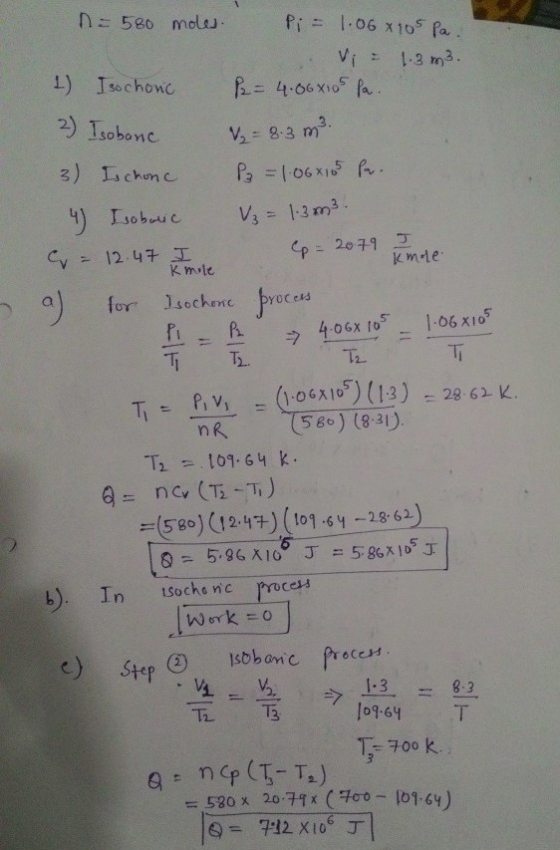

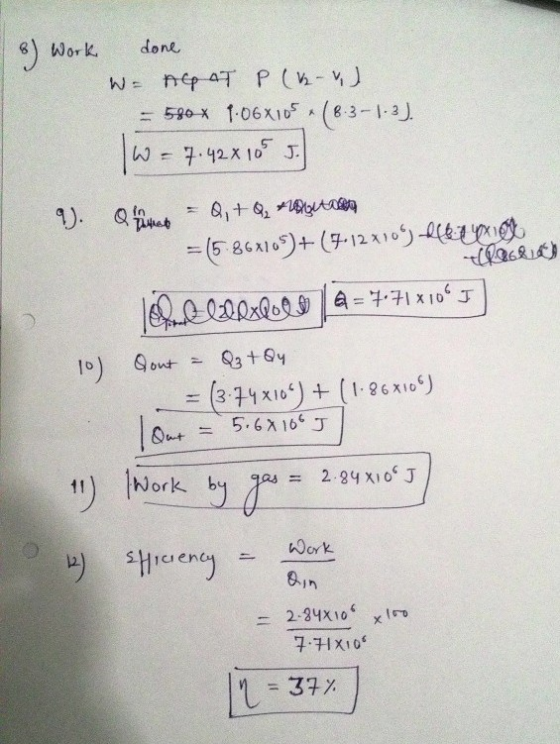
11) Work Done = Qin - Qout = 2.11 * 106 J
12) Efficiency = work/ Qin = (2.11*106) / ( 7.71 * 106)
= 0.27 or 27 %
Add Answer to:
A piston contains 580 moles of an ideal monatomic gas that initally has a pressure of...
A piston contains 600 moles of an ideal monatomic gas that initally has a pressure of...
 A piston contains 600 moles of an ideal monatomic gas that initally has a pressure of 2.35 x 10 Pa and a volume of 1.8 m5. The piston is connected to a hot and cold reservoir and the gas goes through the following quasi-static cycle accepting energy from the hot reservoir and exhausting energy into the cold reservoir 1. The pressure of the gas is increased to 5.35 x 10⁵ Pa while maintaining a constant volume. 2. The volume of...
Rectangular PV Cycle 1 2 3 4 A piston contains 600 moles of an ideal monatomic...
 Rectangular PV Cycle 1 2 3 4 A piston contains 600 moles of an ideal monatomic gas that initally has a pressure of 2.31 x 10 Pa and a volume of 3.8 m'. The piston is connected to a hot and cold reservoir and the gas goes through the following quasi-static cycle accepting energy from the hot reservoir and exhausting energy into the cold reservoir. 1. The pressure of the gas is increased to 5.31 x 10⁹ Pa while maintaining...
Suppose that 292 moles of a monatomic ideal gas is initially contained in a piston with...
Suppose that 292 moles of a monatomic ideal gas is initially contained in a piston with a volume of 1.34 m3 at a temperature of 588 K. The piston is connected to a hot reservoir with a temperature of 1385 K and a cold reservoir with a temperature of 588 K. The gas undergoes a quasi-static Stirling cycle with the following steps: The temperature of the gas is increased to 1385 K while maintaining a constant volume. The volume of...
A cylinder with a movable piston contains 11.7 moles of a monatomic ideal gas at a...
 A cylinder with a movable piston contains 11.7 moles of a
monatomic ideal gas at a pressure of 1.32 × 10⁵ Pa. The gas is
initially at a temperature of 300 K. An electric heater adds 43200
J of energy into the gas while the piston moves in such a way that
the pressure remains constant. It may help you to recall that CP C
P = 20.79 J/K/mole for a monatomic ideal gas, and that the number
of gas...
A cylinder with a movable piston contains 11.7 moles of a
monatomic ideal gas at a pressure of 1.32 × 10⁵ Pa. The gas is
initially at a temperature of 300 K. An electric heater adds 43200
J of energy into the gas while the piston moves in such a way that
the pressure remains constant. It may help you to recall that CP C
P = 20.79 J/K/mole for a monatomic ideal gas, and that the number
of gas...
A cylinder with a movable piston contains 17.5 moles of a monatomic ideal gas at a...
A cylinder with a movable piston contains 17.5 moles of a monatomic ideal gas at a pressure of 1.66 × 10⁵ Pa. The gas is initially at a temperature of 300 K. An electric heater adds 46600 J of energy into the gas while the piston moves in such a way that the pressure remains constant. It may help you to recall that CPCP = 20.79 J/K/mole for a monatomic ideal gas, and that the number of gas molecules is...
Please help solving it Constant P h a movable piston contains 12.1 moles of a monatomic...
 Please help solving it
Constant P h a movable piston contains 12.1 moles of a monatomic ideal gas at a pressure of 1.52 x 10⁵ Pa. The gas is piston moves in s e for a monatomic ideal uch initially at a temperature of 300 K. An electric heater adds 45200 J of energy into the gas while the a way that the pressure remains constant. It may help you to recall that Cp 20.79 J/K/mol 8as, and that the...
Please help solving it
Constant P h a movable piston contains 12.1 moles of a monatomic ideal gas at a pressure of 1.52 x 10⁵ Pa. The gas is piston moves in s e for a monatomic ideal uch initially at a temperature of 300 K. An electric heater adds 45200 J of energy into the gas while the a way that the pressure remains constant. It may help you to recall that Cp 20.79 J/K/mol 8as, and that the...
A tank with a constant volume of 5.89 m3 contains 15 moles of a monatomic ideal...
A tank with a constant volume of 5.89 m3 contains 15 moles of a monatomic ideal gas. The gas is initially at a temperature of 300 K. An electric heater is used to transfer 56500 J of energy into the gas. It may help you to recall that CVCV = 12.47 J/K/mole for a monatomic ideal gas, and that the number of gas molecules is equal to Avagadros number (6.022 × 10²³) times the number of moles of the gas....
(1) An ideal monatomic gas expands isothermally from 0.600 m3 to 1.25 m3 at a constant...
(1) An ideal monatomic gas expands isothermally from 0.600 m3 to 1.25 m3 at a constant temperature of 640 K. If the initial pressure is 1.01 ✕ 105 Pa find the following. (a) the work done on the gas J (b) the thermal energy transfer Q J (c) the change in the internal energy J (2) Gas in a container is at a pressure of 1.2 atm and a volume of 5.0 m3. (a) What is the work done on...
All parts of this question pertain to a monatomic ideal gas, initially at T=300K and atmospheric...
All parts of this question pertain to a monatomic ideal gas, initially at T=300K and atmospheric pressure (1.01× 10⁵ Pa). There is 1.0 mole of this gas is inside a cylinder with a sliding piston and interior diameter of 20cm. The piston can slide with negligible friction and without allowing any gas to enter or escape. For ideal gas calculations use R= 8.314 J/mol·K. a) What is the initial height of the piston? b) Now imagine that burner is placed...
Five moles of monatomic ideal gas have initial pressure 2.50 × 10³ Pa and initial volume...
Five moles of monatomic ideal gas have initial pressure 2.50 × 10³ Pa and initial volume 2.10 m3. While undergoing an adiabatic expansion, the gas does 1780 J of work. What is the final pressure of the gas after the expansion? (kPa)
 A piston contains 600 moles of an ideal monatomic gas that initally has a pressure of 2.35 x 10 Pa and a volume of 1.8 m5. The piston is connected to a hot and cold reservoir and the gas goes through the following quasi-static cycle accepting energy from the hot reservoir and exhausting energy into the cold reservoir 1. The pressure of the gas is increased to 5.35 x 10⁵ Pa while maintaining a constant volume. 2. The volume of...
 Rectangular PV Cycle 1 2 3 4 A piston contains 600 moles of an ideal monatomic gas that initally has a pressure of 2.31 x 10 Pa and a volume of 3.8 m'. The piston is connected to a hot and cold reservoir and the gas goes through the following quasi-static cycle accepting energy from the hot reservoir and exhausting energy into the cold reservoir. 1. The pressure of the gas is increased to 5.31 x 10⁹ Pa while maintaining...
 A cylinder with a movable piston contains 11.7 moles of a
monatomic ideal gas at a pressure of 1.32 × 10⁵ Pa. The gas is
initially at a temperature of 300 K. An electric heater adds 43200
J of energy into the gas while the piston moves in such a way that
the pressure remains constant. It may help you to recall that CP C
P = 20.79 J/K/mole for a monatomic ideal gas, and that the number
of gas...
A cylinder with a movable piston contains 11.7 moles of a
monatomic ideal gas at a pressure of 1.32 × 10⁵ Pa. The gas is
initially at a temperature of 300 K. An electric heater adds 43200
J of energy into the gas while the piston moves in such a way that
the pressure remains constant. It may help you to recall that CP C
P = 20.79 J/K/mole for a monatomic ideal gas, and that the number
of gas...
 Please help solving it
Constant P h a movable piston contains 12.1 moles of a monatomic ideal gas at a pressure of 1.52 x 10⁵ Pa. The gas is piston moves in s e for a monatomic ideal uch initially at a temperature of 300 K. An electric heater adds 45200 J of energy into the gas while the a way that the pressure remains constant. It may help you to recall that Cp 20.79 J/K/mol 8as, and that the...
Please help solving it
Constant P h a movable piston contains 12.1 moles of a monatomic ideal gas at a pressure of 1.52 x 10⁵ Pa. The gas is piston moves in s e for a monatomic ideal uch initially at a temperature of 300 K. An electric heater adds 45200 J of energy into the gas while the a way that the pressure remains constant. It may help you to recall that Cp 20.79 J/K/mol 8as, and that the...
Most questions answered within 3 hours.
-
Where is the error in this code sequence?
String s1 = "Hello";
String s2 = "ello";...
asked 11 months ago -
Financial data for Joel de Paris, Inc., for last year
follow:
Joel de Paris, Inc.
Balance...
asked 11 months ago -
Consider this reaction:
Al2(SO4)3 (aq)+ BaCl3
(aq) Al2Cl6 (aq)- +
3BaSO4(s) . What is the...
asked 11 months ago -
Suppose that Savneet is considering increasing her
recent random sample from 20 car rentals to 40...
asked 11 months ago -
Trucks arrive at an unloading terminal at an average rate of 120
per hour.
Trucks arrive...
asked 11 months ago -
Why are methanol and ethanol completely soluble in water while
octanol is not very little soluble....
asked 11 months ago -
A facilities manager at a university reads in a research report
that the mean amount of...
asked 11 months ago -
When the CuSO4 is rehydrated by adding water to the anhydrous
compound, is this an endothermic...
asked 11 months ago -
A ray of sunlight is passing from diamond into crown glass; the
angle of incidence is...
asked 11 months ago -
A block of mass 0.249 kg is placed on top of a light, vertical
spring of...
asked 11 months ago -
how do the kidneys compensate in the presences of acidosis
a) trigger hyperventilate
b) reserve acid...
asked 11 months ago -
Question 501 pts
The rental rate of capital to the firm increases. Which of the
following...
asked 11 months ago