
Homework Answers
Add Answer to:
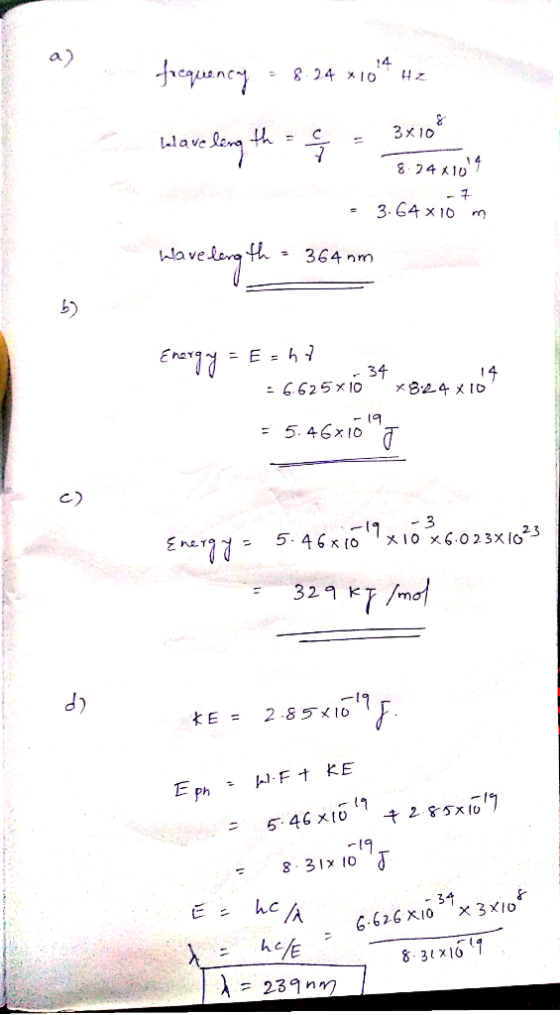
(12 points) An atom will emit an electron when it is struck by light with a...
A helium atom has two electrons, let us call them electron 1 and 2. Suppose electron...
 A helium atom has two electrons, let us call them electron 1 and 2. Suppose electron 1 is in the ground state and electron 2 is in the first excited state. 1. Calculate the minimum energies (in eV) of photons needed to eject each electron out of the atom. [5 points) 2. Draw an energy level diagram for a helium atom and indicate the transitions in part 1. You do not need to calculate the energies of various energy levels....
Be3+ is a one-electron ion. It is a beryllium atom that has lost 3 of its...
Be3+ is a one-electron ion. It is a beryllium atom that has lost 3 of its electrons. Minimum energy of a photon that would ionize this ion= -217.6 eV The wavelength of the photon that would excite Be3+ from its ground state to its first excited state= 7.56 nm Calculate the kinetic energy of the photoelectrons if radiation of 4.0 nm of wavelength falls on an ensemble of Be3+ ions.
Molybdenum metal must absorb radiation with a minimum frequency of 1.09×10^15 s^−1 before it can emit...
Molybdenum metal must absorb radiation with a minimum frequency of 1.09×10^15 s^−1 before it can emit an electron from its surface via the photoelectric effect. 1. What is the minimum energy needed to produce this effect? E = _______ J 2. What wavelength radiation will provide a photon of this energy? λ = ________ nm 3. If molybdenum is irradiated with light of wavelength of 120 nm, what is the maximum possible kinetic energy of the emitted electrons? E =...
How many different energies of light are emitted from an H atom with the electron in...
How many different energies of light are emitted from an H atom with the electron in the n=4 energy shell? Group of answer choices a. 3 b. 4 c. 5 d. 6 2.. Would a photon of visible light (photons with wavelengths = 400 - 700 nm) have sufficient energy to excite an electron in a hydrogen atom from n = 1 to n = 5? NOTE: You'll need to calculate how much energy is required for the transition from...
05 Question (4 points) When a hydrogen atom absorbs a photon of electromagnetic radiation (EMR), the...
 05 Question (4 points) When a hydrogen atom absorbs a photon of electromagnetic radiation (EMR), the internal energy of the atom increases and one or more electrons may be energized into an excited state. The release of this extra energy as the excited state electron transitions back to a lower energy state results in the emission of a photon. These energy changes are responsible for the emission spectrum of hydrogen (shown below) and are described by the Bohr equation. AE...
What is the binding energy of an electron that requires a photon with a maximum wavelength...
What is the binding energy of an electron that requires a photon with a maximum wavelength of 430 nm to eject it? If a photon with a frequency of 8.21 x 10¹⁵ Hz is used, what is the kinetic energy of the electron?
Un 5.2 H ) Which of light in the range of visible light has the highest...
 Un 5.2 H ) Which of light in the range of visible light has the highest energy? Why? The y required to ionize one mole of lithium atoms in the gas phase is about 520. kl What frequency should one mole of photons have in order to ionize one mole of lithium gas atoms? emitted by the transition from the n - 4 to the n. 2 of a 6. What is the energy of a photon in hydrogen atom?...
1. What is the wavelength, in nanometers, of light with a frequency of 1.25×10¹⁵ Hz? ________nm...
1. What is the wavelength, in nanometers, of light with a frequency of 1.25×10¹⁵ Hz? ________nm 2. Some chemical reactions, such as formation of ozone in Earth’s stratosphere, can be initiated by light that has a wavelength less than some particular value. Calculate the longest wavelength (nm) that can provide an energy of at least 374 kJ/mol. _______ nm 3.An energy of 6.8 X 10^-19 J/atom is required to cause an aluminum atom on a metal surface to lose an...
When a fast electron (i.e., one moving at a relativistic speed) passes by a heavy atom,...
 When a fast electron (i.e., one moving at a relativistic speed) passes by a heavy atom, it interacts with the atom's electric field. As a result, the electron's kinetic energy is reduced, the electron slows down in the meantime, a photon of light is emitted. The kinetic energy lost by the electron equals the energy E_r of a photon of radiated light. E = K - K', where K and K' are the kinetic energies of the electron before and...
1.. Suppose that you shine light of energy 1050 kJ/mol on an H atom in the...
1.. Suppose that you shine light of energy 1050 kJ/mol on an H atom in the ground state. What happens to the light and to the electron? Group of answer choices a. The light is not absorbed and the final energy of the electron is -1312 kJ/mol. b.. The light is absorbed and the final energy of the electron is −328 kJ/mol. c.. The light is not absorbed and the final energy of the electron is −1050 kJ/mol. d.. The...
 A helium atom has two electrons, let us call them electron 1 and 2. Suppose electron 1 is in the ground state and electron 2 is in the first excited state. 1. Calculate the minimum energies (in eV) of photons needed to eject each electron out of the atom. [5 points) 2. Draw an energy level diagram for a helium atom and indicate the transitions in part 1. You do not need to calculate the energies of various energy levels....
 05 Question (4 points) When a hydrogen atom absorbs a photon of electromagnetic radiation (EMR), the internal energy of the atom increases and one or more electrons may be energized into an excited state. The release of this extra energy as the excited state electron transitions back to a lower energy state results in the emission of a photon. These energy changes are responsible for the emission spectrum of hydrogen (shown below) and are described by the Bohr equation. AE...
 Un 5.2 H ) Which of light in the range of visible light has the highest energy? Why? The y required to ionize one mole of lithium atoms in the gas phase is about 520. kl What frequency should one mole of photons have in order to ionize one mole of lithium gas atoms? emitted by the transition from the n - 4 to the n. 2 of a 6. What is the energy of a photon in hydrogen atom?...
 When a fast electron (i.e., one moving at a relativistic speed) passes by a heavy atom, it interacts with the atom's electric field. As a result, the electron's kinetic energy is reduced, the electron slows down in the meantime, a photon of light is emitted. The kinetic energy lost by the electron equals the energy E_r of a photon of radiated light. E = K - K', where K and K' are the kinetic energies of the electron before and...
Most questions answered within 3 hours.
-
Where is the error in this code sequence?
String s1 = "Hello";
String s2 = "ello";...
asked 10 months ago -
Financial data for Joel de Paris, Inc., for last year
follow:
Joel de Paris, Inc.
Balance...
asked 10 months ago -
Consider this reaction:
Al2(SO4)3 (aq)+ BaCl3
(aq) Al2Cl6 (aq)- +
3BaSO4(s) . What is the...
asked 10 months ago -
Suppose that Savneet is considering increasing her
recent random sample from 20 car rentals to 40...
asked 10 months ago -
Trucks arrive at an unloading terminal at an average rate of 120
per hour.
Trucks arrive...
asked 10 months ago -
Why are methanol and ethanol completely soluble in water while
octanol is not very little soluble....
asked 10 months ago -
A facilities manager at a university reads in a research report
that the mean amount of...
asked 10 months ago -
When the CuSO4 is rehydrated by adding water to the anhydrous
compound, is this an endothermic...
asked 10 months ago -
A ray of sunlight is passing from diamond into crown glass; the
angle of incidence is...
asked 10 months ago -
A block of mass 0.249 kg is placed on top of a light, vertical
spring of...
asked 10 months ago -
how do the kidneys compensate in the presences of acidosis
a) trigger hyperventilate
b) reserve acid...
asked 10 months ago -
Question 501 pts
The rental rate of capital to the firm increases. Which of the
following...
asked 10 months ago