In the following transformations:
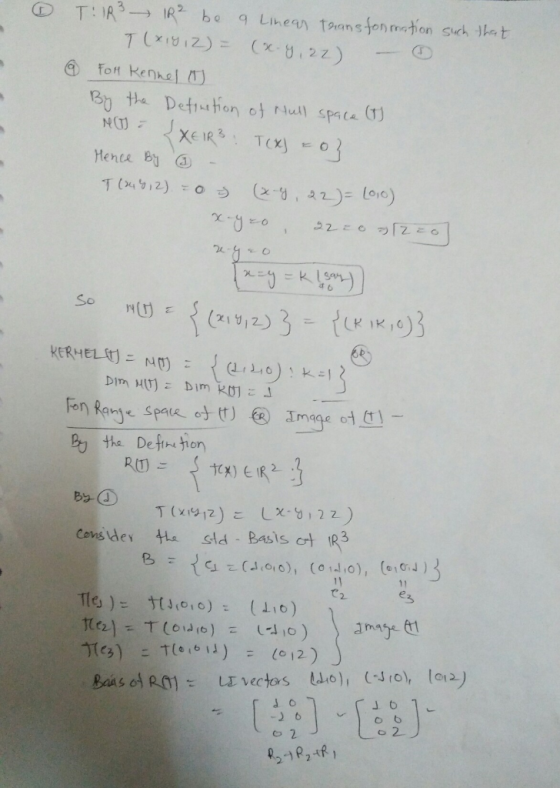
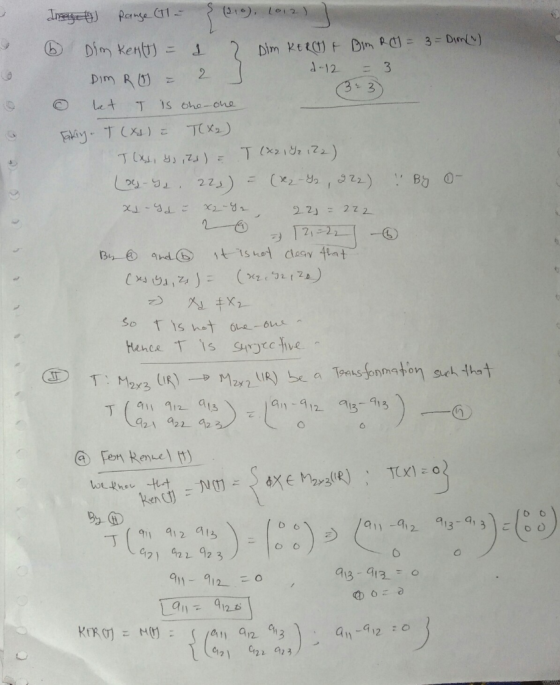
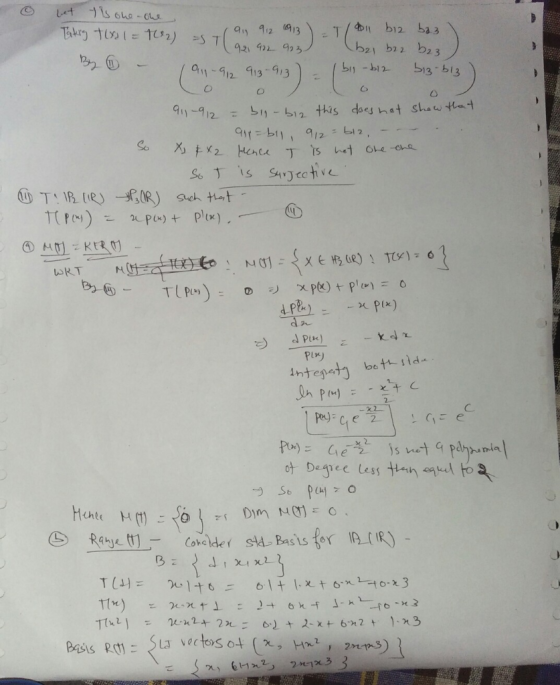
a)Find the Kernel and Image
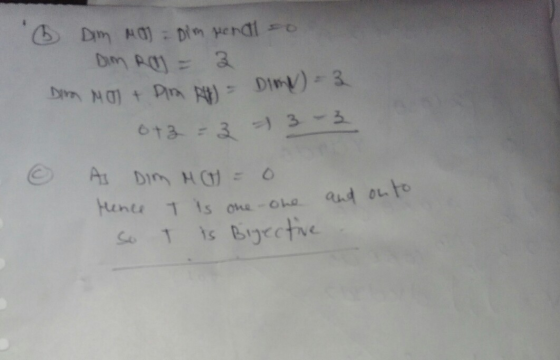
b)Find dimK(T) and dimI(T) and show that dimK(T)+dimi(T)=dimV
c)say if the transformations are injective, suprajective or bijective
i) such that:

ii) ,
such that:
,
such that:
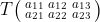

iii)  , such that:

Homework Answers
![draget) Range (11= {(210), 2012) ] 6 Dim kentt) = d 2 Dim KERCtr Dim R = 3-DINN) KIRIT) = Mo Sran 9, 913 921 922 923 sid tol](http://img.homeworklib.com/questions/2f2d31e0-a93a-11eb-8b64-db883abe9651.png?x-oss-process=image/resize,w_560)
Add Answer to:
In the following transformations:
a)Find the Kernel and Image
b)Find dimK(T) and dimI(T) and show that...
A. find the form of Kernel(T) b. find the form of range(T)
 a. find the form of Kernel(T)
b. find the form of range(T)
P2 be the mapping defined by 23. Let T: P -
P2 be the mapping defined by 23. Let T: P -
a. find the form of Kernel(T)
b. find the form of range(T)
P2 be the mapping defined by 23. Let T: P -
P2 be the mapping defined by 23. Let T: P -
a,b and c,completed processes 134. Idempotent Transformations. Find the matrices of the transformations T which or...
 a,b and c,completed processes
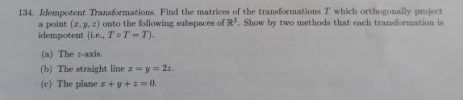
134. Idempotent Transformations. Find the matrices of the transformations T which orthogonally project a point (r,y, z) onto the following subspaces of R3. Show by two methods that each transformation is idempotent (i.e., T o T = T). (a) The z-axis. (b) The straight line r-y-2z. (c) The plane 0. + y + z
134. Idempotent Transformations. Find the matrices of the transformations T which orthogonally project a point (r,y, z) onto the following subspaces of...
a,b and c,completed processes
134. Idempotent Transformations. Find the matrices of the transformations T which orthogonally project a point (r,y, z) onto the following subspaces of R3. Show by two methods that each transformation is idempotent (i.e., T o T = T). (a) The z-axis. (b) The straight line r-y-2z. (c) The plane 0. + y + z
134. Idempotent Transformations. Find the matrices of the transformations T which orthogonally project a point (r,y, z) onto the following subspaces of...
Let T(f(t)) = t(f(t)) from P to P. Find the image and kernel of T.
 Let T(f(t)) = t(f(t)) from P to P. Find the image and kernel of T.
Q1: If (u,v) = (((,,a,,a,), (1;,6,63)) = a,b – a,b, + a,b; show that (u, v)...
 Q1: If (u,v) = (((,,a,,a,), (1;,6,63)) = a,b – a,b, + a,b; show that (u, v) is inner product or not. Q2: Find a basis and dimension for the Kernel and Image of linear transformation T:R — > R3 given by the formula T(x,y,z) = (x + y, x – y + x,y + 22), and show that dim(ker T) + dim(Im T) = n Q3: Find the matrix P that diagonalize A and then compute P-AP and A20. 1...
MATH 26 NafflU 5.4: Linear Transformations and Eigenstuff Find the eigenvalues and eigenspaces corresponding to each...
 MATH 26 NafflU 5.4: Linear Transformations and Eigenstuff Find the eigenvalues and eigenspaces corresponding to each linear transformation below. T : P2(R) → P2(R) with T(p(z)) = 긁 lxtp(t)dt
Determine whether or not the following transformation T :V + W is a linear transformation. If...
 Determine whether or not the following transformation T :V + W is a linear transformation. If T is not a linear transformation, provide a counter example. If it is, then: (i) find the nullspace N(T) and nullity of T, (ii) find the range R(T) and rank of T, (iii) determine if T is one-to-one, (iv) determine if T is onto. : (a) T: R3 + R2 defined by T(x, y, z) = (2x, y, z) (b) T: R2 + R2...
:| Let T : P → R , such that T (ao +ax+a2x2 +a3r)-4 +ai +a, +a3 . a) Prove that T is a linear transformation b) Find the rank and nullity of T. c) Find a basis for the kernel of T. :| Let T : P...
 :| Let T : P → R , such that T (ao +ax+a2x2 +a3r)-4 +ai +a, +a3 . a) Prove that T is a linear transformation b) Find the rank and nullity of T. c) Find a basis for the kernel of T.
:| Let T : P → R , such that T (ao +ax+a2x2 +a3r)-4 +ai +a, +a3 . a) Prove that T is a linear transformation b) Find the rank and nullity of T. c) Find a...
:| Let T : P → R , such that T (ao +ax+a2x2 +a3r)-4 +ai +a, +a3 . a) Prove that T is a linear transformation b) Find the rank and nullity of T. c) Find a basis for the kernel of T.
:| Let T : P → R , such that T (ao +ax+a2x2 +a3r)-4 +ai +a, +a3 . a) Prove that T is a linear transformation b) Find the rank and nullity of T. c) Find a...
1. For each of the following inner product spaces V and linear transformations g, find a...
 1. For each of the following inner product spaces V and linear transformations g, find a value of y € V for which g(x) = (x, y), for all x € V. (i) V = P2(R) with f(t)g(t) and g: V+ R defined by g(s) = f'(0) +2f(1). (ii) V = M2x2(C) with the Frobenius inner product, and g: V+C defined by i g(A) =tr :((1141 - :)4).
1. For each of the following inner product spaces V and linear transformations g, find a...
 1. For each of the following inner product spaces V and linear transformations g, find a value of y € V for which g(x) = (x, y), for all 1 € V. (i) V=P2(R) with f(t)g(t) dt and g: V + R defined by g(f) = f'(0) + 2f (1). (ii) V = M2x2(C) with the Frobenius inner product, and g:V + C defined by i i g(A) = tr (( 1 1 1
Transformation T:R' -»R',T(x,y, z) = (x+y,x-z)nd v=< 1,-1,2 > 8. ar iven B <1,1,1>,< 1,0,1 >&...
 Transformation T:R' -»R',T(x,y, z) = (x+y,x-z)nd v=< 1,-1,2 > 8. ar iven B <1,1,1>,< 1,0,1 ><-1,0,1>},B^ = {<1,1>,<1,0 >},and B, = {<1,0>,< 1,1>} B to Biand from B to B2 a) Find the Transition matrix from b) Find v],T[v];,7[v] c) Find v,and [v]p d) What did you conclude?
Transformation T:R' -»R',T(x,y, z) = (x+y,x-z)nd v= 8. ar iven B ,},B^ = {,},and B, = {,} B to Biand from B to B2 a) Find the Transition matrix from b) Find...
Transformation T:R' -»R',T(x,y, z) = (x+y,x-z)nd v=< 1,-1,2 > 8. ar iven B <1,1,1>,< 1,0,1 ><-1,0,1>},B^ = {<1,1>,<1,0 >},and B, = {<1,0>,< 1,1>} B to Biand from B to B2 a) Find the Transition matrix from b) Find v],T[v];,7[v] c) Find v,and [v]p d) What did you conclude?
Transformation T:R' -»R',T(x,y, z) = (x+y,x-z)nd v= 8. ar iven B ,},B^ = {,},and B, = {,} B to Biand from B to B2 a) Find the Transition matrix from b) Find...
 a. find the form of Kernel(T)
b. find the form of range(T)
P2 be the mapping defined by 23. Let T: P -
P2 be the mapping defined by 23. Let T: P -
a. find the form of Kernel(T)
b. find the form of range(T)
P2 be the mapping defined by 23. Let T: P -
P2 be the mapping defined by 23. Let T: P -
 a,b and c,completed processes
134. Idempotent Transformations. Find the matrices of the transformations T which orthogonally project a point (r,y, z) onto the following subspaces of R3. Show by two methods that each transformation is idempotent (i.e., T o T = T). (a) The z-axis. (b) The straight line r-y-2z. (c) The plane 0. + y + z
134. Idempotent Transformations. Find the matrices of the transformations T which orthogonally project a point (r,y, z) onto the following subspaces of...
a,b and c,completed processes
134. Idempotent Transformations. Find the matrices of the transformations T which orthogonally project a point (r,y, z) onto the following subspaces of R3. Show by two methods that each transformation is idempotent (i.e., T o T = T). (a) The z-axis. (b) The straight line r-y-2z. (c) The plane 0. + y + z
134. Idempotent Transformations. Find the matrices of the transformations T which orthogonally project a point (r,y, z) onto the following subspaces of...
 Let T(f(t)) = t(f(t)) from P to P. Find the image and kernel of T.
 Q1: If (u,v) = (((,,a,,a,), (1;,6,63)) = a,b – a,b, + a,b; show that (u, v) is inner product or not. Q2: Find a basis and dimension for the Kernel and Image of linear transformation T:R — > R3 given by the formula T(x,y,z) = (x + y, x – y + x,y + 22), and show that dim(ker T) + dim(Im T) = n Q3: Find the matrix P that diagonalize A and then compute P-AP and A20. 1...
 MATH 26 NafflU 5.4: Linear Transformations and Eigenstuff Find the eigenvalues and eigenspaces corresponding to each linear transformation below. T : P2(R) → P2(R) with T(p(z)) = 긁 lxtp(t)dt
 Determine whether or not the following transformation T :V + W is a linear transformation. If T is not a linear transformation, provide a counter example. If it is, then: (i) find the nullspace N(T) and nullity of T, (ii) find the range R(T) and rank of T, (iii) determine if T is one-to-one, (iv) determine if T is onto. : (a) T: R3 + R2 defined by T(x, y, z) = (2x, y, z) (b) T: R2 + R2...
 :| Let T : P → R , such that T (ao +ax+a2x2 +a3r)-4 +ai +a, +a3 . a) Prove that T is a linear transformation b) Find the rank and nullity of T. c) Find a basis for the kernel of T.
:| Let T : P → R , such that T (ao +ax+a2x2 +a3r)-4 +ai +a, +a3 . a) Prove that T is a linear transformation b) Find the rank and nullity of T. c) Find a...
:| Let T : P → R , such that T (ao +ax+a2x2 +a3r)-4 +ai +a, +a3 . a) Prove that T is a linear transformation b) Find the rank and nullity of T. c) Find a basis for the kernel of T.
:| Let T : P → R , such that T (ao +ax+a2x2 +a3r)-4 +ai +a, +a3 . a) Prove that T is a linear transformation b) Find the rank and nullity of T. c) Find a...
 1. For each of the following inner product spaces V and linear transformations g, find a value of y € V for which g(x) = (x, y), for all x € V. (i) V = P2(R) with f(t)g(t) and g: V+ R defined by g(s) = f'(0) +2f(1). (ii) V = M2x2(C) with the Frobenius inner product, and g: V+C defined by i g(A) =tr :((1141 - :)4).
 1. For each of the following inner product spaces V and linear transformations g, find a value of y € V for which g(x) = (x, y), for all 1 € V. (i) V=P2(R) with f(t)g(t) dt and g: V + R defined by g(f) = f'(0) + 2f (1). (ii) V = M2x2(C) with the Frobenius inner product, and g:V + C defined by i i g(A) = tr (( 1 1 1
 Transformation T:R' -»R',T(x,y, z) = (x+y,x-z)nd v=< 1,-1,2 > 8. ar iven B <1,1,1>,< 1,0,1 ><-1,0,1>},B^ = {<1,1>,<1,0 >},and B, = {<1,0>,< 1,1>} B to Biand from B to B2 a) Find the Transition matrix from b) Find v],T[v];,7[v] c) Find v,and [v]p d) What did you conclude?
Transformation T:R' -»R',T(x,y, z) = (x+y,x-z)nd v= 8. ar iven B ,},B^ = {,},and B, = {,} B to Biand from B to B2 a) Find the Transition matrix from b) Find...
Transformation T:R' -»R',T(x,y, z) = (x+y,x-z)nd v=< 1,-1,2 > 8. ar iven B <1,1,1>,< 1,0,1 ><-1,0,1>},B^ = {<1,1>,<1,0 >},and B, = {<1,0>,< 1,1>} B to Biand from B to B2 a) Find the Transition matrix from b) Find v],T[v];,7[v] c) Find v,and [v]p d) What did you conclude?
Transformation T:R' -»R',T(x,y, z) = (x+y,x-z)nd v= 8. ar iven B ,},B^ = {,},and B, = {,} B to Biand from B to B2 a) Find the Transition matrix from b) Find...
Most questions answered within 3 hours.
-
Where is the error in this code sequence?
String s1 = "Hello";
String s2 = "ello";...
asked 10 months ago -
Financial data for Joel de Paris, Inc., for last year
follow:
Joel de Paris, Inc.
Balance...
asked 10 months ago -
Consider this reaction:
Al2(SO4)3 (aq)+ BaCl3
(aq) Al2Cl6 (aq)- +
3BaSO4(s) . What is the...
asked 10 months ago -
Suppose that Savneet is considering increasing her
recent random sample from 20 car rentals to 40...
asked 10 months ago -
Trucks arrive at an unloading terminal at an average rate of 120
per hour.
Trucks arrive...
asked 10 months ago -
Why are methanol and ethanol completely soluble in water while
octanol is not very little soluble....
asked 10 months ago -
A facilities manager at a university reads in a research report
that the mean amount of...
asked 10 months ago -
When the CuSO4 is rehydrated by adding water to the anhydrous
compound, is this an endothermic...
asked 10 months ago -
A ray of sunlight is passing from diamond into crown glass; the
angle of incidence is...
asked 10 months ago -
A block of mass 0.249 kg is placed on top of a light, vertical
spring of...
asked 10 months ago -
how do the kidneys compensate in the presences of acidosis
a) trigger hyperventilate
b) reserve acid...
asked 10 months ago -
Question 501 pts
The rental rate of capital to the firm increases. Which of the
following...
asked 10 months ago