As shown in the figure on the right, a small bead with a mass of 4.00...
As shown in the figure on the right, a small bead with a mass of
4.00 grams and a charge of +10.0  C is suspended on a non-conducting 120.0 cm long thread at an angle
of 35o from the center of a very large vertical flat,
non-conducting plate with a uniform, but unknown, surface charge
density. What is the charge density on the plate in C/m2
? Given:
C is suspended on a non-conducting 120.0 cm long thread at an angle
of 35o from the center of a very large vertical flat,
non-conducting plate with a uniform, but unknown, surface charge
density. What is the charge density on the plate in C/m2
? Given:  0 = 8.854 x 10⁻¹² C2 /N-m2 ANSWER:
  = 4.86 x 10⁻⁸ C/m2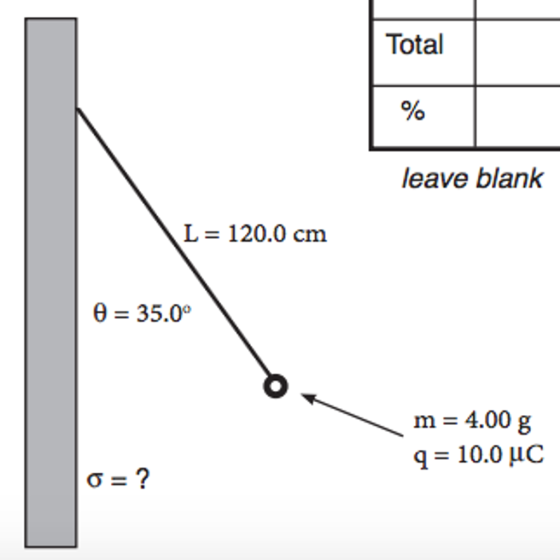
Homework Answers
Electric field due to the plate, Ep = σ/2εo
Let T be the tension in the thread.
Vertical force balance for the bead:
Tcosθ = mg
Horizontal force balance for the bead:
Tsinθ = (σ/2εo)q
Dividing the second equation by first, we get,
tanθ = σq/2εomg
=> σ = 2εomgtanθ/q
=> σ = 2 * (8.854 * 10-12) * (4 * 10-3) * 9.81 * tan35o / (10 * 10-6) = 4.87 * 10-8 C/m2
Add Answer to:
As shown in the figure on the right, a small bead with a mass of
4.00...
A small plastic ball of mass 6.30 × 10⁻³ kg and charge +0.193C is suspended from...
 A small plastic ball of mass
6.30 × 10⁻³ kg and charge +0.193C is suspended from an insulating
thread and hangs between the plates of a capacitor (see the
drawing). The ball is in equilibrium, with the thread making an
angle of 30.0o with respect to the vertical. The area of each plate
is 0.01240 m2. What is the magnitude of the charge on each
plate?
A small plastic ball of mass 6.30 x 10³ kg and charge +0.193HC is...
A small plastic ball of mass
6.30 × 10⁻³ kg and charge +0.193C is suspended from an insulating
thread and hangs between the plates of a capacitor (see the
drawing). The ball is in equilibrium, with the thread making an
angle of 30.0o with respect to the vertical. The area of each plate
is 0.01240 m2. What is the magnitude of the charge on each
plate?
A small plastic ball of mass 6.30 x 10³ kg and charge +0.193HC is...
A small plastic ball of mass 6.30 × 10⁻³ kg and charge +0.193C is suspended from...
 A small plastic ball of mass
6.30 × 10⁻³ kg and charge +0.193C is suspended from an insulating
thread and hangs between the plates of a capacitor (see the
drawing). The ball is in equilibrium, with the thread making an
angle of 30.0o with respect to the vertical. The area of each plate
is 0.01240 m2. What is the magnitude of the charge on each
plate?
A small plastic ball of mass 6.30 x 10³ kg and charge +0.193HC is...
A small plastic ball of mass
6.30 × 10⁻³ kg and charge +0.193C is suspended from an insulating
thread and hangs between the plates of a capacitor (see the
drawing). The ball is in equilibrium, with the thread making an
angle of 30.0o with respect to the vertical. The area of each plate
is 0.01240 m2. What is the magnitude of the charge on each
plate?
A small plastic ball of mass 6.30 x 10³ kg and charge +0.193HC is...
small plastic ball of mass 8.64 x 10 kg and charge +0.128C is suspended from an...
 small plastic ball of mass 8.64 x 10 kg and charge +0.128C is suspended from an insulating thread and hangs between the plates of a capacitor (see the drawing). The ball is in equilibrium, with the thread making an angle of 30.0 with respect to the vertical. The area of each plate is 0.01658 m2. What is the magnitude of the charge on each plate? 30.0 Number Units
A small plastic ball with a mass of 6.85 10-3 kg and with a charge of...
A small plastic ball with a mass of 6.85 10-3 kg and with a charge of +0.142 µC is suspended from an insulating thread and hangs between the plates of a capacitor (see the drawing). The ball is in equilibrium, with the thread making an angle of 30.0° with respect to the vertical. The area of each plate is 0.0166 m2. What is the magnitude of the charge on each plate? C
Chapter 18, Problem 53 A small plastic ball of mass 8.92 x 10⁻³ kg and charge...
 Chapter 18, Problem 53 A small plastic ball of mass 8.92 x 10⁻³ kg and charge +0.219/c is suspended from an insulating thread and hangs between the plates of a capacitor (see the drawing). The ball is in equilibrium with the thread making an angle of 30.0° with respect to the vertical. The area of each plate is 0.01776 m2. what is the magnitude of the charge on each plate? 30.0 Number Units the tolerance is +/-2%
A small plastic ball of mass 5.28 × 10⁻³ kg and charge +0.192C is suspended from...
A small plastic ball of mass 5.28 × 10⁻³ kg and charge +0.192C is suspended from an insulating thread and hangs between the plates of a capacitor (see the drawing). The ball is in equilibrium, with the thread making an angle of 30.0o with respect to the vertical. The area of each plate is 0.01419 m2. What is the magnitude of the charge on each plate?
A small plastic ball of mass 9.27 × 10⁻³ kg and charge +0.117C is suspended from...
A small plastic ball of mass 9.27 × 10⁻³ kg and charge +0.117C is suspended from an insulating thread and hangs between the plates of a capacitor (see the drawing). The ball is in equilibrium, with the thread making an angle of 30.0o with respect to the vertical. The area of each plate is 0.02200 m2. What is the magnitude of the charge on each plate?
Please Help!!!!!!!! 14. A non-conducting, thin sheet of charge carries a uniform area charge density of...
 Please Help!!!!!!!!
14. A non-conducting, thin sheet of charge carries a uniform area charge density of 5.20 nC/m2. Find the magnitude of the electric field (in N/C) at a distance 8.70 cm above the sheet. 15. A charge of 7.00 nC is placed 10.0 em above a square plate with sides exactly twice that len What is the electric flux (in N m/C) through the plate? (Hint: think of the plate as one wall of a cube with the charge...
Please Help!!!!!!!!
14. A non-conducting, thin sheet of charge carries a uniform area charge density of 5.20 nC/m2. Find the magnitude of the electric field (in N/C) at a distance 8.70 cm above the sheet. 15. A charge of 7.00 nC is placed 10.0 em above a square plate with sides exactly twice that len What is the electric flux (in N m/C) through the plate? (Hint: think of the plate as one wall of a cube with the charge...
A small sphere of mass 2.5 x 10^-5 kg carries a total charge of 6.0 x...
 A small sphere of mass 2.5 x 10^-5 kg carries a total charge of 6.0 x 10^-8 C. The sphere hangs from a silk thread between two large parallel conducting plates. The excess charge on each plate is equal in magnitude, but opposite in sign. If the thread makes an angle of 30 degree with the positive plate as shown, what is the magnitude of the charge density on each plate? (+5 points possible)
Problem 3. A charged ball of mass 2.00 grams is suspended by a light thread. A...
 Problem 3. A charged ball of mass 2.00 grams is suspended by a light thread. A uniform electric field of magnitude 6.00 x 10 N/C making an angle 45.0° with the horizontal is present in the region. The charge is at rest with the thread making an angle 30.0 with the vertical. (a) Is the charge positive or negative? Justify your answer b) Determine the magnitude of the charge and the tension in the cord.
 A small plastic ball of mass
6.30 × 10⁻³ kg and charge +0.193C is suspended from an insulating
thread and hangs between the plates of a capacitor (see the
drawing). The ball is in equilibrium, with the thread making an
angle of 30.0o with respect to the vertical. The area of each plate
is 0.01240 m2. What is the magnitude of the charge on each
plate?
A small plastic ball of mass 6.30 x 10³ kg and charge +0.193HC is...
A small plastic ball of mass
6.30 × 10⁻³ kg and charge +0.193C is suspended from an insulating
thread and hangs between the plates of a capacitor (see the
drawing). The ball is in equilibrium, with the thread making an
angle of 30.0o with respect to the vertical. The area of each plate
is 0.01240 m2. What is the magnitude of the charge on each
plate?
A small plastic ball of mass 6.30 x 10³ kg and charge +0.193HC is...
 A small plastic ball of mass
6.30 × 10⁻³ kg and charge +0.193C is suspended from an insulating
thread and hangs between the plates of a capacitor (see the
drawing). The ball is in equilibrium, with the thread making an
angle of 30.0o with respect to the vertical. The area of each plate
is 0.01240 m2. What is the magnitude of the charge on each
plate?
A small plastic ball of mass 6.30 x 10³ kg and charge +0.193HC is...
A small plastic ball of mass
6.30 × 10⁻³ kg and charge +0.193C is suspended from an insulating
thread and hangs between the plates of a capacitor (see the
drawing). The ball is in equilibrium, with the thread making an
angle of 30.0o with respect to the vertical. The area of each plate
is 0.01240 m2. What is the magnitude of the charge on each
plate?
A small plastic ball of mass 6.30 x 10³ kg and charge +0.193HC is...
 small plastic ball of mass 8.64 x 10 kg and charge +0.128C is suspended from an insulating thread and hangs between the plates of a capacitor (see the drawing). The ball is in equilibrium, with the thread making an angle of 30.0 with respect to the vertical. The area of each plate is 0.01658 m2. What is the magnitude of the charge on each plate? 30.0 Number Units
 Chapter 18, Problem 53 A small plastic ball of mass 8.92 x 10⁻³ kg and charge +0.219/c is suspended from an insulating thread and hangs between the plates of a capacitor (see the drawing). The ball is in equilibrium with the thread making an angle of 30.0° with respect to the vertical. The area of each plate is 0.01776 m2. what is the magnitude of the charge on each plate? 30.0 Number Units the tolerance is +/-2%
 Please Help!!!!!!!!
14. A non-conducting, thin sheet of charge carries a uniform area charge density of 5.20 nC/m2. Find the magnitude of the electric field (in N/C) at a distance 8.70 cm above the sheet. 15. A charge of 7.00 nC is placed 10.0 em above a square plate with sides exactly twice that len What is the electric flux (in N m/C) through the plate? (Hint: think of the plate as one wall of a cube with the charge...
Please Help!!!!!!!!
14. A non-conducting, thin sheet of charge carries a uniform area charge density of 5.20 nC/m2. Find the magnitude of the electric field (in N/C) at a distance 8.70 cm above the sheet. 15. A charge of 7.00 nC is placed 10.0 em above a square plate with sides exactly twice that len What is the electric flux (in N m/C) through the plate? (Hint: think of the plate as one wall of a cube with the charge...
 A small sphere of mass 2.5 x 10^-5 kg carries a total charge of 6.0 x 10^-8 C. The sphere hangs from a silk thread between two large parallel conducting plates. The excess charge on each plate is equal in magnitude, but opposite in sign. If the thread makes an angle of 30 degree with the positive plate as shown, what is the magnitude of the charge density on each plate? (+5 points possible)
 Problem 3. A charged ball of mass 2.00 grams is suspended by a light thread. A uniform electric field of magnitude 6.00 x 10 N/C making an angle 45.0° with the horizontal is present in the region. The charge is at rest with the thread making an angle 30.0 with the vertical. (a) Is the charge positive or negative? Justify your answer b) Determine the magnitude of the charge and the tension in the cord.
Most questions answered within 3 hours.
-
Where is the error in this code sequence?
String s1 = "Hello";
String s2 = "ello";...
asked 10 months ago -
Financial data for Joel de Paris, Inc., for last year
follow:
Joel de Paris, Inc.
Balance...
asked 10 months ago -
Consider this reaction:
Al2(SO4)3 (aq)+ BaCl3
(aq) Al2Cl6 (aq)- +
3BaSO4(s) . What is the...
asked 10 months ago -
Suppose that Savneet is considering increasing her
recent random sample from 20 car rentals to 40...
asked 10 months ago -
Trucks arrive at an unloading terminal at an average rate of 120
per hour.
Trucks arrive...
asked 10 months ago -
Why are methanol and ethanol completely soluble in water while
octanol is not very little soluble....
asked 10 months ago -
A facilities manager at a university reads in a research report
that the mean amount of...
asked 10 months ago -
When the CuSO4 is rehydrated by adding water to the anhydrous
compound, is this an endothermic...
asked 10 months ago -
A ray of sunlight is passing from diamond into crown glass; the
angle of incidence is...
asked 10 months ago -
A block of mass 0.249 kg is placed on top of a light, vertical
spring of...
asked 10 months ago -
how do the kidneys compensate in the presences of acidosis
a) trigger hyperventilate
b) reserve acid...
asked 10 months ago -
Question 501 pts
The rental rate of capital to the firm increases. Which of the
following...
asked 10 months ago