2] How far away is a RR Lyrae variable star if it has a period of...
2] How far away is a RR Lyrae variable star if it has a period of 0.5 days and a brightness of 2.3 x 10^-11 W/m^2?
Answer: 8.14 x 10^18 m, 860 ly
Homework Answers
Period of the RR Lyrae variable star is 
Using the Period - Luminosity relationship graph, at time period
,
luminosity lies between is 
Relation between distance of star  , brightness
  and luminosity
 is
is

Distance of star 


Distance of RR Lyrae star is 
Add Answer to:
2] How far away is a RR Lyrae variable star if it has a period
of...
The question has the answer already. i need to show the work on how the answer...
 The question has the answer already. i need to show the work
on how the answer was gotten.
1 How far away is a type II Cepheid if it has a Period of 30 days and has a measured brightness of 10^-12 W/m 2? Answer: 1.656 x 10^20 m, 17,507 ly
The question has the answer already. i need to show the work
on how the answer was gotten.
1 How far away is a type II Cepheid if it has a Period of 30 days and has a measured brightness of 10^-12 W/m 2? Answer: 1.656 x 10^20 m, 17,507 ly
[Only if you understand the problem, please solve. I really need to get correct answer. Last...
 [Only if you understand the problem, please solve. I really need
to get correct answer. Last guy answered it wrong.]
suppose a cepheid has a period of 2 days. estimate its
luminosity from the figure above and then determine its distance if
its measured brightness is 6.6 x 10^-12 watts/m^2
its distance is ____ x 10^7m
. Cepheid variables .RR Lyrae stars 104 103 10 0.2 0.5 1 2 5 10 20 50 100 Pulsation period (days) Suppose a Ceoheid...
[Only if you understand the problem, please solve. I really need
to get correct answer. Last guy answered it wrong.]
suppose a cepheid has a period of 2 days. estimate its
luminosity from the figure above and then determine its distance if
its measured brightness is 6.6 x 10^-12 watts/m^2
its distance is ____ x 10^7m
. Cepheid variables .RR Lyrae stars 104 103 10 0.2 0.5 1 2 5 10 20 50 100 Pulsation period (days) Suppose a Ceoheid...
Question 10 (1 point) Delta Cephei is a cepheid variable star with a period of variability...
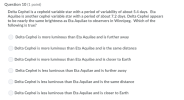 Question 10 (1 point) Delta Cephei is a cepheid variable star with a period of variability of about 5.4 days. Eta Aquilae is another cephei variable star with a period of about 7.2 days. Delta Cephei appears to be nearly the same brightness as Eta Aquilae to observers in Winnipeg. Which of the following is true? Delta Cephei is more luminous than Eta Aquilae and is further away Delta Cephei is more luminous than Eta Aquilae and is the same...
A star has apparent magnitude 10.0 and absolute magnitude 4.5. How far away is it? Express...
A star has apparent magnitude 10.0 and absolute magnitude 4.5. How far away is it? Express your answer using two significant figures.
Could one of the stars listed in the table above be an RR Lyrae star?
Cosmic DistancesDISTANCE MODULUS- For this lab, we will focus on two techniques that can be used to measure the distance modulus of objects in deep space - supernovas and Cepheid variable stars. Before we begin, though, we must understand what "distance modulus" means.- Read through the background material on distance modulus.- Use the distance modulus page to complete the following table:ObjectApparent Magnitude (m)Absolute Magnitude (M)Distance Modulus (m-M)Distance (pc)Star A2.410Star B516Star C1025Star D8.50.5- Could one of the stars listed in the...
Tau Ceti is a star that is located 11.753 ly away. There is a planet orbiting...
 Tau Ceti is a star that is located 11.753 ly away. There
is a planet orbiting this star with an orbital radius of 0.538 AU
(AU stands for astronimcal unit - the average distance between
Earth & the Sun). Fill in the table below by determining the
minimum diameter the objective of a telescope would need to be in
order to resolve the planet from the star at the stated
wavelengths. 1 ly = 9.461 × 10¹⁵ m & 1...
Tau Ceti is a star that is located 11.753 ly away. There
is a planet orbiting this star with an orbital radius of 0.538 AU
(AU stands for astronimcal unit - the average distance between
Earth & the Sun). Fill in the table below by determining the
minimum diameter the objective of a telescope would need to be in
order to resolve the planet from the star at the stated
wavelengths. 1 ly = 9.461 × 10¹⁵ m & 1...
Suppose a star has a luminosity of 9.0×1029 watts and an apparent brightness of 9.0×10⁻¹⁵ watt/m2...
Suppose a star has a luminosity of 9.0×1029 watts and an apparent brightness of 9.0×10⁻¹⁵ watt/m2 . How far away is it? Give your answer in both kilometers and light-years.
Suppose a star has a luminosity of 6.0×1026 watts and an apparent brightness of 4.5×10⁻¹² watt/m2...
Suppose a star has a luminosity of 6.0×1026 watts and an apparent brightness of 4.5×10⁻¹² watt/m2 . How far away is it? Give your answer in both kilometers and light-years.
Two masses are in space far away from any star or planet. Mass 1 is 2...
 Two masses are in space far away from any star or planet. Mass 1 is 2 times 10^5 kg and mass 2 is 13 kg. The magnitude of the gravitational force between is 1.2 Newtons. If mass 2 is orbiting in a circular orbit around mass 1, what is its period of orbit in seconds? Assume mass 1 is not moving at all.
Two masses are in space far away from any star or planet. Mass 1 is 6...
Two masses are in space far away from any star or planet. Mass 1 is 6 x 10³ kg and mass 2 is 30 kg. The magnitude of the gravitational force between is .9 Newtons. If mass 2 is orbiting in a circular orbit around mass 1, what is its period of orbit in seconds? Assume mass 1 is not moving at all.
 The question has the answer already. i need to show the work
on how the answer was gotten.
1 How far away is a type II Cepheid if it has a Period of 30 days and has a measured brightness of 10^-12 W/m 2? Answer: 1.656 x 10^20 m, 17,507 ly
The question has the answer already. i need to show the work
on how the answer was gotten.
1 How far away is a type II Cepheid if it has a Period of 30 days and has a measured brightness of 10^-12 W/m 2? Answer: 1.656 x 10^20 m, 17,507 ly
 [Only if you understand the problem, please solve. I really need
to get correct answer. Last guy answered it wrong.]
suppose a cepheid has a period of 2 days. estimate its
luminosity from the figure above and then determine its distance if
its measured brightness is 6.6 x 10^-12 watts/m^2
its distance is ____ x 10^7m
. Cepheid variables .RR Lyrae stars 104 103 10 0.2 0.5 1 2 5 10 20 50 100 Pulsation period (days) Suppose a Ceoheid...
[Only if you understand the problem, please solve. I really need
to get correct answer. Last guy answered it wrong.]
suppose a cepheid has a period of 2 days. estimate its
luminosity from the figure above and then determine its distance if
its measured brightness is 6.6 x 10^-12 watts/m^2
its distance is ____ x 10^7m
. Cepheid variables .RR Lyrae stars 104 103 10 0.2 0.5 1 2 5 10 20 50 100 Pulsation period (days) Suppose a Ceoheid...
 Question 10 (1 point) Delta Cephei is a cepheid variable star with a period of variability of about 5.4 days. Eta Aquilae is another cephei variable star with a period of about 7.2 days. Delta Cephei appears to be nearly the same brightness as Eta Aquilae to observers in Winnipeg. Which of the following is true? Delta Cephei is more luminous than Eta Aquilae and is further away Delta Cephei is more luminous than Eta Aquilae and is the same...
 Tau Ceti is a star that is located 11.753 ly away. There
is a planet orbiting this star with an orbital radius of 0.538 AU
(AU stands for astronimcal unit - the average distance between
Earth & the Sun). Fill in the table below by determining the
minimum diameter the objective of a telescope would need to be in
order to resolve the planet from the star at the stated
wavelengths. 1 ly = 9.461 × 10¹⁵ m & 1...
Tau Ceti is a star that is located 11.753 ly away. There
is a planet orbiting this star with an orbital radius of 0.538 AU
(AU stands for astronimcal unit - the average distance between
Earth & the Sun). Fill in the table below by determining the
minimum diameter the objective of a telescope would need to be in
order to resolve the planet from the star at the stated
wavelengths. 1 ly = 9.461 × 10¹⁵ m & 1...
 Two masses are in space far away from any star or planet. Mass 1 is 2 times 10^5 kg and mass 2 is 13 kg. The magnitude of the gravitational force between is 1.2 Newtons. If mass 2 is orbiting in a circular orbit around mass 1, what is its period of orbit in seconds? Assume mass 1 is not moving at all.
Most questions answered within 3 hours.
-
Where is the error in this code sequence?
String s1 = "Hello";
String s2 = "ello";...
asked 10 months ago -
Financial data for Joel de Paris, Inc., for last year
follow:
Joel de Paris, Inc.
Balance...
asked 10 months ago -
Consider this reaction:
Al2(SO4)3 (aq)+ BaCl3
(aq) Al2Cl6 (aq)- +
3BaSO4(s) . What is the...
asked 10 months ago -
Suppose that Savneet is considering increasing her
recent random sample from 20 car rentals to 40...
asked 10 months ago -
Trucks arrive at an unloading terminal at an average rate of 120
per hour.
Trucks arrive...
asked 10 months ago -
Why are methanol and ethanol completely soluble in water while
octanol is not very little soluble....
asked 10 months ago -
A facilities manager at a university reads in a research report
that the mean amount of...
asked 10 months ago -
When the CuSO4 is rehydrated by adding water to the anhydrous
compound, is this an endothermic...
asked 10 months ago -
A ray of sunlight is passing from diamond into crown glass; the
angle of incidence is...
asked 10 months ago -
A block of mass 0.249 kg is placed on top of a light, vertical
spring of...
asked 10 months ago -
how do the kidneys compensate in the presences of acidosis
a) trigger hyperventilate
b) reserve acid...
asked 10 months ago -
Question 501 pts
The rental rate of capital to the firm increases. Which of the
following...
asked 10 months ago