A 200 kg weather rocket is loaded with 100 kg of fuel and fired straight up....
A 200 kg weather rocket is loaded with 100 kg of fuel and fired straight up. It accelerates upward at 35 m/s2 for 31 s, then runs out of fuel. Ignore any air resistance effects.
What is the rocket's maximum altitude?
How long is the rocket in the air before hitting the ground? Express your answer with the appropriate units.
Homework Answers


Add Answer to:
A 200 kg weather rocket is loaded with 100 kg of fuel and fired
straight up....
4 (2.55). A weather rocket is initially at rest on the ground and is fired straight...
 4 (2.55). A weather rocket is initially at rest on the ground and is fired straight up. It accelerates at 30 m/sec2 for 30 sec then runs out of fuel. The rocket then continues upward and reaches its highest point. What is the rocket's maximum altitude?
A 1000 kg weather rocket is launched straight up. The rocket motor provides a constant acceleration...
A 1000 kg weather rocket is launched straight up. The rocket motor provides a constant acceleration for 16 s, then the motor stops. The rocket altitude 20 s after launch is 6600 m.You can ignore any effects of air resistance. What was the rocket's acceleration during the first 16 s? Express your answer with the appropriate units.
Please circle your answers 4 (2.55). A weather rocket is initially at rest on the ground...
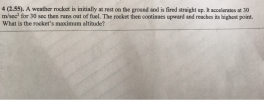 Please circle your answers
4 (2.55). A weather rocket is initially at rest on the ground and is fired straight up. It accelerates at 30 m/sec2 for 30 sec then runs out of fuel. The rocket then continues upward and reaches its highest point. What is the rocket's maximum altitude?
Please circle your answers
4 (2.55). A weather rocket is initially at rest on the ground and is fired straight up. It accelerates at 30 m/sec2 for 30 sec then runs out of fuel. The rocket then continues upward and reaches its highest point. What is the rocket's maximum altitude?
A 1000 kg weather rocket is launched straight up.The rocket motor provides a constant acceleration for...
A 1000 kg weather rocket is launched straight up.The rocket motor provides a constant acceleration for 16 s, then the motor stops. The rocket altitude 20 s after launch is 6200 m. You can ignore any effects of air resistance. What was the rocket's acceleration during the first 16s? What is the rocket's speed as it passes through acloud 6200 m above the ground?
Review Part A A 1000 kg weather rocket is launched straight up. The rocket motor provides...
 Review Part A A 1000 kg weather rocket is launched straight up. The rocket motor provides a constant acceleration for 16 s, then the motor stops. The rocket altitude 20 s after launch is 7100 m. You can ignore any effects of What was the rocket's acceleration during the first 16 s? Express your answer with the appropriate units air resistance al x.10" | a= | Value Units Submit Previous Answers Request Answer A student standing on the ground throws...
A fully fueled rocket has a mass of 21000 kg, of which 25000 kg is fuel....
A fully fueled rocket has a mass of 21000 kg, of which 25000 kg is fuel. The burned fuel is exhausted at a rate of 190 kg/s at a speed of 2800 m/s relative to the rocket. If the rocket is fired vertically upward, calculate.... a.) The trust of the rocket b.) The net force on the rocket at blastoff and just before burnout (when all the fuel has been used up) c.) The rocket's velocity at burnout *** Ignore...
A model rocket blasts off from the ground, rising straight upward with a constant acceleration that...
A model rocket blasts off from the ground, rising straight upward with a constant acceleration that has a magnitude of 82.0 m/s2 for 1.82 seconds, at which point its fuel abruptly runs out. Air resistance has no effect on its flight. What maximum altitude (above the ground) will the rocket reach?
A model rocket blasts off from the ground, rising straight upward with a constant acceleration that...
A model rocket blasts off from the ground, rising straight upward with a constant acceleration that has a magnitude of 82.0 m/s2 for 1.70 seconds, at which point its fuel abruptly runs out. Air resistance has no effect on its flight. What maximum altitude (above the ground) will the rocket reach?
A rocket, initially at rest on the ground, accelerates straight upward from rest with constant acceleration...
A rocket, initially at rest on the ground, accelerates straight upward from rest with constant acceleration 49.0 m/s2 . The acceleration period lasts for time 7.00 s until the fuel is exhausted. After that, the rocket is in free fall. Find the maximum height ymax reached by the rocket. Ignore air resistance and assume a constant acceleration due to gravity equal to 9.80 m/s2 .
A test rocket at ground level is fired straight up from rest with a net upward...
 A test rocket at ground level is fired straight up from rest with a net upward acceleration of 25 m/s2. After 12.0 s, the motor turns off but the rocket continues to coast upward with insignificant air resistance. What maximum elevation does the rocket reach? 6.4 km 3.3 km 8.9 km 4.1 km 5.2 km
 4 (2.55). A weather rocket is initially at rest on the ground and is fired straight up. It accelerates at 30 m/sec2 for 30 sec then runs out of fuel. The rocket then continues upward and reaches its highest point. What is the rocket's maximum altitude?
 Please circle your answers
4 (2.55). A weather rocket is initially at rest on the ground and is fired straight up. It accelerates at 30 m/sec2 for 30 sec then runs out of fuel. The rocket then continues upward and reaches its highest point. What is the rocket's maximum altitude?
Please circle your answers
4 (2.55). A weather rocket is initially at rest on the ground and is fired straight up. It accelerates at 30 m/sec2 for 30 sec then runs out of fuel. The rocket then continues upward and reaches its highest point. What is the rocket's maximum altitude?
 Review Part A A 1000 kg weather rocket is launched straight up. The rocket motor provides a constant acceleration for 16 s, then the motor stops. The rocket altitude 20 s after launch is 7100 m. You can ignore any effects of What was the rocket's acceleration during the first 16 s? Express your answer with the appropriate units air resistance al x.10" | a= | Value Units Submit Previous Answers Request Answer A student standing on the ground throws...
 A test rocket at ground level is fired straight up from rest with a net upward acceleration of 25 m/s2. After 12.0 s, the motor turns off but the rocket continues to coast upward with insignificant air resistance. What maximum elevation does the rocket reach? 6.4 km 3.3 km 8.9 km 4.1 km 5.2 km
Most questions answered within 3 hours.
-
Where is the error in this code sequence?
String s1 = "Hello";
String s2 = "ello";...
asked 11 months ago -
Financial data for Joel de Paris, Inc., for last year
follow:
Joel de Paris, Inc.
Balance...
asked 11 months ago -
Consider this reaction:
Al2(SO4)3 (aq)+ BaCl3
(aq) Al2Cl6 (aq)- +
3BaSO4(s) . What is the...
asked 11 months ago -
Suppose that Savneet is considering increasing her
recent random sample from 20 car rentals to 40...
asked 11 months ago -
Trucks arrive at an unloading terminal at an average rate of 120
per hour.
Trucks arrive...
asked 11 months ago -
Why are methanol and ethanol completely soluble in water while
octanol is not very little soluble....
asked 11 months ago -
A facilities manager at a university reads in a research report
that the mean amount of...
asked 11 months ago -
When the CuSO4 is rehydrated by adding water to the anhydrous
compound, is this an endothermic...
asked 11 months ago -
A ray of sunlight is passing from diamond into crown glass; the
angle of incidence is...
asked 11 months ago -
A block of mass 0.249 kg is placed on top of a light, vertical
spring of...
asked 11 months ago -
how do the kidneys compensate in the presences of acidosis
a) trigger hyperventilate
b) reserve acid...
asked 11 months ago -
Question 501 pts
The rental rate of capital to the firm increases. Which of the
following...
asked 11 months ago