
Homework Answers
Conserving momentum:
m1u1+m2u2 = m1v1 + m2v2
15(0) + 3*8 = 15v + 3*(-2)
v = 2 m/s
Now the initial velocity of the 15 kg block is 2 m/s
KE = (1/2)mv^2 = 1/2 * 15*2*2 = 30 J
KE is converted into spring energy.
Spring energy for 'x' compression = (1/2)kx^2
(1/2)*325*x^2 = 30
x = 0.430 m
Kindly rate :)
Add Answer to:
Constants Part A problem into Find the maximum distance that the block will compress ↑ after...
A 15.0 kg block is attached to a very light horizontal spring of force constant 325 N/m and is resting on a smooth horizontal table
 A 15.0 kg block is attached to a very light horizontal spring of force constant 325 N/m and is resting on a smooth horizontal table. (See the figure below (Figure 1).) Suddenly it is struck by a 3.00 kg stone traveling horizontally at 8.00 m/s to the right, whereupon the stone rebounds at 2.00 m/s horizontally to the left.Part A Find the maximum distance that the block will compress the spring after the collision (Hint Break this problem into two parts....
A 15.0 kg block is attached to a very light horizontal spring of force constant 375...
A 15.0 kg block is attached to a very light horizontal spring of force constant 375 N/m and is resting on a frictionless horizontal table. (See the figure below (Figure 1).) Suddenly it is struck by a 3.00 kg stone traveling horizontally at 8.00 m/s to the right, whereupon the stone rebounds at 2.00 m/s horizontally to the left. Find the maximum distance that the block will compress the spring after the collision. x=...?meter
A 15.0 kg block is attached to a very light horizontal spring of force constant 400 N/m and is resting on a smooth hor...
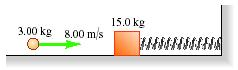 A 15.0 kg block is attached to a very light
horizontal spring of force constant 400 N/m and is
resting on a smooth horizontal table. (See the figure below .)
Suddenly it is struck by a 3.00 kg stone traveling
horizontally at 8.00 m/s to the right, whereupon the
stone rebounds at 2.00 m/s horizontally to the
left.
Find the maximum distance that the block will compress the
spring in m after the collision.
A 15.0 kg block is attached to a very light
horizontal spring of force constant 400 N/m and is
resting on a smooth horizontal table. (See the figure below .)
Suddenly it is struck by a 3.00 kg stone traveling
horizontally at 8.00 m/s to the right, whereupon the
stone rebounds at 2.00 m/s horizontally to the
left.
Find the maximum distance that the block will compress the
spring in m after the collision.
A 15.0 kg box is attached to a very light horizontal spring (uncompressed) with a spring...
A 15.0 kg box is attached to a very light horizontal spring (uncompressed) with a spring force constant 375 N/m and is resting on a smooth horizontal table. (See the figure below (Figure 1).) The box is hit by a 3.00 kg rock that is flying horizontally at 8.00 m/s to the right at the moment of the collision. After the collision, the rock rebounds at 2.00 m/s horizontally to the left. A) Find the maximum distance that the block...
Please help with the following problem A. 5.X kg block is attached to a massless spring...
 Please help with the following problem
A. 5.X kg block is attached to a massless spring with the spring constant of 220 N/m and is at rest on a horizontal surface with the coefficient of kinetic friction of mu_k = 0.1. The block is struck by a 1.1 kg stone traveling horizontally at 5.5 m/s as shown in the figure. The stone rebounds back at 2 m/s. Note that the friction must be taken into account. Find: (a) the speed...
Please help with the following problem
A. 5.X kg block is attached to a massless spring with the spring constant of 220 N/m and is at rest on a horizontal surface with the coefficient of kinetic friction of mu_k = 0.1. The block is struck by a 1.1 kg stone traveling horizontally at 5.5 m/s as shown in the figure. The stone rebounds back at 2 m/s. Note that the friction must be taken into account. Find: (a) the speed...
The 20-lb block is pressed against the spring so as to compress 2 ft when it...
 The 20-lb block is pressed against the spring so as to compress 2 ft when it is at A The plane is smooth Neglect the size of the block Figure 1) Part A Determine the distance d, measured from the wall, to where the block strkes the ground Express your answer to three significant figures and include the appropriate units d- 20.23 Submit Previous Answ Request Answer Figure 1 of 1 x Incorrect: Try Again; 8 attempts remaining Provide Feedback...
A 15 kg block is attached to a very light horizontal spring of force constant 5000.0...
A 15 kg block is attached to a very light horizontal spring of force constant 5000.0 N/m and is resting on a frictionless table. It is struck by a 3.00 kg stone at 8.00 m/s to the right, then rebounds at 2.00 m/s to the left. Calculate the change in mechanical energy during the collision.
Problem 8.24 29 of 36 n Review | Constants A 6.00 g bullet is fired horizontally...
 Problem 8.24 29 of 36 n Review | Constants A 6.00 g bullet is fired horizontally into a 1.40 kg wooden block resting on a horizontal surface. The coefficient of kinetic friction between block and surface is 0.200. The bullet remains embedded in the block, which is observed to slide 0.200 m along the surface before stopping. Part A What was the initial speed of the bullet? AEO ? v = 222.617 m/s Submit Previous Answers Request Answer X Incorrect;...
KHWK1-Ch14 Problem 14.10 a Review I Constants | Periodic Table Part A A block with a...
 KHWK1-Ch14 Problem 14.10 a Review I Constants | Periodic Table Part A A block with a mass of 0.24 kg is attached to a horizontal spring. The block is pulled back from its equilibrium position until the spring exerts a force of 1.2 N on the block. When the block is released, it oscillates with a frequency of 1.5 Hz How far was the block pulled back before being released? Express your answer with the appropriate units. IA az|- |0.075...
Part B Constants Assume that &-65.0V. The battery has negligible interna Find the current in the...
 Part B Constants Assume that &-65.0V. The battery has negligible interna Find the current in the 3.00 Ω resistor. Express your answer in amperes to three significant figures. Submit|P Previous Answers Request Answer X Incorrect; Try Again; 2 attempts remaining Part C Find the current in the 6.00 Ω resistor. Figure 〈 1of1 〉 Express your answer in amperes to three significant figures. 3.00 Ω 12.0 Ω Submit Request Answer 6.00 Ω 4.00 Ω
 A 15.0 kg block is attached to a very light
horizontal spring of force constant 400 N/m and is
resting on a smooth horizontal table. (See the figure below .)
Suddenly it is struck by a 3.00 kg stone traveling
horizontally at 8.00 m/s to the right, whereupon the
stone rebounds at 2.00 m/s horizontally to the
left.
Find the maximum distance that the block will compress the
spring in m after the collision.
A 15.0 kg block is attached to a very light
horizontal spring of force constant 400 N/m and is
resting on a smooth horizontal table. (See the figure below .)
Suddenly it is struck by a 3.00 kg stone traveling
horizontally at 8.00 m/s to the right, whereupon the
stone rebounds at 2.00 m/s horizontally to the
left.
Find the maximum distance that the block will compress the
spring in m after the collision.
 Please help with the following problem
A. 5.X kg block is attached to a massless spring with the spring constant of 220 N/m and is at rest on a horizontal surface with the coefficient of kinetic friction of mu_k = 0.1. The block is struck by a 1.1 kg stone traveling horizontally at 5.5 m/s as shown in the figure. The stone rebounds back at 2 m/s. Note that the friction must be taken into account. Find: (a) the speed...
Please help with the following problem
A. 5.X kg block is attached to a massless spring with the spring constant of 220 N/m and is at rest on a horizontal surface with the coefficient of kinetic friction of mu_k = 0.1. The block is struck by a 1.1 kg stone traveling horizontally at 5.5 m/s as shown in the figure. The stone rebounds back at 2 m/s. Note that the friction must be taken into account. Find: (a) the speed...
 The 20-lb block is pressed against the spring so as to compress 2 ft when it is at A The plane is smooth Neglect the size of the block Figure 1) Part A Determine the distance d, measured from the wall, to where the block strkes the ground Express your answer to three significant figures and include the appropriate units d- 20.23 Submit Previous Answ Request Answer Figure 1 of 1 x Incorrect: Try Again; 8 attempts remaining Provide Feedback...
 Problem 8.24 29 of 36 n Review | Constants A 6.00 g bullet is fired horizontally into a 1.40 kg wooden block resting on a horizontal surface. The coefficient of kinetic friction between block and surface is 0.200. The bullet remains embedded in the block, which is observed to slide 0.200 m along the surface before stopping. Part A What was the initial speed of the bullet? AEO ? v = 222.617 m/s Submit Previous Answers Request Answer X Incorrect;...
 KHWK1-Ch14 Problem 14.10 a Review I Constants | Periodic Table Part A A block with a mass of 0.24 kg is attached to a horizontal spring. The block is pulled back from its equilibrium position until the spring exerts a force of 1.2 N on the block. When the block is released, it oscillates with a frequency of 1.5 Hz How far was the block pulled back before being released? Express your answer with the appropriate units. IA az|- |0.075...
 Part B Constants Assume that &-65.0V. The battery has negligible interna Find the current in the 3.00 Ω resistor. Express your answer in amperes to three significant figures. Submit|P Previous Answers Request Answer X Incorrect; Try Again; 2 attempts remaining Part C Find the current in the 6.00 Ω resistor. Figure 〈 1of1 〉 Express your answer in amperes to three significant figures. 3.00 Ω 12.0 Ω Submit Request Answer 6.00 Ω 4.00 Ω
Most questions answered within 3 hours.
-
Where is the error in this code sequence?
String s1 = "Hello";
String s2 = "ello";...
asked 10 months ago -
Financial data for Joel de Paris, Inc., for last year
follow:
Joel de Paris, Inc.
Balance...
asked 10 months ago -
Consider this reaction:
Al2(SO4)3 (aq)+ BaCl3
(aq) Al2Cl6 (aq)- +
3BaSO4(s) . What is the...
asked 10 months ago -
Suppose that Savneet is considering increasing her
recent random sample from 20 car rentals to 40...
asked 10 months ago -
Trucks arrive at an unloading terminal at an average rate of 120
per hour.
Trucks arrive...
asked 10 months ago -
Why are methanol and ethanol completely soluble in water while
octanol is not very little soluble....
asked 10 months ago -
A facilities manager at a university reads in a research report
that the mean amount of...
asked 10 months ago -
When the CuSO4 is rehydrated by adding water to the anhydrous
compound, is this an endothermic...
asked 10 months ago -
A ray of sunlight is passing from diamond into crown glass; the
angle of incidence is...
asked 10 months ago -
A block of mass 0.249 kg is placed on top of a light, vertical
spring of...
asked 10 months ago -
how do the kidneys compensate in the presences of acidosis
a) trigger hyperventilate
b) reserve acid...
asked 10 months ago -
Question 501 pts
The rental rate of capital to the firm increases. Which of the
following...
asked 10 months ago