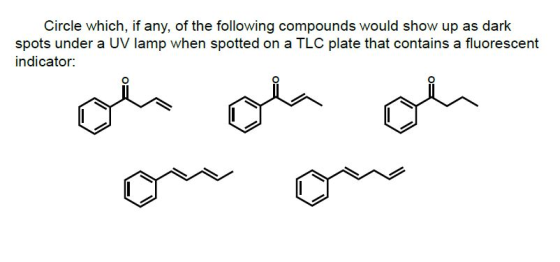
Circle which, if any, of the following compounds would show up as dark spots under a UV lamp when spotted on a TLC plate that contains a fluorescent indicator:
Homework Answers
Hello there,
Actually,I depends upon the choice of your indicator.
The more conjugated the compound, more it will absorb uv-light...thus the circled choices have enough conjugation so that they are potentially strong absorbents of uv light that no light reaches the indicator and hence the concerned spots appear dark spots.
 cheers
Nav
Kindly post a like it will help.
Add Answer to:
Circle which, if any, of the following compounds would show up
as dark spots under a...
Rank the following compounds form most polar to most non-polar, amide, either carboxylic acid, hydrocarbon, and...
 Rank the following compounds form most polar to most non-polar, amide, either carboxylic acid, hydrocarbon, and ketone. Which of these compounds is NOT UV active? Circle all that quality. March the spots to the compounds How would you fix this TLC plate? How would you fix this TLC plate?
Possible Quiz Questions 1 What two methods of visualizing spots on a TLC plate will you...
 Possible Quiz Questions 1 What two methods of visualizing spots on a TLC plate will you use in this Give two reasons why would you predict that the elution solvents (hexanes or acetate) would not be visible under UV visualization? week's lab? ethyl 2. Define R 3. Calculate the R of the spot on the following TLC plate. 4. Which compound in each pair is predicted to have the higher Ri? a. CH3CH2CH2CH2OH and CH3CH2CH2CH28r b. CH3CH2CH2CH2OH and CH3CH2CH2CH2CH2CH2CH3 c....
I need help with my pre and post lab questions. The three compounds below were spotted...
 I need help with my pre and post lab questions.
The three compounds below were spotted on a TLC plate and developed to give the TLC plate shown. Which compound corresponds to which spot? Calculate the Rf value for spot B in the TLC plate shown above. When using polarity to determine the relative rates at which organic compounds travel up the TLC plate, we are considering compounds of similar molecular weight. It should also be noted that Rf values...
I need help with my pre and post lab questions.
The three compounds below were spotted on a TLC plate and developed to give the TLC plate shown. Which compound corresponds to which spot? Calculate the Rf value for spot B in the TLC plate shown above. When using polarity to determine the relative rates at which organic compounds travel up the TLC plate, we are considering compounds of similar molecular weight. It should also be noted that Rf values...
4. Consider the following silica gel TLC plac or compounds A, B, and hexines: developed in...
 4. Consider the following silica gel TLC plac or compounds A, B, and hexines: developed in Fo-o- og a) Determine the Rr values of compounds A, B, and C run on a silica gel TLC plate using hexanes as the solvent b) Which compound, A, B, or C. is the most polar? values if you used acetone instead c) What would you expect to happen to the of hexanes as the eluting solvent? 5) Consider a sample that is a...
Place approximately 10 mg of each of the four reference compounds in labeled vials or 10 X 75-mm ...
 can you solve this for me,
please
Place approximately 10 mg of each of the four reference compounds in labeled vials or 10 X 75-mm test tubes and dissolve the samples in a few drops of methanol. In a fifth tube place a quarter of an analgesic tablet and add 1 mL of methanol. Crush the tablet with a rod, stir well, and allow the insoluble material to settle. Note that aspirin is not stable in methanol, so fresh solutions...
can you solve this for me,
please
Place approximately 10 mg of each of the four reference compounds in labeled vials or 10 X 75-mm test tubes and dissolve the samples in a few drops of methanol. In a fifth tube place a quarter of an analgesic tablet and add 1 mL of methanol. Crush the tablet with a rod, stir well, and allow the insoluble material to settle. Note that aspirin is not stable in methanol, so fresh solutions...
D Question 14 3.5 ts What is the line of solvent that moves up the TLC...
 D Question 14 3.5 ts What is the line of solvent that moves up the TLC plate referred to as? O Solvent front O Capillary front Resolving factor Chromatographic boundary Question 15 3.5 pts Most organic compouds are colorless or white. A UV lamp assists in seeing your separation on TLC plates by: Making the organic sample spots glow and leaving the stationary phase dark Making the stationary phase glow, leaving dark spots where your sample is located Showing how...
Which of the following compounds would you expect to have the lowest Rf value on a...
 Which of the following compounds would you expect to have the lowest Rf value on a silica gel TLC plate developed with dichloromethane? O A. Naphthalene O B. Phenyl acetate OC Butyric acid QUESTION 3 Which of the following compounds would you expect to have the highest Rf value on a silica gel TLC plate developed with dichloromethane? O A 2-octanone O B. Acetic acid C. 1-butanol OD. decane E. acetaldehyde
8 (7 pts) Which of the following pieces of glassware is best used for the process...
 8 (7 pts) Which of the following pieces of glassware is best used for the process known as gravity filtration? Circle the BEST answer. 9. (12 pts) Owing to their structural similarity, separation of mixtures of organic compounds (such as the isomers 2-t-butyl-, 3-t-butyl-, and 4-t-butylcyclohexene) often proves difficult. Silica gel chromatography, however, can be used with some success provided that sufficient silica gel is used to provide optimal separation. Consider the TLC plate pictured at right after developing and...
Which of the following compounds would have the lowest Rfvalue on a TLC plate? HO OH...
 Which of the following compounds would have the lowest Rfvalue on a TLC plate? HO OH A. B. C. D. E.
Help with the chem question in the picture, 11-15. 230 C at 16 mmHg) at atmospheric...
 Help with the chem question in
the picture, 11-15.
230 C at 16 mmHg) at atmospheric pressure 11. A mixture of compounds A and B was run on TLC using 10% ethyl ac- etate/90% hexanes, and the R, values of 0.05 and 0.12 were obtained. Is this optimal? How can the separation be improved? 12. A mixture ofphenol and cyclohexanol is run on a TLC plate using 30% ethyl sing a UV lamp. Does this mean acetate/70% hexanes. Only one...
Help with the chem question in
the picture, 11-15.
230 C at 16 mmHg) at atmospheric pressure 11. A mixture of compounds A and B was run on TLC using 10% ethyl ac- etate/90% hexanes, and the R, values of 0.05 and 0.12 were obtained. Is this optimal? How can the separation be improved? 12. A mixture ofphenol and cyclohexanol is run on a TLC plate using 30% ethyl sing a UV lamp. Does this mean acetate/70% hexanes. Only one...
 Rank the following compounds form most polar to most non-polar, amide, either carboxylic acid, hydrocarbon, and ketone. Which of these compounds is NOT UV active? Circle all that quality. March the spots to the compounds How would you fix this TLC plate? How would you fix this TLC plate?
 Possible Quiz Questions 1 What two methods of visualizing spots on a TLC plate will you use in this Give two reasons why would you predict that the elution solvents (hexanes or acetate) would not be visible under UV visualization? week's lab? ethyl 2. Define R 3. Calculate the R of the spot on the following TLC plate. 4. Which compound in each pair is predicted to have the higher Ri? a. CH3CH2CH2CH2OH and CH3CH2CH2CH28r b. CH3CH2CH2CH2OH and CH3CH2CH2CH2CH2CH2CH3 c....
 I need help with my pre and post lab questions.
The three compounds below were spotted on a TLC plate and developed to give the TLC plate shown. Which compound corresponds to which spot? Calculate the Rf value for spot B in the TLC plate shown above. When using polarity to determine the relative rates at which organic compounds travel up the TLC plate, we are considering compounds of similar molecular weight. It should also be noted that Rf values...
I need help with my pre and post lab questions.
The three compounds below were spotted on a TLC plate and developed to give the TLC plate shown. Which compound corresponds to which spot? Calculate the Rf value for spot B in the TLC plate shown above. When using polarity to determine the relative rates at which organic compounds travel up the TLC plate, we are considering compounds of similar molecular weight. It should also be noted that Rf values...
 4. Consider the following silica gel TLC plac or compounds A, B, and hexines: developed in Fo-o- og a) Determine the Rr values of compounds A, B, and C run on a silica gel TLC plate using hexanes as the solvent b) Which compound, A, B, or C. is the most polar? values if you used acetone instead c) What would you expect to happen to the of hexanes as the eluting solvent? 5) Consider a sample that is a...
 can you solve this for me,
please
Place approximately 10 mg of each of the four reference compounds in labeled vials or 10 X 75-mm test tubes and dissolve the samples in a few drops of methanol. In a fifth tube place a quarter of an analgesic tablet and add 1 mL of methanol. Crush the tablet with a rod, stir well, and allow the insoluble material to settle. Note that aspirin is not stable in methanol, so fresh solutions...
can you solve this for me,
please
Place approximately 10 mg of each of the four reference compounds in labeled vials or 10 X 75-mm test tubes and dissolve the samples in a few drops of methanol. In a fifth tube place a quarter of an analgesic tablet and add 1 mL of methanol. Crush the tablet with a rod, stir well, and allow the insoluble material to settle. Note that aspirin is not stable in methanol, so fresh solutions...
 D Question 14 3.5 ts What is the line of solvent that moves up the TLC plate referred to as? O Solvent front O Capillary front Resolving factor Chromatographic boundary Question 15 3.5 pts Most organic compouds are colorless or white. A UV lamp assists in seeing your separation on TLC plates by: Making the organic sample spots glow and leaving the stationary phase dark Making the stationary phase glow, leaving dark spots where your sample is located Showing how...
 Which of the following compounds would you expect to have the lowest Rf value on a silica gel TLC plate developed with dichloromethane? O A. Naphthalene O B. Phenyl acetate OC Butyric acid QUESTION 3 Which of the following compounds would you expect to have the highest Rf value on a silica gel TLC plate developed with dichloromethane? O A 2-octanone O B. Acetic acid C. 1-butanol OD. decane E. acetaldehyde
 8 (7 pts) Which of the following pieces of glassware is best used for the process known as gravity filtration? Circle the BEST answer. 9. (12 pts) Owing to their structural similarity, separation of mixtures of organic compounds (such as the isomers 2-t-butyl-, 3-t-butyl-, and 4-t-butylcyclohexene) often proves difficult. Silica gel chromatography, however, can be used with some success provided that sufficient silica gel is used to provide optimal separation. Consider the TLC plate pictured at right after developing and...
 Which of the following compounds would have the lowest Rfvalue on a TLC plate? HO OH A. B. C. D. E.
 Help with the chem question in
the picture, 11-15.
230 C at 16 mmHg) at atmospheric pressure 11. A mixture of compounds A and B was run on TLC using 10% ethyl ac- etate/90% hexanes, and the R, values of 0.05 and 0.12 were obtained. Is this optimal? How can the separation be improved? 12. A mixture ofphenol and cyclohexanol is run on a TLC plate using 30% ethyl sing a UV lamp. Does this mean acetate/70% hexanes. Only one...
Help with the chem question in
the picture, 11-15.
230 C at 16 mmHg) at atmospheric pressure 11. A mixture of compounds A and B was run on TLC using 10% ethyl ac- etate/90% hexanes, and the R, values of 0.05 and 0.12 were obtained. Is this optimal? How can the separation be improved? 12. A mixture ofphenol and cyclohexanol is run on a TLC plate using 30% ethyl sing a UV lamp. Does this mean acetate/70% hexanes. Only one...
Most questions answered within 3 hours.
-
Where is the error in this code sequence?
String s1 = "Hello";
String s2 = "ello";...
asked 11 months ago -
Financial data for Joel de Paris, Inc., for last year
follow:
Joel de Paris, Inc.
Balance...
asked 11 months ago -
Consider this reaction:
Al2(SO4)3 (aq)+ BaCl3
(aq) Al2Cl6 (aq)- +
3BaSO4(s) . What is the...
asked 11 months ago -
Suppose that Savneet is considering increasing her
recent random sample from 20 car rentals to 40...
asked 11 months ago -
Trucks arrive at an unloading terminal at an average rate of 120
per hour.
Trucks arrive...
asked 11 months ago -
Why are methanol and ethanol completely soluble in water while
octanol is not very little soluble....
asked 11 months ago -
A facilities manager at a university reads in a research report
that the mean amount of...
asked 11 months ago -
When the CuSO4 is rehydrated by adding water to the anhydrous
compound, is this an endothermic...
asked 11 months ago -
A ray of sunlight is passing from diamond into crown glass; the
angle of incidence is...
asked 11 months ago -
A block of mass 0.249 kg is placed on top of a light, vertical
spring of...
asked 11 months ago -
how do the kidneys compensate in the presences of acidosis
a) trigger hyperventilate
b) reserve acid...
asked 11 months ago -
Question 501 pts
The rental rate of capital to the firm increases. Which of the
following...
asked 11 months ago