Prove that each of the following conclusions (C) follows from the given premises. P1: (Ǝx)(P(x) ∧...
Prove that each of the following conclusions (C) follows from the given premises.
P1: (Ǝx)(P(x) ∧ (∀y)(B(y) ⇒ R(x,y)))
P2: ~(Ǝx)(Ǝy)(P(x) ∧ F(y) ∧ R(x,y))
P3: (∀y) (F(y) ⇒ B(y))
C: ~(Ǝx)F(x)
Homework Answers
The given premises of the argument are :
P1: (Ǝx)(P(x) ∧ (∀y)(B(y) ⇒ R(x,y)))
P2: ~(Ǝx)(Ǝy)(P(x) ∧ F(y) ∧ R(x,y))
P3: (∀y) (F(y) ⇒ B(y))
The conclusion to be proved is :
C: ~(Ǝx)F(x)
The argument is proved to be valid using the following table :
| Statement no. | Statement | Justification |
| 1 | (Ǝx)(P(x) ∧ (∀y)(B(y) ⇒ R(x,y))) | given |
| 2 | ~(Ǝx)(Ǝy)(P(x) ∧ F(y) ∧ R(x,y)) | given |
| 3 | (∀y) (F(y) ⇒ B(y)) | given |
| 4 | (Ǝx)(P(x) ∧ (B(c) ⇒ R(x,c))) | Universal instantiation on statement 1 with respect to variable y |
| 5 | P(b) ∧ ( B(c) ⇒ R(b,c) ) | Existential instantiation on statement 4 with respect to variable x |
| 6 | ~(Ǝx)(P(x) ∧ F(c) ∧ R(x,c)) | Existential instantiation on statement 2 with respect to variable y |
| 7 | (∀x) ~(P(x) ∧ F(c) ∧ R(x,c)) | Change of quantifier on statement 6 |
| 8 | ~(P(b) ∧ F(c) ∧ R(b,c)) | Universal instantiation on statement 7 with respect to variable x |
| 9 | (F(c) ⇒ B(c)) | Universal instantiation on statement 8 with respect to variable y |
| 10 | ( B(c) ⇒ R(b,c) ) | Simplification rule of inference on statement 5 |
| 11 | (F(c) ⇒ R(b,c) ) | Hypothetical Syllogism rule of inference on statements 9 and 10 |
| 12 | ~P(b) v ~F(c) v ~R(b,c) | De Morgan's Law on statement 8 |
| 13 | P(b) | Simplification rule of inference on statement 5 |
| 14 | ~F(c) v ~R(b,c) | Disjunctive Syllogism on statements 12 and 13 |
| 15 | ~F(c) v R(b,c) | Material Implication rule of inference on statement 11 |
| 16 | ~F(c) v ~F(c) | Resolution on statements 14 and 15 |
| 17 | ~F(c) | Idempotent Law on statement 16 |
| 18 | (∀x)~F(x) | Universal Generalization on statement 17 |
| 19 | ~(Ǝx)F(x) | Change of quantifier on statement 18 |
The conclusion ~(Ǝx)F(x) can be derived from the given premises.
Thus, the given argument is valid.
Add Answer to:
Prove that each of the following conclusions (C) follows from
the given premises.
P1: (Ǝx)(P(x) ∧...
Given are the polynomials P1:=1+ 2y + 3y?, P2 :=1+ 4y +9y?, Pz:=1+ 8y + 27y....
 Given are the polynomials P1:=1+ 2y + 3y?, P2 :=1+ 4y +9y?, Pz:=1+ 8y + 27y. To show that P1, P2, P3 € R2[y] are linearly independent, proceed as follows. (a) Find the images Vı := [PL]B, V2 := [P2]B and V3 := [P3]b in R3 of P1, P2 and P3 under the coordinate map with respect to the standard basis B = {1, y, yʻ} of R2[y]. (b) Form the matrix A = (v1 V2 V3] and find its...
X follows the log-normal distribution. If, P (X < x) = p1 and P (log X...
X follows the log-normal distribution. If, P (X < x) = p1 and P (log X < log x) = p2, which of the following is true? p1 = p2 p1<p2 p1>p2 Not enough information
Let f be the function defined below on the given region R, and let P be the partition P=P1×P2. Fi...
Let f be the function defined below on the given region R, and let P be the partition P=P1×P2. Find Uf(P). f(x,y)=3x+4y R:0≤x≤2,0≤y≤1 P1=[0,1,3/2,2],P2=[0,1/2,1] a) Uf(P)=23/4 b) Uf(P)=37/4 c) Uf(P)=39/4 d) Uf(P)=93/8 e) Uf(P)=57/4 f) None of these.
Two inner products are given on P? (z) as follows. If p(z) = Po + P1...
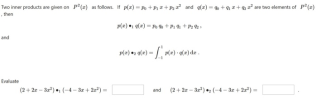 Two inner products are given on P? (z) as follows. If p(z) = Po + P1 z + P2 a? and q(z) = % +1 r+2 a are two elements of P? (x) then p(z) •1 q(x) = Po o + P1 91 + P2 2 and p(2) •2 q(x) = / p(=) • q(z) dz . Evaluate (2+ 2z – 3r) •2 (-4- 3z + 2z?) = (2+ 2x – 3z) • (-4– 3z + 2z?) = and %3!
Equations: p + q = 1 p 2 + 2pq + q 2 = 1 Three-way cross [(P1 x P2) x P3] predicted from F1's: 1/...
Equations: p + q = 1 p 2 + 2pq + q 2 = 1 Three-way cross [(P1 x P2) x P3] predicted from F1's: 1/2[F1(P1 x P3) + F1(P2 x P3)] Double cross [(P1 x P2) x (P3 x P4)] predicted from F1's: 1/4[F1(P1 x P3) + F1(P1 x P4) + F1(P2 x P3) + F1(P2 x P4)] V p = V A + V E + V D V G = V A + V D V E...
Show that the following (formalized) arguments are valid by deriving conclusions from given premises by utilizing inference rules. the C 0 15 13] (51 [14] C AB 3: A V B Show that the following (...
 Show that the following (formalized) arguments are valid by deriving conclusions from given premises by utilizing inference rules. the C 0 15 13] (51 [14] C AB 3: A V B
Show that the following (formalized) arguments are valid by deriving conclusions from given premises by utilizing inference rules. the C 0 15 13] (51 [14] C AB 3: A V B
Show that the following (formalized) arguments are valid by deriving conclusions from given premises by utilizing inference rules. the C 0 15 13] (51 [14] C AB 3: A V B
1. Given the following predicates and premises: C(x): “ x is in this class” R(x): “...
1. Given the following predicates and premises: C(x): “ x is in this class” R(x): “ x owns a yellow truck” T(x): “ x has gotten a parking ticket.” Premises C(Linda), R(Linda) , ∀x(R(x) → T(x)) Conclude that ∃x(C(x) ∧ T(x)) 2.Find the error/s in this argument that shows that if ∃xP(x) ∧ ∃xQ(x) is true then ∃x(P(x) ∧ Q(x)) is true. 1. ∃xP(x) ∧ ∃xQ(x) Premise 2. ∃xP(x) Simplification from (1) 3. P(c) Existential instantiation from (2) 4. ∃xQ(x)...
Consider any two random variables X, Y of any distirbution and not necesarily independent. Given that...
Consider any two random variables X, Y of any distirbution and not necesarily independent. Given that P(X=a)=p1, P(max(X, Y) =a) =p2, and P(min(X, Y) =a) =p3. Find P(Y=a) in terms of p1, p2 and p3. Hint: Use the first Bayes theorem. Choose a suitable event-complement pair to partition the probability space by comparing X and Y .
4.) NSTRUCTIONS: Select the conclusion that follows in a single step from the given premises. Given the following premises: 1. ∼M ⊃ S 2. ∼M 3. (M ∨ H) ∨ ∼S a. M ∨ H ...
4.) NSTRUCTIONS: Select the conclusion that follows in a single step from the given premises. Given the following premises: 1. ∼M ⊃ S 2. ∼M 3. (M ∨ H) ∨ ∼S a. M ∨ H 3, Simp b. M ∨ (H ∨ ∼S) 3, Assoc c. ∼S 1, 2, MP d. ∼ M ∨ S 1, Impl e. H 2, 3, DS 3.) NSTRUCTIONS: Select the conclusion that follows in a single step from the given premises. Given the following...
(1) Having the following sets: [2 marks] P: P1, P2, P3 R: R1, R2, R3 E:...
(1) Having the following sets: [2 marks] P: P1, P2, P3 R: R1, R2, R3 E: P1→R2, P2→R1 R1→P1, R2→P2, R3→P3 Draw the resource allocation graph of the previous system? Examine if the system deadlocked or not and list all the cycles?
 Given are the polynomials P1:=1+ 2y + 3y?, P2 :=1+ 4y +9y?, Pz:=1+ 8y + 27y. To show that P1, P2, P3 € R2[y] are linearly independent, proceed as follows. (a) Find the images Vı := [PL]B, V2 := [P2]B and V3 := [P3]b in R3 of P1, P2 and P3 under the coordinate map with respect to the standard basis B = {1, y, yʻ} of R2[y]. (b) Form the matrix A = (v1 V2 V3] and find its...
 Two inner products are given on P? (z) as follows. If p(z) = Po + P1 z + P2 a? and q(z) = % +1 r+2 a are two elements of P? (x) then p(z) •1 q(x) = Po o + P1 91 + P2 2 and p(2) •2 q(x) = / p(=) • q(z) dz . Evaluate (2+ 2z – 3r) •2 (-4- 3z + 2z?) = (2+ 2x – 3z) • (-4– 3z + 2z?) = and %3!
 Show that the following (formalized) arguments are valid by deriving conclusions from given premises by utilizing inference rules. the C 0 15 13] (51 [14] C AB 3: A V B
Show that the following (formalized) arguments are valid by deriving conclusions from given premises by utilizing inference rules. the C 0 15 13] (51 [14] C AB 3: A V B
Show that the following (formalized) arguments are valid by deriving conclusions from given premises by utilizing inference rules. the C 0 15 13] (51 [14] C AB 3: A V B
Most questions answered within 3 hours.
-
Where is the error in this code sequence?
String s1 = "Hello";
String s2 = "ello";...
asked 11 months ago -
Financial data for Joel de Paris, Inc., for last year
follow:
Joel de Paris, Inc.
Balance...
asked 11 months ago -
Consider this reaction:
Al2(SO4)3 (aq)+ BaCl3
(aq) Al2Cl6 (aq)- +
3BaSO4(s) . What is the...
asked 11 months ago -
Suppose that Savneet is considering increasing her
recent random sample from 20 car rentals to 40...
asked 11 months ago -
Trucks arrive at an unloading terminal at an average rate of 120
per hour.
Trucks arrive...
asked 11 months ago -
Why are methanol and ethanol completely soluble in water while
octanol is not very little soluble....
asked 11 months ago -
A facilities manager at a university reads in a research report
that the mean amount of...
asked 11 months ago -
When the CuSO4 is rehydrated by adding water to the anhydrous
compound, is this an endothermic...
asked 11 months ago -
A ray of sunlight is passing from diamond into crown glass; the
angle of incidence is...
asked 11 months ago -
A block of mass 0.249 kg is placed on top of a light, vertical
spring of...
asked 11 months ago -
how do the kidneys compensate in the presences of acidosis
a) trigger hyperventilate
b) reserve acid...
asked 11 months ago -
Question 501 pts
The rental rate of capital to the firm increases. Which of the
following...
asked 11 months ago