The circuit above has the following parameters:
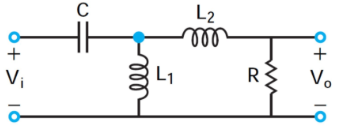
The circuit above has the following parameters:
R=55 Ohm, C=1.5 uF ("u"=micro), L1=3 mH, L2=4 mH;
Using MATLAB (or equivalent tool) generate the transfer function H = Vo/Vi magnitude MdB(f) and Phase(f) frequency dependencies in the frequency range from 100 Hz to 12000 Hz.
Define the Magntude plot of the transfer function by entering f (Hz) and M (dB) points. Do not enter units.
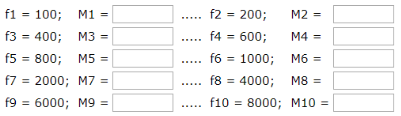
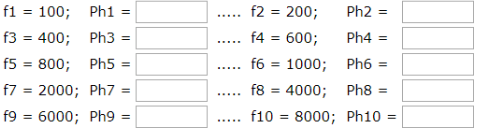
Define the Phase plot of the transfer function by entering f (Hz) and Phase (in degrees) points. Do not enter units.
Homework Answers
Script:1
syms s;
L1=0.003;L2=0.004;
C=1.5*(10^(-6));
R=55;
Z=[(1/s*C)+(s*L1) -s*L1 ;
-s*L1 (s*(L1+L2))+R ];
V=[1 0]';
I=inv(Z)*V;
H=I(2)*R
Command window:
H =
______________________________________________________________________________
Script 2:(From the above trasnfer function)
clc;close all;clear all;
b =[24349702177296608133120000 0 0];
a=[12174851088648304375000 1549526502191602375 24349702177296608133120000 1770887431076116955136];
f=linspace(100,12000,1000);
w=2*pi*f;
H=freqs(b,a,w);
figure;
subplot(211)
plot(f,20*log10(abs(H)));grid;
xlabel('f(Hz)');ylabel('|H|')
title('Magnitude response')
subplot(212)
plot(f,rad2deg(angle(H)));grid;
xlabel('f(Hz)');ylabel('
title('Phase response')
%For tabulation
f=[100 200 400 600 800 1000 2000 4000 6000 8000];
w=2*pi*f;
H=freqs(b,a,w);
M=20*log10(abs(H));
PH=rad2deg(angle(H));
A=[f' M' PH']

f(Hz) M(Mag) PH(phase)
103 ×
0.1000 0.0101 -0.0900
0.2000 0.0040 -0.0900
0.4000 -0.0020 -0.0900
0.6000 -0.0055 -0.0900
0.8000 -0.0080 -0.0900
1.0000 -0.0099 -0.0900
2.0000 -0.0160 -0.0900
4.0000 -0.0220 -0.0900
6.0000 -0.0255 -0.0900
8.0000 -0.0280 -0.0900
Problem 05 In R Out For the circuit above, answer the following questions. 1. Derive the formula ...
 Please Help!
Problem 05 In R Out For the circuit above, answer the following questions. 1. Derive the formula for the transfer function angular resonant frequency omega_res (enter the right hand side part of the formula only) Use exactly same notations for L,C and R as in the circuit diagram. Hints for solving the problem. (1) Ignore trivial solution omega_res 0 (2) In case obtaining the resonant frequency using the condition imag(H)0 fails, try finding the resonant frequency using impedance...
Please Help!
Problem 05 In R Out For the circuit above, answer the following questions. 1. Derive the formula for the transfer function angular resonant frequency omega_res (enter the right hand side part of the formula only) Use exactly same notations for L,C and R as in the circuit diagram. Hints for solving the problem. (1) Ignore trivial solution omega_res 0 (2) In case obtaining the resonant frequency using the condition imag(H)0 fails, try finding the resonant frequency using impedance...
Using Matlab, plot the magnitude and phase of the transfer function (vo/vi) vs. frequency range 1-100...
 Using Matlab, plot the magnitude and phase of the transfer
function (vo/vi) vs. frequency range 1-100 kHz. Use log scale for
the frequency axis, dB scale for the magnitude axis, and degrees
for the phase axis. Note dB = 20log10(vo/vi). The 10 stands for
base 10. I need help writing a MATLAB code to output this plot and
also coming up with the vo/vi function itself.
0.1807 H 1402 nF 0.1624 H 1.560nF 1.559 mH
Using Matlab, plot the magnitude and phase of the transfer
function (vo/vi) vs. frequency range 1-100 kHz. Use log scale for
the frequency axis, dB scale for the magnitude axis, and degrees
for the phase axis. Note dB = 20log10(vo/vi). The 10 stands for
base 10. I need help writing a MATLAB code to output this plot and
also coming up with the vo/vi function itself.
0.1807 H 1402 nF 0.1624 H 1.560nF 1.559 mH
Input voltage is applied to a circuit consisting of a series connection of capacitor C=10 uF...
 Input voltage is applied to a circuit consisting of a series connection of capacitor C=10 uF ("u"="micro") and resistor R=60 Ohm. The output voltage is the voltage across resistor R. Find the corner frequency omc of the circuit in rad/s (do not enter the units). Submit Answer Tries 0/3 Using the graph windows below, generate Bode plots for the magnitude and phase of the transfer function H in the com/omc) range from 0.01 to 100- The horizontal axis (omega-axis) has...
3. For the active filter circuit below, complete the following: a) Find the magnitude of the...
 3. For the active filter circuit below, complete the following: a) Find the magnitude of the transfer function | H | starting from the nodal equations. b) Find the phase shift of the transfer function (W) c) Find the cutoff frequency fc in Hz d) Is this a high pass or low pass filter? e) Find the passband gain of the filter 62 k2 ANA EVA 22 nF 3.3k f) Given the following input signal: vi(t) = 1.0 sin(2nft +...
21 Vi Z2 Vo Figure 1 1. Ref: Figure 1. Let Z1 L (an inductor), Z2 - R (a resistor). Vi Calculate the magnitude and phase of the transfer function H(w) Figure 1 T 2. Repeat #1 with L = 100 mH, R 1kΩ....
 21 Vi Z2 Vo Figure 1 1. Ref: Figure 1. Let Z1 L (an inductor), Z2 - R (a resistor). Vi Calculate the magnitude and phase of the transfer function H(w) Figure 1 T 2. Repeat #1 with L = 100 mH, R 1kΩ. a) Plot the frequency response in dB* on a both on a linear scale and then a log scale from ω-1 to 100,000,000 rad/sec with points every decade (1 b) 1,000 etc). 10 100 Plot the...
Simulation For each filter mentioned in the following cases, first simulate the circuit using Multisim. You can get a plot of the transfer function that is called the Bode plot. From the right toolba...
 Simulation For each filter mentioned in the following cases, first simulate the circuit using Multisim. You can get a plot of the transfer function that is called the Bode plot. From the right toolbar, select "Bode Plotter". Change initial (I) and final (F) frequencies to 1Hz and 200 KHz, respectively. Use a Voltage AC source as the input signal. You do not need to change any parameter from voltage AC source. Connect "Bode Plotter" to input and output of your...
the voltage transfer function Avi) Vo(s)/Vin(s) (s-plane representation) for your selected circuit. What is the frequency...
 the voltage transfer function Avi) Vo(s)/Vin(s) (s-plane representation) for your selected circuit. What is the frequency response for this circuit (both magnitude and phase)? What is the corner frequency in Hz and rad/sec? What kind of filter is this? (2+2+1+1) points 1 Vi ?.
For each filter mentioned in the following cases, first simulate the circuit using Multisim. You can get a plot of the transfer function that is called the Bode plot. From the right toolbar, select &...
 For each filter mentioned in the following cases, first simulate the circuit using Multisim. You can get a plot of the transfer function that is called the Bode plot. From the right toolbar, select "Bode Plotter". Change initial (I) and final (F frequencies to 1Hz and 200 KHz, respectively. Use a Voltage AC source as the input signal. You do not need to change any parameter from voltage AC source Connect "Bode Plotter" to input and output of your circuit...
Matlab Code if available Problem 04 mm us(0 In the circuit, the voltage source Vs(t) frequency,...
 Matlab Code if available
Problem 04 mm us(0 In the circuit, the voltage source Vs(t) frequency, amplitude and phase are 22 kHz, 10 V and 0.25 rad correspondingly; Rs=4 Ohm, Ri=12 Ohm, R2=9 Ohm, R3=2 Ohm, L1=0.11 mH, L2=0.13 mH, C= 1.4 uF ("u"="micro"). Part A. Using any appropriate techniques, find the parameters of Thevenin equivalent circuit with respect to the ports "a" and "b". Present the Thevenin source in the polar form and the Thevenin impedance in the algebraic...
Matlab Code if available
Problem 04 mm us(0 In the circuit, the voltage source Vs(t) frequency, amplitude and phase are 22 kHz, 10 V and 0.25 rad correspondingly; Rs=4 Ohm, Ri=12 Ohm, R2=9 Ohm, R3=2 Ohm, L1=0.11 mH, L2=0.13 mH, C= 1.4 uF ("u"="micro"). Part A. Using any appropriate techniques, find the parameters of Thevenin equivalent circuit with respect to the ports "a" and "b". Present the Thevenin source in the polar form and the Thevenin impedance in the algebraic...
Prelab 10.1: Active lowpass filter Given the circuit shown in Figure 10.1 with Ri-R2-Rs-R4-R-1.0 [k2, and...
 Prelab 10.1: Active lowpass filter Given the circuit shown in Figure 10.1 with Ri-R2-Rs-R4-R-1.0 [k2, and C 0.1 [uF (a) Represent the circuit in state-space form given by i(t) = ar(t) + bu(t), i.e., find the values of parameters a, b, c, and d. (b) Find the expression for the transfer function, G(s) the complex frequency (Laplace) domain. (c) Find the expression of the frequency transfer function H(f) and the value of the half power frequency, fB in Hz (d)...
 Please Help!
Problem 05 In R Out For the circuit above, answer the following questions. 1. Derive the formula for the transfer function angular resonant frequency omega_res (enter the right hand side part of the formula only) Use exactly same notations for L,C and R as in the circuit diagram. Hints for solving the problem. (1) Ignore trivial solution omega_res 0 (2) In case obtaining the resonant frequency using the condition imag(H)0 fails, try finding the resonant frequency using impedance...
Please Help!
Problem 05 In R Out For the circuit above, answer the following questions. 1. Derive the formula for the transfer function angular resonant frequency omega_res (enter the right hand side part of the formula only) Use exactly same notations for L,C and R as in the circuit diagram. Hints for solving the problem. (1) Ignore trivial solution omega_res 0 (2) In case obtaining the resonant frequency using the condition imag(H)0 fails, try finding the resonant frequency using impedance...
 Using Matlab, plot the magnitude and phase of the transfer
function (vo/vi) vs. frequency range 1-100 kHz. Use log scale for
the frequency axis, dB scale for the magnitude axis, and degrees
for the phase axis. Note dB = 20log10(vo/vi). The 10 stands for
base 10. I need help writing a MATLAB code to output this plot and
also coming up with the vo/vi function itself.
0.1807 H 1402 nF 0.1624 H 1.560nF 1.559 mH
Using Matlab, plot the magnitude and phase of the transfer
function (vo/vi) vs. frequency range 1-100 kHz. Use log scale for
the frequency axis, dB scale for the magnitude axis, and degrees
for the phase axis. Note dB = 20log10(vo/vi). The 10 stands for
base 10. I need help writing a MATLAB code to output this plot and
also coming up with the vo/vi function itself.
0.1807 H 1402 nF 0.1624 H 1.560nF 1.559 mH
 Input voltage is applied to a circuit consisting of a series connection of capacitor C=10 uF ("u"="micro") and resistor R=60 Ohm. The output voltage is the voltage across resistor R. Find the corner frequency omc of the circuit in rad/s (do not enter the units). Submit Answer Tries 0/3 Using the graph windows below, generate Bode plots for the magnitude and phase of the transfer function H in the com/omc) range from 0.01 to 100- The horizontal axis (omega-axis) has...
 3. For the active filter circuit below, complete the following: a) Find the magnitude of the transfer function | H | starting from the nodal equations. b) Find the phase shift of the transfer function (W) c) Find the cutoff frequency fc in Hz d) Is this a high pass or low pass filter? e) Find the passband gain of the filter 62 k2 ANA EVA 22 nF 3.3k f) Given the following input signal: vi(t) = 1.0 sin(2nft +...
 21 Vi Z2 Vo Figure 1 1. Ref: Figure 1. Let Z1 L (an inductor), Z2 - R (a resistor). Vi Calculate the magnitude and phase of the transfer function H(w) Figure 1 T 2. Repeat #1 with L = 100 mH, R 1kΩ. a) Plot the frequency response in dB* on a both on a linear scale and then a log scale from ω-1 to 100,000,000 rad/sec with points every decade (1 b) 1,000 etc). 10 100 Plot the...
 Simulation For each filter mentioned in the following cases, first simulate the circuit using Multisim. You can get a plot of the transfer function that is called the Bode plot. From the right toolbar, select "Bode Plotter". Change initial (I) and final (F) frequencies to 1Hz and 200 KHz, respectively. Use a Voltage AC source as the input signal. You do not need to change any parameter from voltage AC source. Connect "Bode Plotter" to input and output of your...
 the voltage transfer function Avi) Vo(s)/Vin(s) (s-plane representation) for your selected circuit. What is the frequency response for this circuit (both magnitude and phase)? What is the corner frequency in Hz and rad/sec? What kind of filter is this? (2+2+1+1) points 1 Vi ?.
 For each filter mentioned in the following cases, first simulate the circuit using Multisim. You can get a plot of the transfer function that is called the Bode plot. From the right toolbar, select "Bode Plotter". Change initial (I) and final (F frequencies to 1Hz and 200 KHz, respectively. Use a Voltage AC source as the input signal. You do not need to change any parameter from voltage AC source Connect "Bode Plotter" to input and output of your circuit...
 Matlab Code if available
Problem 04 mm us(0 In the circuit, the voltage source Vs(t) frequency, amplitude and phase are 22 kHz, 10 V and 0.25 rad correspondingly; Rs=4 Ohm, Ri=12 Ohm, R2=9 Ohm, R3=2 Ohm, L1=0.11 mH, L2=0.13 mH, C= 1.4 uF ("u"="micro"). Part A. Using any appropriate techniques, find the parameters of Thevenin equivalent circuit with respect to the ports "a" and "b". Present the Thevenin source in the polar form and the Thevenin impedance in the algebraic...
Matlab Code if available
Problem 04 mm us(0 In the circuit, the voltage source Vs(t) frequency, amplitude and phase are 22 kHz, 10 V and 0.25 rad correspondingly; Rs=4 Ohm, Ri=12 Ohm, R2=9 Ohm, R3=2 Ohm, L1=0.11 mH, L2=0.13 mH, C= 1.4 uF ("u"="micro"). Part A. Using any appropriate techniques, find the parameters of Thevenin equivalent circuit with respect to the ports "a" and "b". Present the Thevenin source in the polar form and the Thevenin impedance in the algebraic...
 Prelab 10.1: Active lowpass filter Given the circuit shown in Figure 10.1 with Ri-R2-Rs-R4-R-1.0 [k2, and C 0.1 [uF (a) Represent the circuit in state-space form given by i(t) = ar(t) + bu(t), i.e., find the values of parameters a, b, c, and d. (b) Find the expression for the transfer function, G(s) the complex frequency (Laplace) domain. (c) Find the expression of the frequency transfer function H(f) and the value of the half power frequency, fB in Hz (d)...
Most questions answered within 3 hours.
-
Where is the error in this code sequence?
String s1 = "Hello";
String s2 = "ello";...
asked 10 months ago -
Financial data for Joel de Paris, Inc., for last year
follow:
Joel de Paris, Inc.
Balance...
asked 10 months ago -
Consider this reaction:
Al2(SO4)3 (aq)+ BaCl3
(aq) Al2Cl6 (aq)- +
3BaSO4(s) . What is the...
asked 10 months ago -
Suppose that Savneet is considering increasing her
recent random sample from 20 car rentals to 40...
asked 10 months ago -
Trucks arrive at an unloading terminal at an average rate of 120
per hour.
Trucks arrive...
asked 10 months ago -
Why are methanol and ethanol completely soluble in water while
octanol is not very little soluble....
asked 10 months ago -
A facilities manager at a university reads in a research report
that the mean amount of...
asked 10 months ago -
When the CuSO4 is rehydrated by adding water to the anhydrous
compound, is this an endothermic...
asked 10 months ago -
A ray of sunlight is passing from diamond into crown glass; the
angle of incidence is...
asked 10 months ago -
A block of mass 0.249 kg is placed on top of a light, vertical
spring of...
asked 10 months ago -
how do the kidneys compensate in the presences of acidosis
a) trigger hyperventilate
b) reserve acid...
asked 10 months ago -
Question 501 pts
The rental rate of capital to the firm increases. Which of the
following...
asked 10 months ago