

Homework Answers

Add Answer to:
consider a physical system
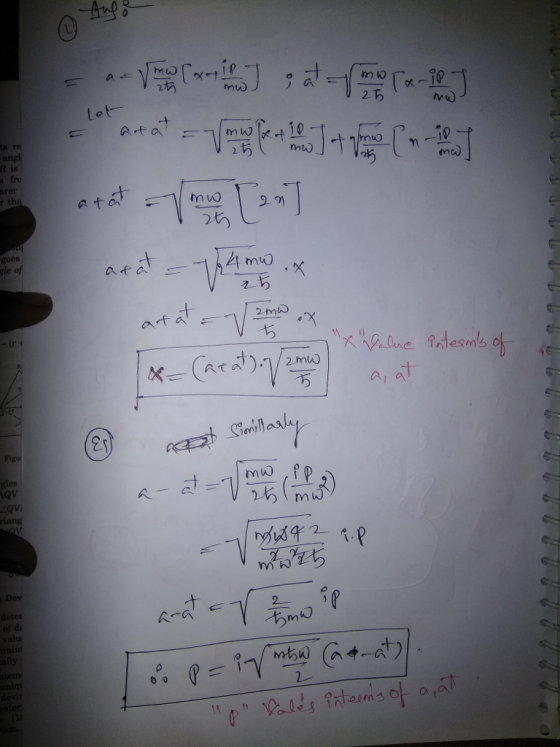
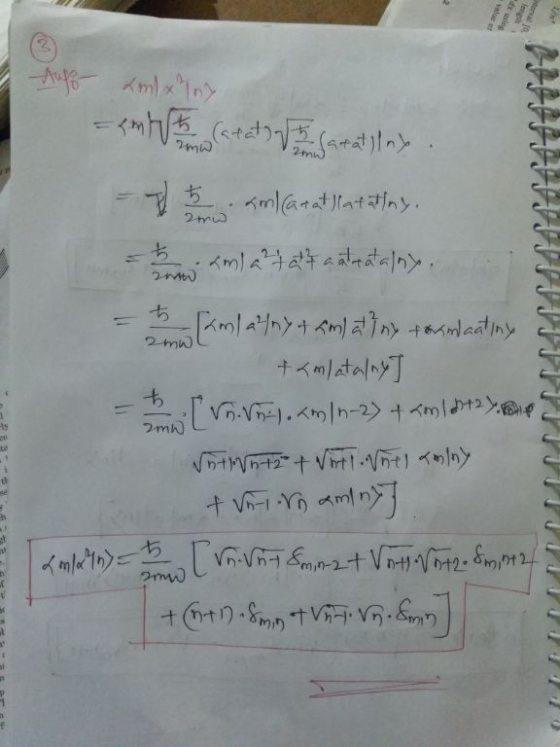
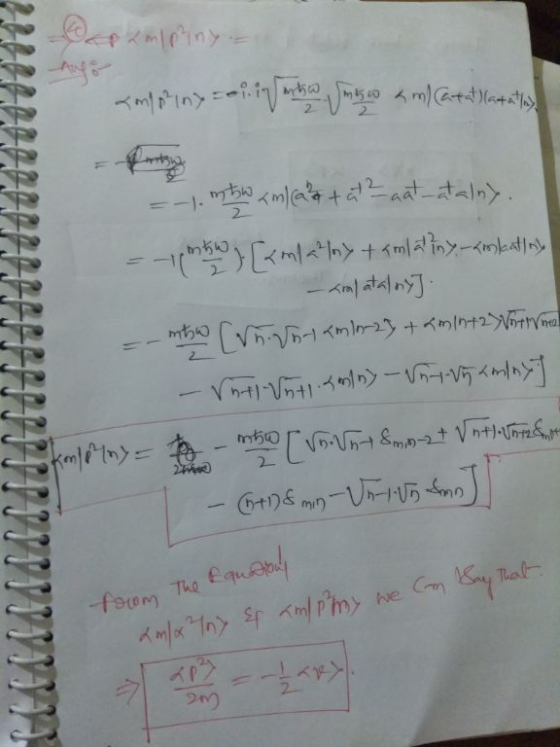
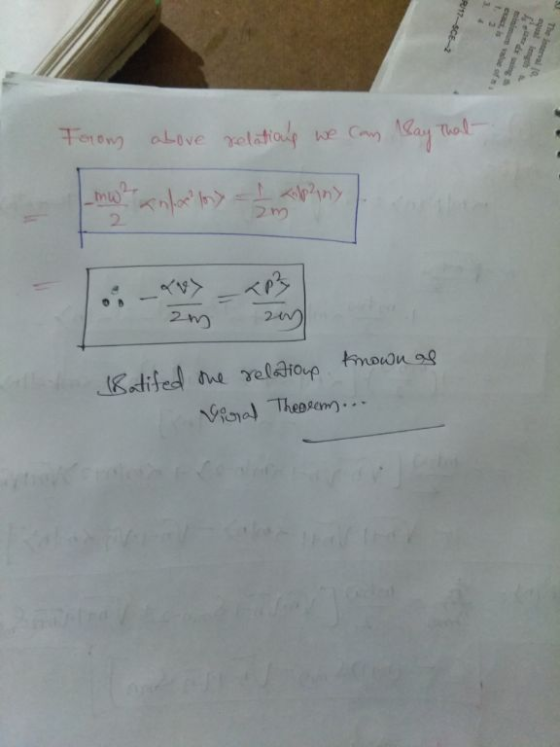
1. Consider a one-dimensional simple harmonic oscillator. a. Using +mw 2h mw...
2. Consider a one-dimensional simple harmonic oscillator. Do the following algebraically. 2. Consider a one -dimensional...
 2. Consider a one-dimensional simple harmonic oscillator. Do the
following algebraically.
2. Consider a one -dimensional simple harmonic oscillator. Do the following algebraically. a) Construct a linear superposition of I0) and |1) by choosing appropriate phases, such that (x) is as large as possible. i) Suppose the oscillator is in the state la) att 0. Find la) and x) ii) Evaluate the expectation value(x) at t 〉 0. ii Evaluate (A x)2) att > 0. b) Answer the same questions...
2. Consider a one-dimensional simple harmonic oscillator. Do the
following algebraically.
2. Consider a one -dimensional simple harmonic oscillator. Do the following algebraically. a) Construct a linear superposition of I0) and |1) by choosing appropriate phases, such that (x) is as large as possible. i) Suppose the oscillator is in the state la) att 0. Find la) and x) ii) Evaluate the expectation value(x) at t 〉 0. ii Evaluate (A x)2) att > 0. b) Answer the same questions...
A particle with mass m is in a one-dimensional simple harmonic oscillator potential. At time t = 0 it is described by the state where lo and l) are normalised energy eigenfunctions corresponding to e...
 A particle with mass m is in a one-dimensional simple harmonic oscillator potential. At time t = 0 it is described by the state where lo and l) are normalised energy eigenfunctions corresponding to energies E and Ey and b and c are real constants. (a) Find b and c so that (x) is as large as possible. b) Write down the wavefunction of this particle at a time t later c)Caleulate (x) for the particle at time t (d)...
1. Consider a one-dimensional simple harmonic oscillator. We know that the total energy (E) has values:...
 1. Consider a one-dimensional simple harmonic oscillator. We know that the total energy (E) has values: Here the angular frequency (o) corresponds to the freshman physics value of [spring constant/massja and (n) can be 0, 1,2, any non-negative integer. We know that the total energy is a measurable, observable quantity. The total energy includes the kinetic energy and the potential energy. Please explain whether or not the kinetic energy and the potential energy can both be measured at the same...
Consider a one-dimensional simple harmonic oscillator under the influence of a restoring force -kx. Find its...
Consider a one-dimensional simple harmonic oscillator under the influence of a restoring force -kx. Find its average displacemtnt, average speed, average potential energy within a quater of its time period.
could someone please help me with part c? Consider a one-dimensional harmonic oscillator, at a timet...
 could someone please help me
with part c?
Consider a one-dimensional harmonic oscillator, at a timet - 0 in the state, where In〉 is the nth energy eigenstate with energy eigenvalues En = (n + ,wo a) Write out an expression, in terms of the energies En, for the state vector at a time t. That is, write down what ^(t)) is equal to. b) Calculate the expectation value of the energy of the state vector. c) Calculate the expectation...
could someone please help me
with part c?
Consider a one-dimensional harmonic oscillator, at a timet - 0 in the state, where In〉 is the nth energy eigenstate with energy eigenvalues En = (n + ,wo a) Write out an expression, in terms of the energies En, for the state vector at a time t. That is, write down what ^(t)) is equal to. b) Calculate the expectation value of the energy of the state vector. c) Calculate the expectation...
4. (20 points) Harmonic Oscillator The ground state wave function of a simple harmonic oscillator is...
 4. (20 points) Harmonic Oscillator The ground state wave function of a simple harmonic oscillator is (a) = Ae-42", where a = (a) Using the normalization condition, obtain the constant A. (b) Find (c), (), and Az, using the result of A obtained in (a). Again, A.= V(32) - (2) (c) Find (p) and Ap. For the latter, you need to evaluate (p). Hint: For a harmonic oscillator, the time-averaged kinetic energy is equal to the time-averaged potential energy, and...
Question A2: Coherent states of the harmonic oscillator Consider a one-dimensional harmonic oscillator with the Hamiltonian...
 Question A2: Coherent states of the harmonic oscillator Consider a one-dimensional harmonic oscillator with the Hamiltonian 12 12 m2 H = -2m d. 2+ 2 Here m and w are the mass and frequency, respectively. Consider a time-dependent wave function of the form <(x,t) = C'exp (-a(x – 9(t)+ ik(t)z +io(t)), where a and C are positive constants, and g(t), k(t), and o(t) are real functions of time t. 1. Express C in terms of a. [2 marks] 2. By...
Estimate the ground-state energy of a one-dimensional simple harmonic oscillator using (50) = e-a-l as a...
 Estimate the ground-state energy of a one-dimensional simple harmonic oscillator using (50) = e-a-l as a trial function with a to be varied. For a simple harmonic oscillator we have H + jmwºr? Recall that, for the variational method, the trial function (HO) gives an expectation value of H such that (016) > Eo, where Eo is the ground state energy. You may use: n! dH() ||= TH(c) – z[1 – H(r)], 8(2), dx S." arcade an+1 where (x) and...
Simple Harmonic Motion Consider a harmonic oscillator with period 0.13 s. If the speed at the...
Simple Harmonic Motion Consider a harmonic oscillator with period 0.13 s. If the speed at the equlibrium position is 2.10 m/s, what is the speed of a mass at a point which is displaced by 1.5 cm? (Work this out using conservation of energy). Please make sure to draw an energy bar chart for this. Find the answer and show the steps taken to get to the answer. Evaluate the answer and explain why it makes sense.
Please do this problem about quantum mechanic harmonic oscillator and show all your steps thank you. Q1. Consider a particle of mass m moving in a one-dimensional harmonic oscillator potential. 1....
 Please do this problem about quantum mechanic harmonic
oscillator and show all your steps thank you.
Q1. Consider a particle of mass m moving in a one-dimensional harmonic oscillator potential. 1. Calculate the product of uncertainties in position and momentum for the particle in 2. Compare the result of (a) with the uncertainty product when the particle is in its the fifth excited state, ie. (OxơP)5. lowest energy state.
Q1. Consider a particle of mass m moving in a one-dimensional...
Please do this problem about quantum mechanic harmonic
oscillator and show all your steps thank you.
Q1. Consider a particle of mass m moving in a one-dimensional harmonic oscillator potential. 1. Calculate the product of uncertainties in position and momentum for the particle in 2. Compare the result of (a) with the uncertainty product when the particle is in its the fifth excited state, ie. (OxơP)5. lowest energy state.
Q1. Consider a particle of mass m moving in a one-dimensional...
 2. Consider a one-dimensional simple harmonic oscillator. Do the
following algebraically.
2. Consider a one -dimensional simple harmonic oscillator. Do the following algebraically. a) Construct a linear superposition of I0) and |1) by choosing appropriate phases, such that (x) is as large as possible. i) Suppose the oscillator is in the state la) att 0. Find la) and x) ii) Evaluate the expectation value(x) at t 〉 0. ii Evaluate (A x)2) att > 0. b) Answer the same questions...
2. Consider a one-dimensional simple harmonic oscillator. Do the
following algebraically.
2. Consider a one -dimensional simple harmonic oscillator. Do the following algebraically. a) Construct a linear superposition of I0) and |1) by choosing appropriate phases, such that (x) is as large as possible. i) Suppose the oscillator is in the state la) att 0. Find la) and x) ii) Evaluate the expectation value(x) at t 〉 0. ii Evaluate (A x)2) att > 0. b) Answer the same questions...
 A particle with mass m is in a one-dimensional simple harmonic oscillator potential. At time t = 0 it is described by the state where lo and l) are normalised energy eigenfunctions corresponding to energies E and Ey and b and c are real constants. (a) Find b and c so that (x) is as large as possible. b) Write down the wavefunction of this particle at a time t later c)Caleulate (x) for the particle at time t (d)...
 1. Consider a one-dimensional simple harmonic oscillator. We know that the total energy (E) has values: Here the angular frequency (o) corresponds to the freshman physics value of [spring constant/massja and (n) can be 0, 1,2, any non-negative integer. We know that the total energy is a measurable, observable quantity. The total energy includes the kinetic energy and the potential energy. Please explain whether or not the kinetic energy and the potential energy can both be measured at the same...
 could someone please help me
with part c?
Consider a one-dimensional harmonic oscillator, at a timet - 0 in the state, where In〉 is the nth energy eigenstate with energy eigenvalues En = (n + ,wo a) Write out an expression, in terms of the energies En, for the state vector at a time t. That is, write down what ^(t)) is equal to. b) Calculate the expectation value of the energy of the state vector. c) Calculate the expectation...
could someone please help me
with part c?
Consider a one-dimensional harmonic oscillator, at a timet - 0 in the state, where In〉 is the nth energy eigenstate with energy eigenvalues En = (n + ,wo a) Write out an expression, in terms of the energies En, for the state vector at a time t. That is, write down what ^(t)) is equal to. b) Calculate the expectation value of the energy of the state vector. c) Calculate the expectation...
 4. (20 points) Harmonic Oscillator The ground state wave function of a simple harmonic oscillator is (a) = Ae-42", where a = (a) Using the normalization condition, obtain the constant A. (b) Find (c), (), and Az, using the result of A obtained in (a). Again, A.= V(32) - (2) (c) Find (p) and Ap. For the latter, you need to evaluate (p). Hint: For a harmonic oscillator, the time-averaged kinetic energy is equal to the time-averaged potential energy, and...
 Question A2: Coherent states of the harmonic oscillator Consider a one-dimensional harmonic oscillator with the Hamiltonian 12 12 m2 H = -2m d. 2+ 2 Here m and w are the mass and frequency, respectively. Consider a time-dependent wave function of the form <(x,t) = C'exp (-a(x – 9(t)+ ik(t)z +io(t)), where a and C are positive constants, and g(t), k(t), and o(t) are real functions of time t. 1. Express C in terms of a. [2 marks] 2. By...
 Estimate the ground-state energy of a one-dimensional simple harmonic oscillator using (50) = e-a-l as a trial function with a to be varied. For a simple harmonic oscillator we have H + jmwºr? Recall that, for the variational method, the trial function (HO) gives an expectation value of H such that (016) > Eo, where Eo is the ground state energy. You may use: n! dH() ||= TH(c) – z[1 – H(r)], 8(2), dx S." arcade an+1 where (x) and...
 Please do this problem about quantum mechanic harmonic
oscillator and show all your steps thank you.
Q1. Consider a particle of mass m moving in a one-dimensional harmonic oscillator potential. 1. Calculate the product of uncertainties in position and momentum for the particle in 2. Compare the result of (a) with the uncertainty product when the particle is in its the fifth excited state, ie. (OxơP)5. lowest energy state.
Q1. Consider a particle of mass m moving in a one-dimensional...
Please do this problem about quantum mechanic harmonic
oscillator and show all your steps thank you.
Q1. Consider a particle of mass m moving in a one-dimensional harmonic oscillator potential. 1. Calculate the product of uncertainties in position and momentum for the particle in 2. Compare the result of (a) with the uncertainty product when the particle is in its the fifth excited state, ie. (OxơP)5. lowest energy state.
Q1. Consider a particle of mass m moving in a one-dimensional...
Most questions answered within 3 hours.
-
Where is the error in this code sequence?
String s1 = "Hello";
String s2 = "ello";...
asked 11 months ago -
Financial data for Joel de Paris, Inc., for last year
follow:
Joel de Paris, Inc.
Balance...
asked 11 months ago -
Consider this reaction:
Al2(SO4)3 (aq)+ BaCl3
(aq) Al2Cl6 (aq)- +
3BaSO4(s) . What is the...
asked 11 months ago -
Suppose that Savneet is considering increasing her
recent random sample from 20 car rentals to 40...
asked 11 months ago -
Trucks arrive at an unloading terminal at an average rate of 120
per hour.
Trucks arrive...
asked 11 months ago -
Why are methanol and ethanol completely soluble in water while
octanol is not very little soluble....
asked 11 months ago -
A facilities manager at a university reads in a research report
that the mean amount of...
asked 11 months ago -
When the CuSO4 is rehydrated by adding water to the anhydrous
compound, is this an endothermic...
asked 11 months ago -
A ray of sunlight is passing from diamond into crown glass; the
angle of incidence is...
asked 11 months ago -
A block of mass 0.249 kg is placed on top of a light, vertical
spring of...
asked 11 months ago -
how do the kidneys compensate in the presences of acidosis
a) trigger hyperventilate
b) reserve acid...
asked 11 months ago -
Question 501 pts
The rental rate of capital to the firm increases. Which of the
following...
asked 11 months ago