
Homework Answers

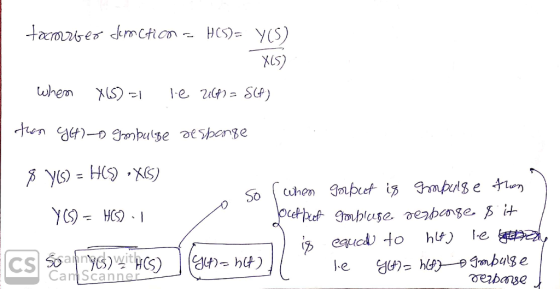

![14)= 3 [4,6++i) – (164-47] = 3^42 - 3464-9) H(S) = 3.fere - Bus] - (es-e-43) 1469 = 3(es.e *)] Now for step sertanse gorput =](http://img.homeworklib.com/questions/9b0c5e70-ac3c-11eb-b0ef-d9df6b6da3d2.png?x-oss-process=image/resize,w_560)
![golf+) 6 ar(44) gt)= 3 [&L&H)-84-45] [0-0 =0 3 Co-o] =3 3 [2-13 = 6 3 [3-0] = 3.3=9 3 [4-07 23.4 =12 5 3 [5-0] = 3-5 = 15 6 l](http://img.homeworklib.com/questions/9ba4a6d0-ac3c-11eb-8331-b3dc07407335.png?x-oss-process=image/resize,w_560)
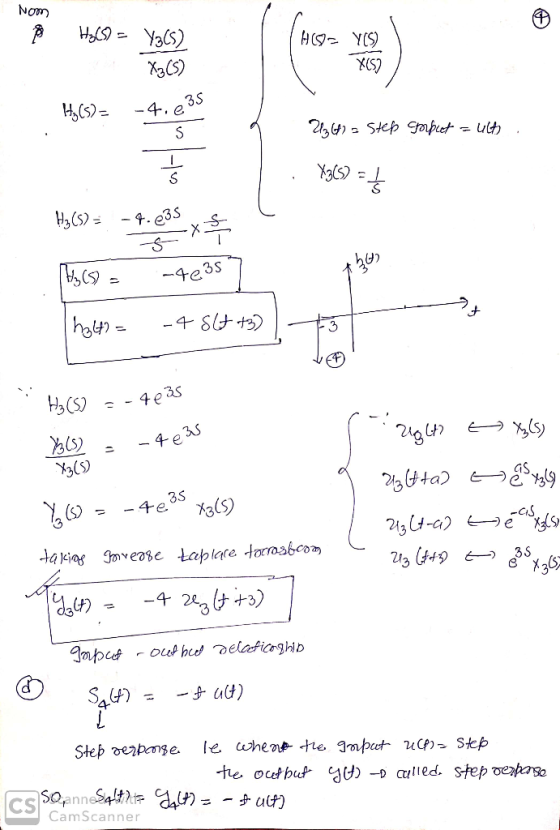
 one ? please thank you
Add Answer to:
3. Impulse Response and Step Response. (25 pts) Consider the following LTI systems: • T1: Has...
4. LTI Systems and Erponential Response. (12 pts) (a) (2 pts) Suppose an LTI system has...
 4. LTI Systems and Erponential Response. (12 pts) (a) (2 pts) Suppose an LTI system has input-output relationship y(t) 2r(t+3). What is the transfer function H(jw) of the given system. Show that H(jw)2. Hint: H(jw(tejdt (b) (5 pts) Suppose an LTI system has input-output relationship y(t)2r(t+3) as Problem 4-(a). Find the output y(t) using the complex exponential response method as discussed in lecture for the input r(t) = ej2t + 2 cos2(t). Hint: cos2(0) 1 (20 cos(26) an d 1-ejot...
LTI Systems. Consider two LTI subsystems that are connected in series
(a) LTI Systems. Consider two LTI subsystems that are connected in series, where system Tl has step response s1(t)=u(t-1)-u(t-5) and system T2 has impulse response h2t = e-3tu(t). Find the overall impulse response h(t). Hint: you will need to find h1(t) first (b)Fourier Series. The input signal r(t) and impulse response h(t) of an LTI system are as follows:x(t) = sin(2t)cos(t)-ej3t +2 and h(t) = sin(2t)/t Use the Fourier Series method to find the output y(t) (c)Parseval's Identity and Theorem. Consider the system in the...
Problem 6 (20 pts) Suppose that the impulse response of a causal LTI system has a...
 Problem 6 (20 pts) Suppose that the impulse response of a causal LTI system has a Laplace transform which is given by 5+1 H(3) and that the input to this system is x(t) = ell! $+ 25 +2 a) Determine the Laplace transform of the output y(t), along with its associated region of convergence. (12 pts) b) Determine the output y(t). (8 pts)
This is the information missing for part four 3. Impulae and Step Reaponae. (24 pta Consider...
 This is the information missing for part four
3. Impulae and Step Reaponae. (24 pta Consider the following LTT systema T: Has input-output relationship pi(t)-2) . Ta: Has impulke response ha),otheri . Th Has step respon" ss(t) = 4u(t + 1) * T. Han step response a4(t) = e-qa(t + 2) (a) (4 pts) What is the impulse respotse hi(t) of system T? What is the corresponding step response ai(t)? Show that h(t)(-2) and s(t)(t2) (b) (11 pts) What is...
This is the information missing for part four
3. Impulae and Step Reaponae. (24 pta Consider the following LTT systema T: Has input-output relationship pi(t)-2) . Ta: Has impulke response ha),otheri . Th Has step respon" ss(t) = 4u(t + 1) * T. Han step response a4(t) = e-qa(t + 2) (a) (4 pts) What is the impulse respotse hi(t) of system T? What is the corresponding step response ai(t)? Show that h(t)(-2) and s(t)(t2) (b) (11 pts) What is...
(e) Consider an LTI system with impulse response h(t) = π8ǐnc(2(t-1). i. (5 pts) Find the frequency response H(jw). Hint: Use the FT properties and pairs tables. ii. (5 pts) Find the output y(t) when...
 (e) Consider an LTI system with impulse response h(t) = π8ǐnc(2(t-1). i. (5 pts) Find the frequency response H(jw). Hint: Use the FT properties and pairs tables. ii. (5 pts) Find the output y(t) when the input is (tsin(t) by using the Fourier Transform method. 3. Fourier Transforms: LTI Systems Described by LCCDE (35 pts) (a) Consider a causal (meaning zero initial conditions) LTI system represented by its input-output relationship in the form of a differential equation:-p +3讐+ 2y(t)--r(t). i....
Consider the LTI system with input ??(??) = ?? ?????(??) and the impulse response ?(??) =...
 Consider the LTI system with input ??(??) = ?? ?????(??) and the
impulse response ?(??) = ?? ?2????(??). A. (3 points) Determine
??(??) and ??(??) and the ROCs B. (3 points) Using the
convolutional property of the Laplace transform, determine ??(??),
the Laplace transform of the output, ??(??) C. (3 points) From the
answer of part B, find ??(??)
9 points) Consider the LTI system with input x(t)eu(t) and the impulse response h(t)-e-2u(t) A. 3 points) Determine X(s) and H(s)...
Consider the LTI system with input ??(??) = ?? ?????(??) and the
impulse response ?(??) = ?? ?2????(??). A. (3 points) Determine
??(??) and ??(??) and the ROCs B. (3 points) Using the
convolutional property of the Laplace transform, determine ??(??),
the Laplace transform of the output, ??(??) C. (3 points) From the
answer of part B, find ??(??)
9 points) Consider the LTI system with input x(t)eu(t) and the impulse response h(t)-e-2u(t) A. 3 points) Determine X(s) and H(s)...
Consider a LTI system with unit impulse response, h(t) = e-3tu(t). Using direct integration technique for...
Consider a LTI system with unit impulse response, h(t) = e-3tu(t). Using direct integration technique for finding convolution, find its zero-state response due to an input, x(t) = u(t) (which is called unit step response of the system). Also, from your answer above, write down its response due to an input of the form, x(t) = 2δ(t) – 4u(t). [Hint: Use principle of superposition] !!Please show/explain step, WILL RATE!!
Consider an LTI system with the impulse response h(t) = e- . Is the system casual?...
 Consider an LTI system with the impulse response h(t) = e- . Is the system casual? Explain. Find and plot the output s(t) given that the system input is x(t) = u(t). Note that s(t) in this case is commonly known as the step response of the system. If the input is x(t) = u(t)-u(t-T). Express the output y(t) as a function of s(t). Also, explicitly write the output y(t) as a function of t. a) b) c)
2. Linearity Consider a system given with the following impulse response: (5%) h[n] 4u[1 a) Is the system LTI? b) Is it...
 2. Linearity Consider a system given with the following impulse response: (5%) h[n] 4u[1 a) Is the system LTI? b) Is it causal? c) Is it stable?
2. Linearity Consider a system given with the following impulse response: (5%) h[n] 4u[1 a) Is the system LTI? b) Is it causal? c) Is it stable?
2. Linearity Consider a system given with the following impulse response: (5%) h[n] 4u[1 a) Is the system LTI? b) Is it causal? c) Is it stable?
A causal LTI system yields the following input output relationship. Find h(t), the impulse response of...
 A causal LTI system yields the following input output relationship. Find h(t), the impulse response of the system. (Hint: Try first to determine the output when the input is u(t)) a(t) y(t) LTT →t 2 2 Figure 1: An input-output pair
 4. LTI Systems and Erponential Response. (12 pts) (a) (2 pts) Suppose an LTI system has input-output relationship y(t) 2r(t+3). What is the transfer function H(jw) of the given system. Show that H(jw)2. Hint: H(jw(tejdt (b) (5 pts) Suppose an LTI system has input-output relationship y(t)2r(t+3) as Problem 4-(a). Find the output y(t) using the complex exponential response method as discussed in lecture for the input r(t) = ej2t + 2 cos2(t). Hint: cos2(0) 1 (20 cos(26) an d 1-ejot...
 Problem 6 (20 pts) Suppose that the impulse response of a causal LTI system has a Laplace transform which is given by 5+1 H(3) and that the input to this system is x(t) = ell! $+ 25 +2 a) Determine the Laplace transform of the output y(t), along with its associated region of convergence. (12 pts) b) Determine the output y(t). (8 pts)
 This is the information missing for part four
3. Impulae and Step Reaponae. (24 pta Consider the following LTT systema T: Has input-output relationship pi(t)-2) . Ta: Has impulke response ha),otheri . Th Has step respon" ss(t) = 4u(t + 1) * T. Han step response a4(t) = e-qa(t + 2) (a) (4 pts) What is the impulse respotse hi(t) of system T? What is the corresponding step response ai(t)? Show that h(t)(-2) and s(t)(t2) (b) (11 pts) What is...
This is the information missing for part four
3. Impulae and Step Reaponae. (24 pta Consider the following LTT systema T: Has input-output relationship pi(t)-2) . Ta: Has impulke response ha),otheri . Th Has step respon" ss(t) = 4u(t + 1) * T. Han step response a4(t) = e-qa(t + 2) (a) (4 pts) What is the impulse respotse hi(t) of system T? What is the corresponding step response ai(t)? Show that h(t)(-2) and s(t)(t2) (b) (11 pts) What is...
 (e) Consider an LTI system with impulse response h(t) = π8ǐnc(2(t-1). i. (5 pts) Find the frequency response H(jw). Hint: Use the FT properties and pairs tables. ii. (5 pts) Find the output y(t) when the input is (tsin(t) by using the Fourier Transform method. 3. Fourier Transforms: LTI Systems Described by LCCDE (35 pts) (a) Consider a causal (meaning zero initial conditions) LTI system represented by its input-output relationship in the form of a differential equation:-p +3讐+ 2y(t)--r(t). i....
 Consider the LTI system with input ??(??) = ?? ?????(??) and the
impulse response ?(??) = ?? ?2????(??). A. (3 points) Determine
??(??) and ??(??) and the ROCs B. (3 points) Using the
convolutional property of the Laplace transform, determine ??(??),
the Laplace transform of the output, ??(??) C. (3 points) From the
answer of part B, find ??(??)
9 points) Consider the LTI system with input x(t)eu(t) and the impulse response h(t)-e-2u(t) A. 3 points) Determine X(s) and H(s)...
Consider the LTI system with input ??(??) = ?? ?????(??) and the
impulse response ?(??) = ?? ?2????(??). A. (3 points) Determine
??(??) and ??(??) and the ROCs B. (3 points) Using the
convolutional property of the Laplace transform, determine ??(??),
the Laplace transform of the output, ??(??) C. (3 points) From the
answer of part B, find ??(??)
9 points) Consider the LTI system with input x(t)eu(t) and the impulse response h(t)-e-2u(t) A. 3 points) Determine X(s) and H(s)...
 Consider an LTI system with the impulse response h(t) = e- . Is the system casual? Explain. Find and plot the output s(t) given that the system input is x(t) = u(t). Note that s(t) in this case is commonly known as the step response of the system. If the input is x(t) = u(t)-u(t-T). Express the output y(t) as a function of s(t). Also, explicitly write the output y(t) as a function of t. a) b) c)
 2. Linearity Consider a system given with the following impulse response: (5%) h[n] 4u[1 a) Is the system LTI? b) Is it causal? c) Is it stable?
2. Linearity Consider a system given with the following impulse response: (5%) h[n] 4u[1 a) Is the system LTI? b) Is it causal? c) Is it stable?
2. Linearity Consider a system given with the following impulse response: (5%) h[n] 4u[1 a) Is the system LTI? b) Is it causal? c) Is it stable?
 A causal LTI system yields the following input output relationship. Find h(t), the impulse response of the system. (Hint: Try first to determine the output when the input is u(t)) a(t) y(t) LTT →t 2 2 Figure 1: An input-output pair
Most questions answered within 3 hours.
-
Where is the error in this code sequence?
String s1 = "Hello";
String s2 = "ello";...
asked 10 months ago -
Financial data for Joel de Paris, Inc., for last year
follow:
Joel de Paris, Inc.
Balance...
asked 10 months ago -
Consider this reaction:
Al2(SO4)3 (aq)+ BaCl3
(aq) Al2Cl6 (aq)- +
3BaSO4(s) . What is the...
asked 10 months ago -
Suppose that Savneet is considering increasing her
recent random sample from 20 car rentals to 40...
asked 10 months ago -
Trucks arrive at an unloading terminal at an average rate of 120
per hour.
Trucks arrive...
asked 10 months ago -
Why are methanol and ethanol completely soluble in water while
octanol is not very little soluble....
asked 10 months ago -
A facilities manager at a university reads in a research report
that the mean amount of...
asked 10 months ago -
When the CuSO4 is rehydrated by adding water to the anhydrous
compound, is this an endothermic...
asked 10 months ago -
A ray of sunlight is passing from diamond into crown glass; the
angle of incidence is...
asked 10 months ago -
A block of mass 0.249 kg is placed on top of a light, vertical
spring of...
asked 10 months ago -
how do the kidneys compensate in the presences of acidosis
a) trigger hyperventilate
b) reserve acid...
asked 10 months ago -
Question 501 pts
The rental rate of capital to the firm increases. Which of the
following...
asked 10 months ago