
How do I find the derivatives for these functions without using the product rule?
Homework Answers
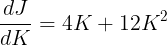
A. 
Differentiating J wrt K we get


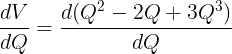
b. 
Differentiating V wrt Q we get
Similarly as we have done in previous case

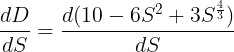
C. 
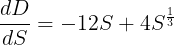
Differentiating D wrt S we get
D. 
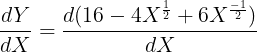

E. 
Differentiating T wrt R we get


F. 
Differentiating Q wrt S we get
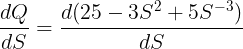

G. 

Now differentiating B wrt Q we get
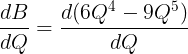
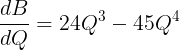
H. 


Differentiating Z wrt P we get


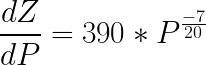
only in the case of G and H it was required to simplify the equation then differentiating it.
Please contact before rating up will be obliged to you for your generous support. Thank You.
Add Answer to:
How do I find the derivatives for these functions without using
the product rule?
b) V...
Below are eight functions. Find the first derivative of each. Space is provided. Use good dark ink...
Below are eight functions. Find the first derivative of each. Space is provided. Use good dark ink if you are returning this by a scanned version. All of the derivatives can be found by using combinations of the constant rule, power function rule and sum-difference rule. Do not use the product rule. It is not needed. The degree of difficulty (more or less) increases from (a-h). Be sure to show intermediate work. Check the scoring rubric to see how the points are awarded. For example, the first...
3. Find the indicated derivatives of the following functions without inte- grating. Make sure to fully justify your...
 3. Find the indicated derivatives of the following functions without inte- grating. Make sure to fully justify your work! () ) (a) Let c E R da cos dt er+1 d tan(t) df (b) dr arctan(r) rt (c) H(r) 1+2+ dt; H"()
3. Find the indicated derivatives of the following functions without inte- grating. Make sure to fully justify your work! () ) (a) Let c E R da cos dt er+1 d tan(t) df (b) dr arctan(r) rt (c)...
3. Find the indicated derivatives of the following functions without inte- grating. Make sure to fully justify your work! () ) (a) Let c E R da cos dt er+1 d tan(t) df (b) dr arctan(r) rt (c) H(r) 1+2+ dt; H"()
3. Find the indicated derivatives of the following functions without inte- grating. Make sure to fully justify your work! () ) (a) Let c E R da cos dt er+1 d tan(t) df (b) dr arctan(r) rt (c)...
Exercise 1. Do the following: (a) Write a statement defining the Chain Rule for the functions...
 Exercise 1. Do the following: (a) Write a statement defining the Chain Rule for the functions g: R" → Rm and f: RM + RP. Then describe how it works in a paragraph, assuming the reader is a classmate who has been following the course but missed the lecture on Properties of the Derivative. (b) Explain in detail how the Chain Rule you learned in Calculus I, (fog)(x) = f (g(2)).g'(x), is really just the special case of your statement...
On Python 3.7.2: How would I make functions for these string functions/methods without using the actual...
On Python 3.7.2: How would I make functions for these string functions/methods without using the actual functions? (For example, how would I find if a string is comprised of alphabets without using the function "isalpha()" ?) len() isalpha() isupper() isdigit() swapcase() string_lower()
Linear Algebra 2) General Inner Products, Length, Distance and Angle a) Determine if (u,v)-3uiv,-u,v, is a dot product b) Show that (u.v)-a+a,h,'2 is a product if a, 20 e)Let A-(41 ..)and B-G...
 Linear Algebra
2) General Inner Products, Length, Distance and Angle a) Determine if (u,v)-3uiv,-u,v, is a dot product b) Show that (u.v)-a+a,h,'2 is a product if a, 20 e)Let A-(41 ..)and B-G ) Use inner product on 4 -2 M (A, B aitai +apb +2a to find the length of A, B, namely ll-41 and 1 d) Find the angle between the two matrices above e) Find the distance between the two above matrices 0) For the functions (x)-1 and...
Linear Algebra
2) General Inner Products, Length, Distance and Angle a) Determine if (u,v)-3uiv,-u,v, is a dot product b) Show that (u.v)-a+a,h,'2 is a product if a, 20 e)Let A-(41 ..)and B-G ) Use inner product on 4 -2 M (A, B aitai +apb +2a to find the length of A, B, namely ll-41 and 1 d) Find the angle between the two matrices above e) Find the distance between the two above matrices 0) For the functions (x)-1 and...
a. Use the Chain Rule to find the indicated partial derivatives. z = x4 + x2y, x...
a. Use the Chain Rule to find the indicated partial derivatives. z = x4 + x2y, x = s + 2t − u, y = stu2; ∂z ∂s ∂z ∂t ∂z ∂u when s = 1, t = 2, u = 3 b. Use the Chain Rule to find the indicated partial derivatives. w = xy + yz + zx, x = r cos(θ), y = r sin(θ), z = rθ; ∂w ∂r ∂w ∂θ when r = 8, θ = pi/2 c. Use the...
suppose u and v are functions of x that are differentiable at x=2 and that u(2) =3, u'(2) = -4, v(2) = 1, and v'(2) find values of derivatives at x = 2 (d/dx)(uv) =
suppose u and v are functions of x that are differentiable at x=2 and that u(2) =3, u'(2) = -4, v(2) = 1, and v'(2)find values of derivatives at x = 2(d/dx)(uv) = ? I would like to know how to set this up because I'm only used to getting problems that want the d/dx given ex: y=2x+1 so I was confused for this The answer is 2 but how do I set this up?
3x+2 f(x) =( :) (x-> +1) Your problem: using the rules of differentiation, find the derivatives...
 3x+2 f(x) =( :) (x-> +1) Your problem: using the rules of differentiation, find the derivatives of the collowing: f)-(3442) fool(3x+2) (-5x + x + 1) - 2 1 =(-15x 10x" + (-2x = 2) =>15x410x5 - 2x = = 3x -3x- 27 (X)(3+0)-(3x+2)(1) x² g'=(x) =F12x15x4_2 = -5x6 xb * please check my work, if wrong, please write out correct solation! Chain Rule: When functions are composed, to take the derivative involves both the outside function and the inside...
how to do this problem with steps and show which is which. Problem : Find v(t)...
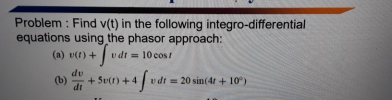 how to do this problem with steps and show which is
which.
Problem : Find v(t) in the following integro-differential equations using the phasor approach: (a) v(t) +dt 10 cos (b) + 5D(t) + 4 u dt = 20 sin(4t + 10°)
how to do this problem with steps and show which is
which.
Problem : Find v(t) in the following integro-differential equations using the phasor approach: (a) v(t) +dt 10 cos (b) + 5D(t) + 4 u dt = 20 sin(4t + 10°)
Find the derivatives of the following functions (A) y=xt-x2 (B) y=x2 (C) y-3x3 + 4x -3...
 Find the derivatives of the following functions (A) y=xt-x2 (B) y=x2 (C) y-3x3 + 4x -3 (D) y=x (F) f(x)- 100x100 (G) fx)- (H) f(x)=- 1-5r ) f(x)= (J f(x) - (x + 1)(x3 +5x + 2) (Requires quotient rule) 4+x For f(x) = 6x3, find f(x) and f"(x), and fm(x). For f(x)- 5x3 -3x2+x-20, find f(x), f"(x), and f""(x)
 3. Find the indicated derivatives of the following functions without inte- grating. Make sure to fully justify your work! () ) (a) Let c E R da cos dt er+1 d tan(t) df (b) dr arctan(r) rt (c) H(r) 1+2+ dt; H"()
3. Find the indicated derivatives of the following functions without inte- grating. Make sure to fully justify your work! () ) (a) Let c E R da cos dt er+1 d tan(t) df (b) dr arctan(r) rt (c)...
3. Find the indicated derivatives of the following functions without inte- grating. Make sure to fully justify your work! () ) (a) Let c E R da cos dt er+1 d tan(t) df (b) dr arctan(r) rt (c) H(r) 1+2+ dt; H"()
3. Find the indicated derivatives of the following functions without inte- grating. Make sure to fully justify your work! () ) (a) Let c E R da cos dt er+1 d tan(t) df (b) dr arctan(r) rt (c)...
 Exercise 1. Do the following: (a) Write a statement defining the Chain Rule for the functions g: R" → Rm and f: RM + RP. Then describe how it works in a paragraph, assuming the reader is a classmate who has been following the course but missed the lecture on Properties of the Derivative. (b) Explain in detail how the Chain Rule you learned in Calculus I, (fog)(x) = f (g(2)).g'(x), is really just the special case of your statement...
 Linear Algebra
2) General Inner Products, Length, Distance and Angle a) Determine if (u,v)-3uiv,-u,v, is a dot product b) Show that (u.v)-a+a,h,'2 is a product if a, 20 e)Let A-(41 ..)and B-G ) Use inner product on 4 -2 M (A, B aitai +apb +2a to find the length of A, B, namely ll-41 and 1 d) Find the angle between the two matrices above e) Find the distance between the two above matrices 0) For the functions (x)-1 and...
Linear Algebra
2) General Inner Products, Length, Distance and Angle a) Determine if (u,v)-3uiv,-u,v, is a dot product b) Show that (u.v)-a+a,h,'2 is a product if a, 20 e)Let A-(41 ..)and B-G ) Use inner product on 4 -2 M (A, B aitai +apb +2a to find the length of A, B, namely ll-41 and 1 d) Find the angle between the two matrices above e) Find the distance between the two above matrices 0) For the functions (x)-1 and...
 3x+2 f(x) =( :) (x-> +1) Your problem: using the rules of differentiation, find the derivatives of the collowing: f)-(3442) fool(3x+2) (-5x + x + 1) - 2 1 =(-15x 10x" + (-2x = 2) =>15x410x5 - 2x = = 3x -3x- 27 (X)(3+0)-(3x+2)(1) x² g'=(x) =F12x15x4_2 = -5x6 xb * please check my work, if wrong, please write out correct solation! Chain Rule: When functions are composed, to take the derivative involves both the outside function and the inside...
 how to do this problem with steps and show which is
which.
Problem : Find v(t) in the following integro-differential equations using the phasor approach: (a) v(t) +dt 10 cos (b) + 5D(t) + 4 u dt = 20 sin(4t + 10°)
how to do this problem with steps and show which is
which.
Problem : Find v(t) in the following integro-differential equations using the phasor approach: (a) v(t) +dt 10 cos (b) + 5D(t) + 4 u dt = 20 sin(4t + 10°)
 Find the derivatives of the following functions (A) y=xt-x2 (B) y=x2 (C) y-3x3 + 4x -3 (D) y=x (F) f(x)- 100x100 (G) fx)- (H) f(x)=- 1-5r ) f(x)= (J f(x) - (x + 1)(x3 +5x + 2) (Requires quotient rule) 4+x For f(x) = 6x3, find f(x) and f"(x), and fm(x). For f(x)- 5x3 -3x2+x-20, find f(x), f"(x), and f""(x)
Most questions answered within 3 hours.
-
Where is the error in this code sequence?
String s1 = "Hello";
String s2 = "ello";...
asked 10 months ago -
Financial data for Joel de Paris, Inc., for last year
follow:
Joel de Paris, Inc.
Balance...
asked 10 months ago -
Consider this reaction:
Al2(SO4)3 (aq)+ BaCl3
(aq) Al2Cl6 (aq)- +
3BaSO4(s) . What is the...
asked 10 months ago -
Suppose that Savneet is considering increasing her
recent random sample from 20 car rentals to 40...
asked 10 months ago -
Trucks arrive at an unloading terminal at an average rate of 120
per hour.
Trucks arrive...
asked 10 months ago -
Why are methanol and ethanol completely soluble in water while
octanol is not very little soluble....
asked 10 months ago -
A facilities manager at a university reads in a research report
that the mean amount of...
asked 10 months ago -
When the CuSO4 is rehydrated by adding water to the anhydrous
compound, is this an endothermic...
asked 10 months ago -
A ray of sunlight is passing from diamond into crown glass; the
angle of incidence is...
asked 10 months ago -
A block of mass 0.249 kg is placed on top of a light, vertical
spring of...
asked 10 months ago -
how do the kidneys compensate in the presences of acidosis
a) trigger hyperventilate
b) reserve acid...
asked 10 months ago -
Question 501 pts
The rental rate of capital to the firm increases. Which of the
following...
asked 10 months ago