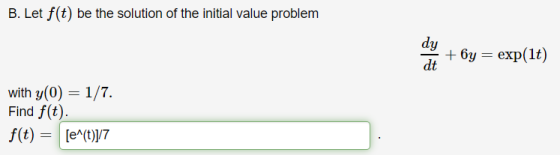
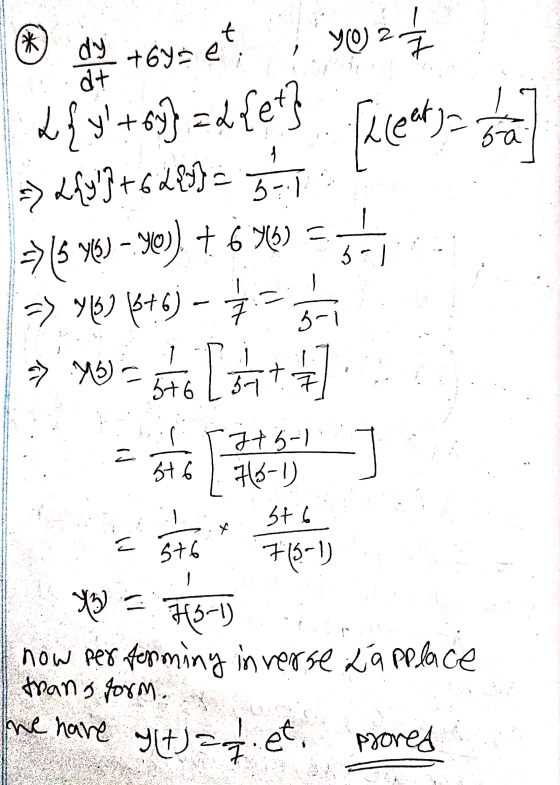
Can you explain me how this is right with the steps, please?
Homework Answers
Add Answer to:
Can you explain me how this is right with the steps, please?
B. Let f(t) be...
(1 point) A. Let g(t) be the solution of the initial value problem dy dt with g(1)1 Find g(t) B. Let f(t) be the solution of the initial value problem dy dt with f(0) 0 Find f(t). C. Find a constant...
 (1 point) A. Let g(t) be the solution of the initial value problem dy dt with g(1)1 Find g(t) B. Let f(t) be the solution of the initial value problem dy dt with f(0) 0 Find f(t). C. Find a constant c so that solves the differential equation in part B and k(1) 13. cE
(1 point) A. Let g(t) be the solution of the initial value problem dy dt with g(1)1 Find g(t) B. Let f(t) be the solution...
(1 point) A. Let g(t) be the solution of the initial value problem dy dt with g(1)1 Find g(t) B. Let f(t) be the solution of the initial value problem dy dt with f(0) 0 Find f(t). C. Find a constant c so that solves the differential equation in part B and k(1) 13. cE
(1 point) A. Let g(t) be the solution of the initial value problem dy dt with g(1)1 Find g(t) B. Let f(t) be the solution...
Can somebody please explain to me how to get each arrow of the nullclines step by...
 Can somebody please explain to me how to get each arrow of the
nullclines step by step?
dx x(-x-3y150) dt dy=y(-2x - y + 100) dt 5. (a) y 100 150
dx x(-x-3y150) dt dy=y(-2x - y + 100) dt
5. (a) y 100 150
Can somebody please explain to me how to get each arrow of the
nullclines step by step?
dx x(-x-3y150) dt dy=y(-2x - y + 100) dt 5. (a) y 100 150
dx x(-x-3y150) dt dy=y(-2x - y + 100) dt
5. (a) y 100 150
please show all steps , thank you 6. Consider the initial value problem y" + 2y'...
 please show all steps , thank you
6. Consider the initial value problem y" + 2y' + 2y = (t – 7); y(0) = 0, y'(0) = 1. a. Find the solution to the initial value problem. (10 points) b. Sketch a plot of the solution for t E (0,37]. (5 points) c. Describe the behavior of the solution. How is this system damped? (5 points)
please show all steps , thank you
6. Consider the initial value problem y" + 2y' + 2y = (t – 7); y(0) = 0, y'(0) = 1. a. Find the solution to the initial value problem. (10 points) b. Sketch a plot of the solution for t E (0,37]. (5 points) c. Describe the behavior of the solution. How is this system damped? (5 points)
1 point) Let a and b be constants, and let Let f(t,) . Then f is...
 1 point) Let a and b be constants, and let Let f(t,) . Then f is a smooth function of variables t and z, and frz Let z-W be a Wiener process. The goal is apply Ito's lemma in the form, to find a stochastic differential equation that is satisfied by Y = f(t, z) After applying Ito's lemma, dt t dz Type z Wt as z. Since Y e is a common factor on the right side, after dividing...
Let f be a function of two variables x,y. Define r(t) Yobt y(t) Хо + at,...
 Let f be a function of two variables x,y. Define r(t) Yobt y(t) Хо + at, Let g(t) f(x(t), y(t)) (a) Explain what does (x(t), y(t)) represent in the plane (b) Explain how the graph of g can be viewed as a part of the graph of f. dg (c) Find dt \t=0 in terms of partial derivatives of f. What does this repre- sent? (d) What does your answer in part c become if a 0 or b=0? (e)...
Could I please have some help with this question? Is there like steps you can remember...
 Could I please have some help with this question? Is there like
steps you can remember to apply to any question like this, am
getting really confused. Thank you :)
Consider the initial value problem 31 yg(t); y(0)(0) 0 where if 0tT )0 if t T (a) Use the Laplace transform to find the solution of the problem (b) Sketch the solution y(t) on the interval [0, 67] (c) What is the value of y(37)?
Consider the initial value problem...
Could I please have some help with this question? Is there like
steps you can remember to apply to any question like this, am
getting really confused. Thank you :)
Consider the initial value problem 31 yg(t); y(0)(0) 0 where if 0tT )0 if t T (a) Use the Laplace transform to find the solution of the problem (b) Sketch the solution y(t) on the interval [0, 67] (c) What is the value of y(37)?
Consider the initial value problem...
Problem #18: Let y(t) be the solution to the following initial value problem. [2 marks] y"...
 Problem #18: Let y(t) be the solution to the following initial value problem. [2 marks] y" – 6y' + 8y = 17e3t, y(0) = 1, y'(0) = 1 Find Y(s), the Laplace transform of y(t).
Can someone explain how to do this problem? 2. Let f(t, y) — х +у, 0<x<...
 Can someone explain how to do this problem?
2. Let f(t, y) — х +у, 0<x< 1, 0 <y<1 < ,Y < !) (a) Find P (X 1 2 (b) Find P(X < 2Y)
Can someone explain how to do this problem?
2. Let f(t, y) — х +у, 0<x< 1, 0 <y<1 < ,Y < !) (a) Find P (X 1 2 (b) Find P(X < 2Y)
Please answer and show me all the steps Thanks Find the equilibrium solution of the following...
 Please answer and show me all the steps
Thanks
Find the equilibrium solution of the following ODE to the nearest thousandth (3 decimal places) Y + 3y - 18 = 0 dt In the answer box only put the value of the equilibrium solution. So, if the equilibrium solution is y(t) = 6.123. Just put 6.1 in the answer box
Please answer and show me all the steps
Thanks
Find the equilibrium solution of the following ODE to the nearest thousandth (3 decimal places) Y + 3y - 18 = 0 dt In the answer box only put the value of the equilibrium solution. So, if the equilibrium solution is y(t) = 6.123. Just put 6.1 in the answer box
Please can you show me the all intermediate steps and explain clearly in the solution? Let...
 Please can you show me the all intermediate steps and explain
clearly in the solution?
Let Ly be the language accepted by the DFA below and L2 = {0M1mom 1kok1"|n, m, k > 0}. Create a CFG that generates L3 = L; U L2 using the techniques pre- sented in textbook. 91 1 start – 40 0 92
Please can you show me the all intermediate steps and explain
clearly in the solution?
Let Ly be the language accepted by the DFA below and L2 = {0M1mom 1kok1"|n, m, k > 0}. Create a CFG that generates L3 = L; U L2 using the techniques pre- sented in textbook. 91 1 start – 40 0 92
 (1 point) A. Let g(t) be the solution of the initial value problem dy dt with g(1)1 Find g(t) B. Let f(t) be the solution of the initial value problem dy dt with f(0) 0 Find f(t). C. Find a constant c so that solves the differential equation in part B and k(1) 13. cE
(1 point) A. Let g(t) be the solution of the initial value problem dy dt with g(1)1 Find g(t) B. Let f(t) be the solution...
(1 point) A. Let g(t) be the solution of the initial value problem dy dt with g(1)1 Find g(t) B. Let f(t) be the solution of the initial value problem dy dt with f(0) 0 Find f(t). C. Find a constant c so that solves the differential equation in part B and k(1) 13. cE
(1 point) A. Let g(t) be the solution of the initial value problem dy dt with g(1)1 Find g(t) B. Let f(t) be the solution...
 Can somebody please explain to me how to get each arrow of the
nullclines step by step?
dx x(-x-3y150) dt dy=y(-2x - y + 100) dt 5. (a) y 100 150
dx x(-x-3y150) dt dy=y(-2x - y + 100) dt
5. (a) y 100 150
Can somebody please explain to me how to get each arrow of the
nullclines step by step?
dx x(-x-3y150) dt dy=y(-2x - y + 100) dt 5. (a) y 100 150
dx x(-x-3y150) dt dy=y(-2x - y + 100) dt
5. (a) y 100 150
 please show all steps , thank you
6. Consider the initial value problem y" + 2y' + 2y = (t – 7); y(0) = 0, y'(0) = 1. a. Find the solution to the initial value problem. (10 points) b. Sketch a plot of the solution for t E (0,37]. (5 points) c. Describe the behavior of the solution. How is this system damped? (5 points)
please show all steps , thank you
6. Consider the initial value problem y" + 2y' + 2y = (t – 7); y(0) = 0, y'(0) = 1. a. Find the solution to the initial value problem. (10 points) b. Sketch a plot of the solution for t E (0,37]. (5 points) c. Describe the behavior of the solution. How is this system damped? (5 points)
 1 point) Let a and b be constants, and let Let f(t,) . Then f is a smooth function of variables t and z, and frz Let z-W be a Wiener process. The goal is apply Ito's lemma in the form, to find a stochastic differential equation that is satisfied by Y = f(t, z) After applying Ito's lemma, dt t dz Type z Wt as z. Since Y e is a common factor on the right side, after dividing...
 Let f be a function of two variables x,y. Define r(t) Yobt y(t) Хо + at, Let g(t) f(x(t), y(t)) (a) Explain what does (x(t), y(t)) represent in the plane (b) Explain how the graph of g can be viewed as a part of the graph of f. dg (c) Find dt \t=0 in terms of partial derivatives of f. What does this repre- sent? (d) What does your answer in part c become if a 0 or b=0? (e)...
 Could I please have some help with this question? Is there like
steps you can remember to apply to any question like this, am
getting really confused. Thank you :)
Consider the initial value problem 31 yg(t); y(0)(0) 0 where if 0tT )0 if t T (a) Use the Laplace transform to find the solution of the problem (b) Sketch the solution y(t) on the interval [0, 67] (c) What is the value of y(37)?
Consider the initial value problem...
Could I please have some help with this question? Is there like
steps you can remember to apply to any question like this, am
getting really confused. Thank you :)
Consider the initial value problem 31 yg(t); y(0)(0) 0 where if 0tT )0 if t T (a) Use the Laplace transform to find the solution of the problem (b) Sketch the solution y(t) on the interval [0, 67] (c) What is the value of y(37)?
Consider the initial value problem...
 Problem #18: Let y(t) be the solution to the following initial value problem. [2 marks] y" – 6y' + 8y = 17e3t, y(0) = 1, y'(0) = 1 Find Y(s), the Laplace transform of y(t).
 Can someone explain how to do this problem?
2. Let f(t, y) — х +у, 0<x< 1, 0 <y<1 < ,Y < !) (a) Find P (X 1 2 (b) Find P(X < 2Y)
Can someone explain how to do this problem?
2. Let f(t, y) — х +у, 0<x< 1, 0 <y<1 < ,Y < !) (a) Find P (X 1 2 (b) Find P(X < 2Y)
 Please answer and show me all the steps
Thanks
Find the equilibrium solution of the following ODE to the nearest thousandth (3 decimal places) Y + 3y - 18 = 0 dt In the answer box only put the value of the equilibrium solution. So, if the equilibrium solution is y(t) = 6.123. Just put 6.1 in the answer box
Please answer and show me all the steps
Thanks
Find the equilibrium solution of the following ODE to the nearest thousandth (3 decimal places) Y + 3y - 18 = 0 dt In the answer box only put the value of the equilibrium solution. So, if the equilibrium solution is y(t) = 6.123. Just put 6.1 in the answer box
 Please can you show me the all intermediate steps and explain
clearly in the solution?
Let Ly be the language accepted by the DFA below and L2 = {0M1mom 1kok1"|n, m, k > 0}. Create a CFG that generates L3 = L; U L2 using the techniques pre- sented in textbook. 91 1 start – 40 0 92
Please can you show me the all intermediate steps and explain
clearly in the solution?
Let Ly be the language accepted by the DFA below and L2 = {0M1mom 1kok1"|n, m, k > 0}. Create a CFG that generates L3 = L; U L2 using the techniques pre- sented in textbook. 91 1 start – 40 0 92
Most questions answered within 3 hours.
-
Where is the error in this code sequence?
String s1 = "Hello";
String s2 = "ello";...
asked 10 months ago -
Financial data for Joel de Paris, Inc., for last year
follow:
Joel de Paris, Inc.
Balance...
asked 10 months ago -
Consider this reaction:
Al2(SO4)3 (aq)+ BaCl3
(aq) Al2Cl6 (aq)- +
3BaSO4(s) . What is the...
asked 10 months ago -
Suppose that Savneet is considering increasing her
recent random sample from 20 car rentals to 40...
asked 10 months ago -
Trucks arrive at an unloading terminal at an average rate of 120
per hour.
Trucks arrive...
asked 10 months ago -
Why are methanol and ethanol completely soluble in water while
octanol is not very little soluble....
asked 10 months ago -
A facilities manager at a university reads in a research report
that the mean amount of...
asked 10 months ago -
When the CuSO4 is rehydrated by adding water to the anhydrous
compound, is this an endothermic...
asked 10 months ago -
A ray of sunlight is passing from diamond into crown glass; the
angle of incidence is...
asked 10 months ago -
A block of mass 0.249 kg is placed on top of a light, vertical
spring of...
asked 10 months ago -
how do the kidneys compensate in the presences of acidosis
a) trigger hyperventilate
b) reserve acid...
asked 10 months ago -
Question 501 pts
The rental rate of capital to the firm increases. Which of the
following...
asked 10 months ago