
Homework Answers
Add Answer to:
Figure 1 shows a circuit after some switch-flipping and is now at time t = 0....
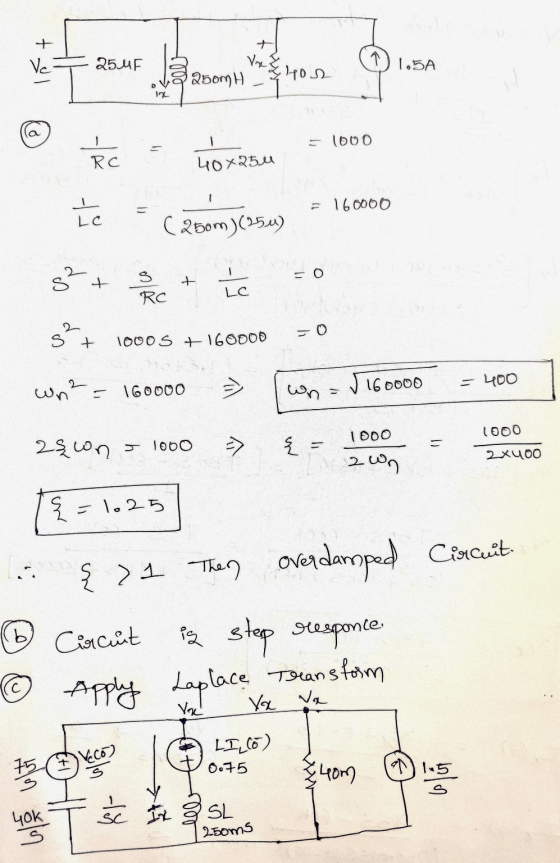
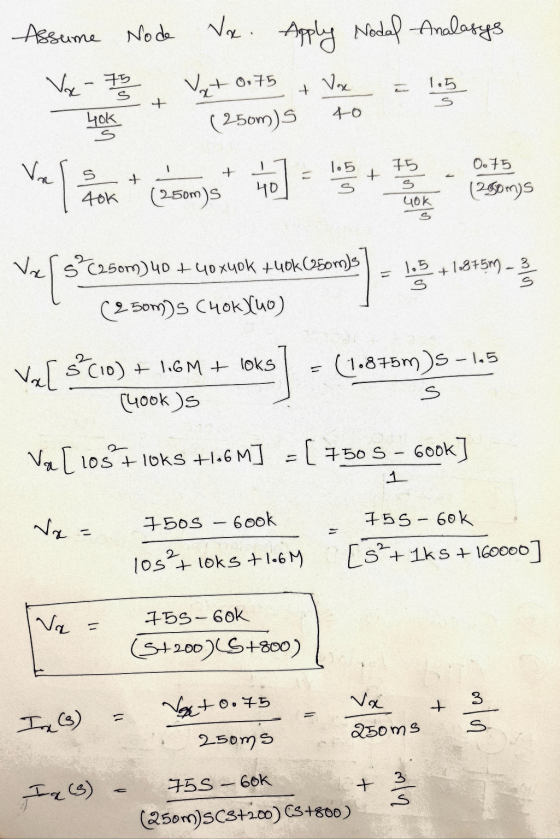
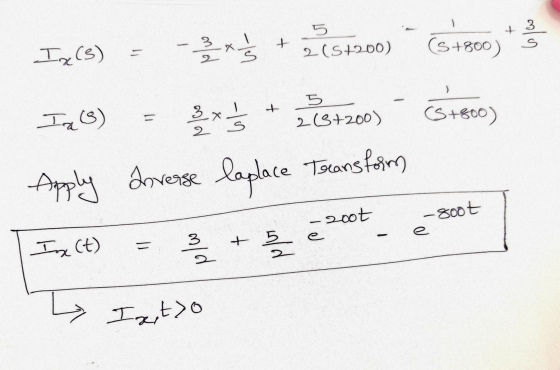
The switch in the circuit of Figure 1 has been in position A for a long...
 The switch in the circuit of Figure 1 has been in position A for a long time. At t-0, it is moved to position B The resulting step response of the series RLC circuit is described by the r differential equation (1). Figure 1 dt L dt LC LC The solution to equation (1) has two components the transient response vt(t) and the steady state response, Vss(t) v(t)v(t)+ Vss(t) The transient response v(t) is the same as that for the...
Sponse Question 8 800 22 640 mH =0 90 15 V TUF After the switch is...
 Sponse Question 8 800 22 640 mH =0 90 15 V TUF After the switch is thrown at r=0, will the circuit behave in an overdamped, critically damped, or underdag Critically damped Underdamped. O Overdamped. Moving to another question will save this response. ere to search
Function Generatr Inductor Model Ra R, Figure 1 Series RLC Circuit Preliminary This laboratory wi...
 Function Generatr Inductor Model Ra R, Figure 1 Series RLC Circuit Preliminary This laboratory will demonstrate how varying resistance changes the natural response of a series RLC circuit (Fig. 1). The function generator is modeled as an ideal voltage source v(t) 5 u() V in series with source resistance Rs-50Q. After measurements using an LCR meter, the inductor is modeled as an ideal L 90 mH inductor in series with resistance RL-20Q. The capacitance is C-0.22 μF. 1) Calculate the...
The answer key says Underdamped, but i do not understand why. Question 10 In the circuit below, the inductor current, iz(), for t2 0 is known to be, -10t 1012 ve(t)) Vc(t) Find the response curve tha...
 The answer key says Underdamped, but i do not understand
why.
Question 10 In the circuit below, the inductor current, iz(), for t2 0 is known to be, -10t 1012 ve(t)) Vc(t) Find the response curve that best represents the inductor current above iL(t) iL(t) (2) Underdamped (1) Undamped it t) i(t) (4) Overdamped (3) Critically damped (5) None of the above
Question 10 In the circuit below, the inductor current, iz(), for t2 0 is known to be, -10t...
The answer key says Underdamped, but i do not understand
why.
Question 10 In the circuit below, the inductor current, iz(), for t2 0 is known to be, -10t 1012 ve(t)) Vc(t) Find the response curve that best represents the inductor current above iL(t) iL(t) (2) Underdamped (1) Undamped it t) i(t) (4) Overdamped (3) Critically damped (5) None of the above
Question 10 In the circuit below, the inductor current, iz(), for t2 0 is known to be, -10t...
The current, i, in a series RLC circuit when the switch is closed at t 0 can be determined from t...
 use MATLAB functions to solve this problem
The current, i, in a series RLC circuit when the switch is closed at t 0 can be determined from the solution of the V 2nd-order ODE to v t-0 d2i ndi 1 where R, L, and c are the resistance of the resistor, the inductance of the inductor, and the capacitance of the capacitor, respectively. (a) Solve the equation for i in terms of L, R, C, and t, assuming that at...
use MATLAB functions to solve this problem
The current, i, in a series RLC circuit when the switch is closed at t 0 can be determined from the solution of the V 2nd-order ODE to v t-0 d2i ndi 1 where R, L, and c are the resistance of the resistor, the inductance of the inductor, and the capacitance of the capacitor, respectively. (a) Solve the equation for i in terms of L, R, C, and t, assuming that at...
Engineering circuit analysis by Hayt 8th edition question 27 and figure 9.43 I think 10u(1-t) means 10 (for t<1)...
 Engineering circuit analysis by Hayt
8th edition
question 27 and figure 9.43
I think 10u(1-t) means 10 (for t<1) and 0
(for t>1)
then, I can't remove this current source because it
continuously make 10micro A
(at t=500ms, t=1.002ms)
I don't know what's wrong now..
366 26. For the circuit of Fig. 9,43, 1 30-) mA. (a) Select R, so th O)6 V (b) Compute e2 ms). (c) Determine the settling, time of t capacitor voltage. (d) Is the inductor...
Engineering circuit analysis by Hayt
8th edition
question 27 and figure 9.43
I think 10u(1-t) means 10 (for t<1) and 0
(for t>1)
then, I can't remove this current source because it
continuously make 10micro A
(at t=500ms, t=1.002ms)
I don't know what's wrong now..
366 26. For the circuit of Fig. 9,43, 1 30-) mA. (a) Select R, so th O)6 V (b) Compute e2 ms). (c) Determine the settling, time of t capacitor voltage. (d) Is the inductor...
2. Charge-up response of series RLC circuit. No energy is stored in the 0.1H inductor or...
 2. Charge-up response of series RLC circuit. No energy is stored in the 0.1H inductor or the 0.4uF capacitor before the switch in the circuit shown in the figure below is closed. Find S2 Key= A 2800 1. 0.4uF - 3. Discharge response of series RLC circuit. The circuit had been in steady state prior to moving the switch at t=0. Find = Key = Space Key C1 0.44F For both circuits: a) Is the response underdamped, overdamped, or critically...
Problem 5: Consider the circuit shown in the figure below in which the initial inductor current...
 Problem 5: Consider the circuit shown in the figure below in which the initial inductor current and capacitor voltage are both zero. (a) Write the differential equation for vc(t). (b) Find the particular solution. (c) Is this circuit overdamped, critically damped, or underdamped? 4 0 i(t) vc()
1) In the following circuit the switch has been closed for a long time and is...
 1) In the following circuit the switch has been closed for a long time and is opened at t0 S1 R1 ?0 V1 R2 L1 10H C1 (a) Find i1(0)=--, ife)- Ve(00) = 4 points (b) Write the differential equation for the circuit. 4 points (c) Write the circuit characteristic equation. 2 points (d) Determine the roots of the characteristic equation. 6 points (e) Is the circuit overdamped, critically damped or underdamped? 2 points
A second-order RLC circuit is shown in Fig. 1 0.05F 3Ω 2Ω 6A 6A 5H Fig.1 A second-order RLC cir...
 A second-order RLC circuit is shown in Fig. 1 0.05F 3Ω 2Ω 6A 6A 5H Fig.1 A second-order RLC circuit with a switch (1) Analytical part: derive the differential equations and solve them to find the response i(t for t>0. Specify whether it is an underdamped, critically damped or overdamped case.
A second-order RLC circuit is shown in Fig. 1
0.05F 3Ω 2Ω 6A 6A 5H Fig.1 A second-order RLC circuit with a switch (1) Analytical part: derive the differential...
A second-order RLC circuit is shown in Fig. 1 0.05F 3Ω 2Ω 6A 6A 5H Fig.1 A second-order RLC circuit with a switch (1) Analytical part: derive the differential equations and solve them to find the response i(t for t>0. Specify whether it is an underdamped, critically damped or overdamped case.
A second-order RLC circuit is shown in Fig. 1
0.05F 3Ω 2Ω 6A 6A 5H Fig.1 A second-order RLC circuit with a switch (1) Analytical part: derive the differential...
 The switch in the circuit of Figure 1 has been in position A for a long time. At t-0, it is moved to position B The resulting step response of the series RLC circuit is described by the r differential equation (1). Figure 1 dt L dt LC LC The solution to equation (1) has two components the transient response vt(t) and the steady state response, Vss(t) v(t)v(t)+ Vss(t) The transient response v(t) is the same as that for the...
 Sponse Question 8 800 22 640 mH =0 90 15 V TUF After the switch is thrown at r=0, will the circuit behave in an overdamped, critically damped, or underdag Critically damped Underdamped. O Overdamped. Moving to another question will save this response. ere to search
 Function Generatr Inductor Model Ra R, Figure 1 Series RLC Circuit Preliminary This laboratory will demonstrate how varying resistance changes the natural response of a series RLC circuit (Fig. 1). The function generator is modeled as an ideal voltage source v(t) 5 u() V in series with source resistance Rs-50Q. After measurements using an LCR meter, the inductor is modeled as an ideal L 90 mH inductor in series with resistance RL-20Q. The capacitance is C-0.22 μF. 1) Calculate the...
 The answer key says Underdamped, but i do not understand
why.
Question 10 In the circuit below, the inductor current, iz(), for t2 0 is known to be, -10t 1012 ve(t)) Vc(t) Find the response curve that best represents the inductor current above iL(t) iL(t) (2) Underdamped (1) Undamped it t) i(t) (4) Overdamped (3) Critically damped (5) None of the above
Question 10 In the circuit below, the inductor current, iz(), for t2 0 is known to be, -10t...
The answer key says Underdamped, but i do not understand
why.
Question 10 In the circuit below, the inductor current, iz(), for t2 0 is known to be, -10t 1012 ve(t)) Vc(t) Find the response curve that best represents the inductor current above iL(t) iL(t) (2) Underdamped (1) Undamped it t) i(t) (4) Overdamped (3) Critically damped (5) None of the above
Question 10 In the circuit below, the inductor current, iz(), for t2 0 is known to be, -10t...
 use MATLAB functions to solve this problem
The current, i, in a series RLC circuit when the switch is closed at t 0 can be determined from the solution of the V 2nd-order ODE to v t-0 d2i ndi 1 where R, L, and c are the resistance of the resistor, the inductance of the inductor, and the capacitance of the capacitor, respectively. (a) Solve the equation for i in terms of L, R, C, and t, assuming that at...
use MATLAB functions to solve this problem
The current, i, in a series RLC circuit when the switch is closed at t 0 can be determined from the solution of the V 2nd-order ODE to v t-0 d2i ndi 1 where R, L, and c are the resistance of the resistor, the inductance of the inductor, and the capacitance of the capacitor, respectively. (a) Solve the equation for i in terms of L, R, C, and t, assuming that at...
 Engineering circuit analysis by Hayt
8th edition
question 27 and figure 9.43
I think 10u(1-t) means 10 (for t<1) and 0
(for t>1)
then, I can't remove this current source because it
continuously make 10micro A
(at t=500ms, t=1.002ms)
I don't know what's wrong now..
366 26. For the circuit of Fig. 9,43, 1 30-) mA. (a) Select R, so th O)6 V (b) Compute e2 ms). (c) Determine the settling, time of t capacitor voltage. (d) Is the inductor...
Engineering circuit analysis by Hayt
8th edition
question 27 and figure 9.43
I think 10u(1-t) means 10 (for t<1) and 0
(for t>1)
then, I can't remove this current source because it
continuously make 10micro A
(at t=500ms, t=1.002ms)
I don't know what's wrong now..
366 26. For the circuit of Fig. 9,43, 1 30-) mA. (a) Select R, so th O)6 V (b) Compute e2 ms). (c) Determine the settling, time of t capacitor voltage. (d) Is the inductor...
 2. Charge-up response of series RLC circuit. No energy is stored in the 0.1H inductor or the 0.4uF capacitor before the switch in the circuit shown in the figure below is closed. Find S2 Key= A 2800 1. 0.4uF - 3. Discharge response of series RLC circuit. The circuit had been in steady state prior to moving the switch at t=0. Find = Key = Space Key C1 0.44F For both circuits: a) Is the response underdamped, overdamped, or critically...
 Problem 5: Consider the circuit shown in the figure below in which the initial inductor current and capacitor voltage are both zero. (a) Write the differential equation for vc(t). (b) Find the particular solution. (c) Is this circuit overdamped, critically damped, or underdamped? 4 0 i(t) vc()
 1) In the following circuit the switch has been closed for a long time and is opened at t0 S1 R1 ?0 V1 R2 L1 10H C1 (a) Find i1(0)=--, ife)- Ve(00) = 4 points (b) Write the differential equation for the circuit. 4 points (c) Write the circuit characteristic equation. 2 points (d) Determine the roots of the characteristic equation. 6 points (e) Is the circuit overdamped, critically damped or underdamped? 2 points
 A second-order RLC circuit is shown in Fig. 1 0.05F 3Ω 2Ω 6A 6A 5H Fig.1 A second-order RLC circuit with a switch (1) Analytical part: derive the differential equations and solve them to find the response i(t for t>0. Specify whether it is an underdamped, critically damped or overdamped case.
A second-order RLC circuit is shown in Fig. 1
0.05F 3Ω 2Ω 6A 6A 5H Fig.1 A second-order RLC circuit with a switch (1) Analytical part: derive the differential...
A second-order RLC circuit is shown in Fig. 1 0.05F 3Ω 2Ω 6A 6A 5H Fig.1 A second-order RLC circuit with a switch (1) Analytical part: derive the differential equations and solve them to find the response i(t for t>0. Specify whether it is an underdamped, critically damped or overdamped case.
A second-order RLC circuit is shown in Fig. 1
0.05F 3Ω 2Ω 6A 6A 5H Fig.1 A second-order RLC circuit with a switch (1) Analytical part: derive the differential...
Most questions answered within 3 hours.
-
Where is the error in this code sequence?
String s1 = "Hello";
String s2 = "ello";...
asked 10 months ago -
Financial data for Joel de Paris, Inc., for last year
follow:
Joel de Paris, Inc.
Balance...
asked 10 months ago -
Consider this reaction:
Al2(SO4)3 (aq)+ BaCl3
(aq) Al2Cl6 (aq)- +
3BaSO4(s) . What is the...
asked 10 months ago -
Suppose that Savneet is considering increasing her
recent random sample from 20 car rentals to 40...
asked 10 months ago -
Trucks arrive at an unloading terminal at an average rate of 120
per hour.
Trucks arrive...
asked 10 months ago -
Why are methanol and ethanol completely soluble in water while
octanol is not very little soluble....
asked 10 months ago -
A facilities manager at a university reads in a research report
that the mean amount of...
asked 10 months ago -
When the CuSO4 is rehydrated by adding water to the anhydrous
compound, is this an endothermic...
asked 10 months ago -
A ray of sunlight is passing from diamond into crown glass; the
angle of incidence is...
asked 10 months ago -
A block of mass 0.249 kg is placed on top of a light, vertical
spring of...
asked 10 months ago -
how do the kidneys compensate in the presences of acidosis
a) trigger hyperventilate
b) reserve acid...
asked 10 months ago -
Question 501 pts
The rental rate of capital to the firm increases. Which of the
following...
asked 10 months ago