An airplane is flying at an altitude of 2.7 miles and is 8.3 miles from the...
An airplane is flying at an altitude of 2.7 miles and is 8.3 miles from the runway. Find the angle of depression that the airplane must make to land safely.
Homework Answers
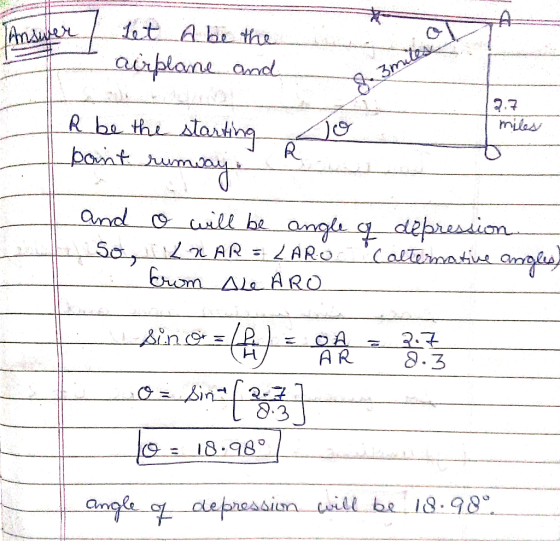
Add Answer to:
An airplane is flying at an altitude of 2.7 miles and is 8.3
miles from the...
An airplane is flying at an altitude of 500m over the ocean at a speed of...
An airplane is flying at an altitude of 500m over the ocean at a speed of 60m/s. A ship is moving along a path directly under the airplane, but in an opposite direction at 10m/s. At what horizontal distance from the ship should the plane drop a parcel to land on the ship?
An airplane is flying with a constant altitude at a speed of 475 mph in a...
 An airplane is flying with a constant altitude at a speed of 475 mph in a direction 25° north of west directly towards its final destination. The airplane then encounters wind blowing at a steady 30 mph in a direction 85° north of east. Yes a. Start by drawing a vector diagram for this situation. Did you draw a diagram? Great! Your diagram might look something like this: Wind New Path Original Path b. If the pilot does not correct...
An airplane weighs 16,000 lbs and is flying at 5000 ft altitude and at an airspeed...
An airplane weighs 16,000 lbs and is flying at 5000 ft altitude and at an airspeed of 200 fps. Find (a) the potential energy, (b) the kinetic energy, and (c) the total energy. Assuming no extra drag on the airplane, if the pilot dove until the airspeed was 400 fps, what would the altitude be?
A cup of coffee is on a table in an airplane flying at a constant altitude...
A cup of coffee is on a table in an airplane flying at a constant altitude and a constant velocity. The coefficient of static friction between the cup and the table is 0.440 . Suddenly, the plane accelerates forward, its altitude remaining constant. What is the maximum acceleration that the plane can have without the cup sliding backward on the table? Use g = 9.81 m/s2. When should I make Fx or Fy = ma or =0
An airplane flies at an altitude of y =6 miles toward a point directly over an...
 An airplane flies at an altitude of y =6 miles toward a point directly over an observer (see figure). The speed of the plane is 600 miles per hour. Find the rates (in radians per hour) at which the angle of elevation is changing when the angle is 45, = 60°, and e 70°. y mi Not drawn to scale 0 45 (a) rad/hr -50 (b) 600 x rad/hr 75 70° (Round your answer to two decimal places.) (c) rad/hr...
An airplane is flying at Mach 1.58 at an altitude of 7,100.00 meters, where the speed...
An airplane is flying at Mach 1.58 at an altitude of 7,100.00 meters, where the speed of sound is v = 314.75 m/s. How far away from a stationary observer will the plane be when the observer hears the sonic boom? (Enter the total distance in m.)
An airplane is flying at Mach 1.43 at an altitude of 7,400.00 meters, where the speed...
An airplane is flying at Mach 1.43 at an altitude of 7,400.00 meters, where the speed of sound is v = 313.50 m/s. How far away from a stationary observer will the plane be when the observer hears the sonic boom? (Enter the total distance in m.)
An airplane is flying at Mach 1.63 at an altitude of 7,200.00 meters, where the speed...
An airplane is flying at Mach 1.63 at an altitude of 7,200.00 meters, where the speed of sound is v = 314.33 m/s. How far away from a stationary observer will the plane be when the observer hears the sonic boom? (Enter the total distance in m.)
An airplane is flying with a velocity of 256 m/s at an angle of 30.0° with...
An airplane is flying with a velocity of 256 m/s at an angle of 30.0° with the horizontal, as the drawing shows. When the altitude of the plane is 2.2 km, a flare is released from the plane. The flare hits the target on the ground. What is the angle θ?
An airplane is flying at an altitude where the actual pressure and temperature are 4.72 cross...
An airplane is flying at an altitude where the actual pressure and temperature are 4.72 cross times 10 to the power of 4 N/m2 and 255.7 K, respectively. What are the pressure and temperature altitudes? You may refer to the Standard Atmosphere tables.
 An airplane is flying with a constant altitude at a speed of 475 mph in a direction 25° north of west directly towards its final destination. The airplane then encounters wind blowing at a steady 30 mph in a direction 85° north of east. Yes a. Start by drawing a vector diagram for this situation. Did you draw a diagram? Great! Your diagram might look something like this: Wind New Path Original Path b. If the pilot does not correct...
 An airplane flies at an altitude of y =6 miles toward a point directly over an observer (see figure). The speed of the plane is 600 miles per hour. Find the rates (in radians per hour) at which the angle of elevation is changing when the angle is 45, = 60°, and e 70°. y mi Not drawn to scale 0 45 (a) rad/hr -50 (b) 600 x rad/hr 75 70° (Round your answer to two decimal places.) (c) rad/hr...
Most questions answered within 3 hours.
-
Where is the error in this code sequence?
String s1 = "Hello";
String s2 = "ello";...
asked 11 months ago -
Financial data for Joel de Paris, Inc., for last year
follow:
Joel de Paris, Inc.
Balance...
asked 11 months ago -
Consider this reaction:
Al2(SO4)3 (aq)+ BaCl3
(aq) Al2Cl6 (aq)- +
3BaSO4(s) . What is the...
asked 11 months ago -
Suppose that Savneet is considering increasing her
recent random sample from 20 car rentals to 40...
asked 11 months ago -
Trucks arrive at an unloading terminal at an average rate of 120
per hour.
Trucks arrive...
asked 11 months ago -
Why are methanol and ethanol completely soluble in water while
octanol is not very little soluble....
asked 11 months ago -
A facilities manager at a university reads in a research report
that the mean amount of...
asked 11 months ago -
When the CuSO4 is rehydrated by adding water to the anhydrous
compound, is this an endothermic...
asked 11 months ago -
A ray of sunlight is passing from diamond into crown glass; the
angle of incidence is...
asked 11 months ago -
A block of mass 0.249 kg is placed on top of a light, vertical
spring of...
asked 11 months ago -
how do the kidneys compensate in the presences of acidosis
a) trigger hyperventilate
b) reserve acid...
asked 11 months ago -
Question 501 pts
The rental rate of capital to the firm increases. Which of the
following...
asked 11 months ago