Describe Compton’s experiment. Present and explain the formula for the Compton wavelength shift.
Describe Compton’s experiment. Present and explain the formula for the Compton wavelength shift.
Homework Answers
The copmpton effect occurs when the incident x-ray photon with relatively high energy ejects an electron from an atom and xray photon of lower energy is scattered from the atom.
Compton shift is the increase in X-ray or gamma-ray wavelength resulting from the transfer of energy that accompanies the scattering of photons in the Compton effect.
It is given in the following mathematical form:
λs−λ0=hm0c(1−cosΘ)
Where,
Ө: angle at which radiation scattered
m0: rest mass of an electron
hm0c : Compton wavelength of the electron
λs and λ0: radiation spectrum peaks.
Derivation of Compton effect equation
Considering the elastic collide between a photon and an electron, following is the derivation:
hν : energy of photon
pi=hνc :momentum of the photon
pi=pfcosΘ+pecosϕ(1) (conservation of momentum in x direction)
0=−pfsinΘ+pesinϕ(2) (conservation of momentum in y direction)
p2e=p2e(cos2ϕ+sin2ϕ)
=(pi−pfcosΘ)2+p2fsin2Θ
=p2i+p2f−2pipfcosΘ
hν0+m0c2=hν+(√m20c4+p2ec2)
m20c4+p2ec2=(hν0−hν+m0c2)2
=(hν0−hν)2+m20c4+2m0c2(hν0−hν)
p2ec2=(hν0−hν)2+2m0c2(hν0−hν)
p2ic2+p2fc2−2pipfcosΘc2=(hν0−hν)2+2m0c2(hν0−hν)
hνν0(1−cosΘ)=m0c2(ν0−ν)
∴λs−λ0=hm0c(1−cosΘ)
Therefore, above is the Compton effect equation andhm0c≡λc is Compton wavelength of an electron.
The compton wavelength shift depends on scattering angle.
the maximum increase in a photon’s wavelength (which is a decrease in its energy or frequency) is twice the Compton wavelength of the interacting electron. It’s because the maximum energy is lost only when a high-energy photon scores a direct hit and bounces straight back.
After a direct hit, the photon shoots straight back—an angle of 180 degrees, right?
The cosine of 180 degrees is -1, correct? 1-(-1) = 2. The rest of the equation for Compton scattering is simply the Compton wavelength of an electron, which is the inverse of the mass of an electron divided by the speed of light—all multiplied by Planck’s constant.
It’s important to understand that Compton scattering is a phenomenon of the high-energy light of x-rays and gamma rays. It’s not observed at lower frequencies (longer wavelengths), because at those levels all of a photon’s energy during an interaction is transferred to the electron and the photon disappears.
That said, it is important to point out that unless a lower-energy photon is in a kind of resonance with an electron, it won’t interact with it at all but will instead pass by, through, and around. It’s why glass is transparent to visible light. A sheet of iron is not.
When a photon is fired at an atom, the mass of the entire atom must be converted to a Compton wavelength. Since the mass of an atom is in the denominator and that mass will always be many thousands of times greater than a free electron, the larger mass-term in the denominator will drive the change in energy of the photon to nearly zero.
In the case of atoms, the wavelength of the incoming photon will remain essentially unchanged except in the most extreme photon energy states.
Add Answer to:
Describe Compton’s experiment. Present and explain the formula
for the Compton wavelength shift.
(3) Prove the Compton scattering formula: Δλ--( 1-cos θ) for the wavelength shift Δλ of a...
 (3) Prove the Compton scattering formula: Δλ--( 1-cos θ) for the wavelength shift Δλ of a photon of wavelength λ scattering from an electron of mass me and is scattered through angle θ, c is the velocity of light. What value of θ is the maximum shift experienced?
• 1. Recall that the formula for the Compton wavelength shift is h Al= (1 -...
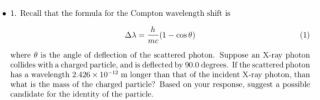 • 1. Recall that the formula for the Compton wavelength shift is h Al= (1 - cos ) (1) where 0 is the angle of deflection of the scattered photon. Suppose an X-ray photon collides with a charged particle, and is deflected by 90.0 degrees. If the scattered photon has a wavelength 2.426 x 10⁻¹² m longer than that of the incident X-ray photon, than what is the mass of the charged particle? Based on your response, suggest a possible...
Problem 2 Compton Effect a) In a Compton scattering experiment the wavelength of the incident x-rays...
Problem 2 Compton Effect a) In a Compton scattering experiment the wavelength of the incident x-rays is 7.078 10-2 [nm] while the wavelength of the outgoing x-ray is 7.314 10-2 [nm]. At what angle was the scattered radiation measured? b) In a Compton scattering experiment a detector is set at an angle of 57°. What must the frequency of the incoming x-rays be in order to produce a final x-ray with a frequency 1% less than the initial frequency? Problem...
3- Determine the maximum wavelength shift in the Compton scattering of photons from protons.
 3- Determine the maximum wavelength shift in the Compton scattering of photons from protons.
a) X-rays with a wavelength of 0.0045 nm are used in a Compton scattering experiment. If...
a) X-rays with a wavelength of 0.0045 nm are used in a Compton scattering experiment. If the x-rays are Compton scattered through an angle of 160°, what is the wavelength of the scattered photon? (b) A photon with an energy of 10.0 keV is Compton scattered by a free electron, which recoils with a kinetic energy of 0.200 keV. (i) What is the wavelength of the scattered photon? (ii) At what angle is the photon scattered? (think about how many...
8. Compton Effect. You perform a Compton experiment with photons of wavelength 0.071 nm. a. What's...
 8. Compton Effect. You perform a Compton experiment with photons of wavelength 0.071 nm. a. What's the energy of the photons in eV? b. What's the wavelength of photons that scatter at 180°? c. What's the energy of photons that scatter at 180°, in eV? d. What's the recoil energy of an electron (in J) if the photon scattering is at 180°? e. Estimate the final kinetic energy of an electron. Ignore relativity
In a Compton scattering experiment, the incident X-rays have a wavelength of 0.2686 nm, and the...
 In a Compton scattering experiment, the incident X-rays have a
wavelength of 0.2686 nm, and the scattered X-rays have a wavelength
of 0.2705 nm. Through what angle in the drawing are the X-rays
scattered?
E, Photon scattering from stationary electron
In a Compton scattering experiment, the incident X-rays have a
wavelength of 0.2686 nm, and the scattered X-rays have a wavelength
of 0.2705 nm. Through what angle in the drawing are the X-rays
scattered?
E, Photon scattering from stationary electron
A Incident X-rays in a Compton scattering experiment have a wavelength of 0.042 nm and scattered...
 A Incident X-rays in a Compton scattering experiment have a wavelength of 0.042 nm and scattered X rays have a wavelength of 0.044 nm what is the kinetic energy of recoiled electrons? B A hydrogen atom is ionized with a 400-nm photon. If the ejected electron previously was in the state with n - 3, find its kinetic energy after it has been ejected.
7. X-rays with a wavelength of 0.0045 nm are used in a Compton scattering experiment. If...
7. X-rays with a wavelength of 0.0045 nm are used in a Compton scattering experiment. If the X-rays are scattered through an angle of 45 degrees, what is the wavelength of the scattered radiation? 8. What is the wavelength of a wave that gives off 2.4 x 10⁻²¹J of energy? 9. What is the wavelength given off by a wave that is moving from n=4 to n=2? What color would you predict this wavelength to be? 10. A 430 g...
3. In a Compton scattering experiment a photon whose wavelength is 5.0 x 10"m is scattered...
 3. In a Compton scattering experiment a photon whose wavelength is 5.0 x 10"m is scattered straight backward. What is the wavelength of the scattered wave? a. 5.0 x 10⁻¹¹m b. 4.5 x 101m c. 5.5 x 10¹¹ m d. 6.0 x 10¹¹m e. 6.5x 10"m
 (3) Prove the Compton scattering formula: Δλ--( 1-cos θ) for the wavelength shift Δλ of a photon of wavelength λ scattering from an electron of mass me and is scattered through angle θ, c is the velocity of light. What value of θ is the maximum shift experienced?
 • 1. Recall that the formula for the Compton wavelength shift is h Al= (1 - cos ) (1) where 0 is the angle of deflection of the scattered photon. Suppose an X-ray photon collides with a charged particle, and is deflected by 90.0 degrees. If the scattered photon has a wavelength 2.426 x 10⁻¹² m longer than that of the incident X-ray photon, than what is the mass of the charged particle? Based on your response, suggest a possible...
 3- Determine the maximum wavelength shift in the Compton scattering of photons from protons.
 8. Compton Effect. You perform a Compton experiment with photons of wavelength 0.071 nm. a. What's the energy of the photons in eV? b. What's the wavelength of photons that scatter at 180°? c. What's the energy of photons that scatter at 180°, in eV? d. What's the recoil energy of an electron (in J) if the photon scattering is at 180°? e. Estimate the final kinetic energy of an electron. Ignore relativity
 In a Compton scattering experiment, the incident X-rays have a
wavelength of 0.2686 nm, and the scattered X-rays have a wavelength
of 0.2705 nm. Through what angle in the drawing are the X-rays
scattered?
E, Photon scattering from stationary electron
In a Compton scattering experiment, the incident X-rays have a
wavelength of 0.2686 nm, and the scattered X-rays have a wavelength
of 0.2705 nm. Through what angle in the drawing are the X-rays
scattered?
E, Photon scattering from stationary electron
 A Incident X-rays in a Compton scattering experiment have a wavelength of 0.042 nm and scattered X rays have a wavelength of 0.044 nm what is the kinetic energy of recoiled electrons? B A hydrogen atom is ionized with a 400-nm photon. If the ejected electron previously was in the state with n - 3, find its kinetic energy after it has been ejected.
 3. In a Compton scattering experiment a photon whose wavelength is 5.0 x 10"m is scattered straight backward. What is the wavelength of the scattered wave? a. 5.0 x 10⁻¹¹m b. 4.5 x 101m c. 5.5 x 10¹¹ m d. 6.0 x 10¹¹m e. 6.5x 10"m
Most questions answered within 3 hours.
-
Where is the error in this code sequence?
String s1 = "Hello";
String s2 = "ello";...
asked 11 months ago -
Financial data for Joel de Paris, Inc., for last year
follow:
Joel de Paris, Inc.
Balance...
asked 11 months ago -
Consider this reaction:
Al2(SO4)3 (aq)+ BaCl3
(aq) Al2Cl6 (aq)- +
3BaSO4(s) . What is the...
asked 11 months ago -
Suppose that Savneet is considering increasing her
recent random sample from 20 car rentals to 40...
asked 11 months ago -
Trucks arrive at an unloading terminal at an average rate of 120
per hour.
Trucks arrive...
asked 11 months ago -
Why are methanol and ethanol completely soluble in water while
octanol is not very little soluble....
asked 11 months ago -
A facilities manager at a university reads in a research report
that the mean amount of...
asked 11 months ago -
When the CuSO4 is rehydrated by adding water to the anhydrous
compound, is this an endothermic...
asked 11 months ago -
A ray of sunlight is passing from diamond into crown glass; the
angle of incidence is...
asked 11 months ago -
A block of mass 0.249 kg is placed on top of a light, vertical
spring of...
asked 11 months ago -
how do the kidneys compensate in the presences of acidosis
a) trigger hyperventilate
b) reserve acid...
asked 11 months ago -
Question 501 pts
The rental rate of capital to the firm increases. Which of the
following...
asked 11 months ago