
Homework Answers
Add Answer to:
mechanical systems
Question 3: 6 Marks In the system shown with the polar moment of inertia...
1 Q2. Figure 2 shows a system in which mass m is connected with a cylinder of mass m2 and moment of inertia Jo through...
 1 Q2. Figure 2 shows a system in which mass m is connected with a cylinder of mass m2 and moment of inertia Jo through a horizontal spring k. The cylinder is m1 rolling on the rough surface without slipping. (1) Find its total kinetic energy, total potential energy TN and Lagrangian, Figure 2 (2) Derive the equations of motion using Lagrangian equation method, and (3) Calculate its natural frequencies
1 Q2. Figure 2 shows a system in which mass...
1 Q2. Figure 2 shows a system in which mass m is connected with a cylinder of mass m2 and moment of inertia Jo through a horizontal spring k. The cylinder is m1 rolling on the rough surface without slipping. (1) Find its total kinetic energy, total potential energy TN and Lagrangian, Figure 2 (2) Derive the equations of motion using Lagrangian equation method, and (3) Calculate its natural frequencies
1 Q2. Figure 2 shows a system in which mass...
Consider the system shown in the figure below. The mass moment of inertia of the bar...
 Consider the system shown in the figure below. The mass moment
of inertia of the bar about the point O is JO, and the torsional
stiffness of the spring attached to the pivot point is kt . Assume
that there is gravity loading. The centre of gravity of the bar is
midways, as shown in the figure.
Question 2 Consider the system shown in the figure below. The mass moment of inertia of the bar about the point O is...
Consider the system shown in the figure below. The mass moment
of inertia of the bar about the point O is JO, and the torsional
stiffness of the spring attached to the pivot point is kt . Assume
that there is gravity loading. The centre of gravity of the bar is
midways, as shown in the figure.
Question 2 Consider the system shown in the figure below. The mass moment of inertia of the bar about the point O is...
Question 5 (20 marks) a) Develop a Lagrangian for the system shown, for small displacements from equilibrium when 6 (t)-0. The cylinder rotates on a fixed axis and has moment of inertia, J, about thi...
 Question 5 (20 marks) a) Develop a Lagrangian for the system shown, for small displacements from equilibrium when 6 (t)-0. The cylinder rotates on a fixed axis and has moment of inertia, J, about this axis. [5 marks] x (t) k2 b) Then use Lagrange's Equation to determine the equations of motion. M(t) denotes an external moment applied to the cylinder. Also, express the equations in matrix form. [10 marks] c) Comment briefly on the dominant dynamic effects you would...
please solve it as soon as possible and be sure of your answers A cylinder of mass m and mass moment of inertia J is free to roll without slipping but is restrained by 3 springs of stiffinesses k....
 please solve it as soon as possible and be sure of
your answers
A cylinder of mass m and mass moment of inertia J is free to roll without slipping but is restrained by 3 springs of stiffinesses k. If the translational and angular displacements of the cylinder are x and 8 from its equilibrium position. Determine the following: a- Equation o method b- Find the natural frequency of vibration f motion of the system assuming that the system is...
please solve it as soon as possible and be sure of
your answers
A cylinder of mass m and mass moment of inertia J is free to roll without slipping but is restrained by 3 springs of stiffinesses k. If the translational and angular displacements of the cylinder are x and 8 from its equilibrium position. Determine the following: a- Equation o method b- Find the natural frequency of vibration f motion of the system assuming that the system is...
the cylinder mass m2 dan the inertia moment to horizontal axis O is Io. that stepped...
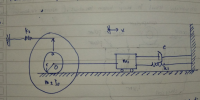 the cylinder mass m2 dan the inertia moment to
horizontal axis O is Io. that stepped cylinder is rolling without
slip on the horizontal surface. mass m1 is translatiom moving
without friction. so find :
a) the equation of motion from that system (EoM)
b) the persoanl frequency (omega n)
c) the attentuation's coefficient "c" ,that makes the system
critically vague
VCI TTTTTTTTTTT male
the cylinder mass m2 dan the inertia moment to
horizontal axis O is Io. that stepped cylinder is rolling without
slip on the horizontal surface. mass m1 is translatiom moving
without friction. so find :
a) the equation of motion from that system (EoM)
b) the persoanl frequency (omega n)
c) the attentuation's coefficient "c" ,that makes the system
critically vague
VCI TTTTTTTTTTT male
Q3. For the rotational system subjected to an applied torque Mocosout shown in Figure 3, the...
 Q3. For the rotational system subjected to an applied torque Mocosout shown in Figure 3, the rotary inertia of the rigid bar about the hinge O can be calculated by Jo =7ml /48. Given k = 5,000N/m, 1 - 1m, m = 20 kg, Mo = 100 Nm, c = 130 rpm. Assume rotation angle is very small, (i) Draw the free body diagram; (ii) Use Newton's 2nd law to derive the equation of motion of the system; and (iii)...
Modelling of mechanical dynamic systems Exercice 1 An disc of an inertia J and radius r...
 Modelling of mechanical dynamic systems Exercice 1 An disc of an inertia J and radius r is attached to a fixed axis of rotation A as shown below. The disc is in contact with a mass M attached via a spring of stiffness K to a fixed wall. The inertia-mass contact is subject to viscous friction of coefficientſ. The motion of the mass with respect to the horizontal floor is subject to the same viscous friction coefficient f.. The system...
Figure 1 shows a slender beam pivoted at point O. Its mass moment of inertia, taken...
 Figure 1 shows a slender beam pivoted at point O. Its mass moment of inertia, taken about an axis that goes through point o, is J The rotational motion of the beam about point O can be described by angular displacement θ Formulate the equation of motion of this system using Lagrange's method. Express this equation in terms of Jo. c c. k and / (a) [10 marks] (b) Detemine the values of the system's undamped natural frequency, damping ratio...
Lab 8 Assignment: Moment of Inertia 1) Moment of Inertia for Different Systems The resistance to...
 Lab 8 Assignment: Moment of Inertia 1) Moment of Inertia for Different Systems The resistance to rotational motion change is more involved than for linear motion because it not only depends on what the mass is, but also on how that mass is distributed about the axis of rotation. The farther away from the axis the mass is distributed, the greater the moment of inertia. Using this simple definition, for each of the following pairs of objects, determine which of...
Consider the area shown in Figure 4. Determine; a) The 2nd Moment of Area (Ix and...
 Consider the area shown in Figure 4. Determine; a) The 2nd Moment of Area (Ix and ly) about the axis system shown. b) The Polar Moment of Inertia (Jo) about point O. c) The 2nd Moment of Area (lx and ly) about an axis system that runs through the centroid of the area and the Polar Moment of Inertia (Jo) about the centroid of the area. [5+3+5 = 13 marks] 100 mm-100 mm 150 mm 150 mm 150 mm 75...
 1 Q2. Figure 2 shows a system in which mass m is connected with a cylinder of mass m2 and moment of inertia Jo through a horizontal spring k. The cylinder is m1 rolling on the rough surface without slipping. (1) Find its total kinetic energy, total potential energy TN and Lagrangian, Figure 2 (2) Derive the equations of motion using Lagrangian equation method, and (3) Calculate its natural frequencies
1 Q2. Figure 2 shows a system in which mass...
1 Q2. Figure 2 shows a system in which mass m is connected with a cylinder of mass m2 and moment of inertia Jo through a horizontal spring k. The cylinder is m1 rolling on the rough surface without slipping. (1) Find its total kinetic energy, total potential energy TN and Lagrangian, Figure 2 (2) Derive the equations of motion using Lagrangian equation method, and (3) Calculate its natural frequencies
1 Q2. Figure 2 shows a system in which mass...
 Consider the system shown in the figure below. The mass moment
of inertia of the bar about the point O is JO, and the torsional
stiffness of the spring attached to the pivot point is kt . Assume
that there is gravity loading. The centre of gravity of the bar is
midways, as shown in the figure.
Question 2 Consider the system shown in the figure below. The mass moment of inertia of the bar about the point O is...
Consider the system shown in the figure below. The mass moment
of inertia of the bar about the point O is JO, and the torsional
stiffness of the spring attached to the pivot point is kt . Assume
that there is gravity loading. The centre of gravity of the bar is
midways, as shown in the figure.
Question 2 Consider the system shown in the figure below. The mass moment of inertia of the bar about the point O is...
 Question 5 (20 marks) a) Develop a Lagrangian for the system shown, for small displacements from equilibrium when 6 (t)-0. The cylinder rotates on a fixed axis and has moment of inertia, J, about this axis. [5 marks] x (t) k2 b) Then use Lagrange's Equation to determine the equations of motion. M(t) denotes an external moment applied to the cylinder. Also, express the equations in matrix form. [10 marks] c) Comment briefly on the dominant dynamic effects you would...
 please solve it as soon as possible and be sure of
your answers
A cylinder of mass m and mass moment of inertia J is free to roll without slipping but is restrained by 3 springs of stiffinesses k. If the translational and angular displacements of the cylinder are x and 8 from its equilibrium position. Determine the following: a- Equation o method b- Find the natural frequency of vibration f motion of the system assuming that the system is...
please solve it as soon as possible and be sure of
your answers
A cylinder of mass m and mass moment of inertia J is free to roll without slipping but is restrained by 3 springs of stiffinesses k. If the translational and angular displacements of the cylinder are x and 8 from its equilibrium position. Determine the following: a- Equation o method b- Find the natural frequency of vibration f motion of the system assuming that the system is...
 the cylinder mass m2 dan the inertia moment to
horizontal axis O is Io. that stepped cylinder is rolling without
slip on the horizontal surface. mass m1 is translatiom moving
without friction. so find :
a) the equation of motion from that system (EoM)
b) the persoanl frequency (omega n)
c) the attentuation's coefficient "c" ,that makes the system
critically vague
VCI TTTTTTTTTTT male
the cylinder mass m2 dan the inertia moment to
horizontal axis O is Io. that stepped cylinder is rolling without
slip on the horizontal surface. mass m1 is translatiom moving
without friction. so find :
a) the equation of motion from that system (EoM)
b) the persoanl frequency (omega n)
c) the attentuation's coefficient "c" ,that makes the system
critically vague
VCI TTTTTTTTTTT male
 Q3. For the rotational system subjected to an applied torque Mocosout shown in Figure 3, the rotary inertia of the rigid bar about the hinge O can be calculated by Jo =7ml /48. Given k = 5,000N/m, 1 - 1m, m = 20 kg, Mo = 100 Nm, c = 130 rpm. Assume rotation angle is very small, (i) Draw the free body diagram; (ii) Use Newton's 2nd law to derive the equation of motion of the system; and (iii)...
 Modelling of mechanical dynamic systems Exercice 1 An disc of an inertia J and radius r is attached to a fixed axis of rotation A as shown below. The disc is in contact with a mass M attached via a spring of stiffness K to a fixed wall. The inertia-mass contact is subject to viscous friction of coefficientſ. The motion of the mass with respect to the horizontal floor is subject to the same viscous friction coefficient f.. The system...
 Figure 1 shows a slender beam pivoted at point O. Its mass moment of inertia, taken about an axis that goes through point o, is J The rotational motion of the beam about point O can be described by angular displacement θ Formulate the equation of motion of this system using Lagrange's method. Express this equation in terms of Jo. c c. k and / (a) [10 marks] (b) Detemine the values of the system's undamped natural frequency, damping ratio...
 Lab 8 Assignment: Moment of Inertia 1) Moment of Inertia for Different Systems The resistance to rotational motion change is more involved than for linear motion because it not only depends on what the mass is, but also on how that mass is distributed about the axis of rotation. The farther away from the axis the mass is distributed, the greater the moment of inertia. Using this simple definition, for each of the following pairs of objects, determine which of...
 Consider the area shown in Figure 4. Determine; a) The 2nd Moment of Area (Ix and ly) about the axis system shown. b) The Polar Moment of Inertia (Jo) about point O. c) The 2nd Moment of Area (lx and ly) about an axis system that runs through the centroid of the area and the Polar Moment of Inertia (Jo) about the centroid of the area. [5+3+5 = 13 marks] 100 mm-100 mm 150 mm 150 mm 150 mm 75...
Most questions answered within 3 hours.
-
Where is the error in this code sequence?
String s1 = "Hello";
String s2 = "ello";...
asked 10 months ago -
Financial data for Joel de Paris, Inc., for last year
follow:
Joel de Paris, Inc.
Balance...
asked 10 months ago -
Consider this reaction:
Al2(SO4)3 (aq)+ BaCl3
(aq) Al2Cl6 (aq)- +
3BaSO4(s) . What is the...
asked 10 months ago -
Suppose that Savneet is considering increasing her
recent random sample from 20 car rentals to 40...
asked 10 months ago -
Trucks arrive at an unloading terminal at an average rate of 120
per hour.
Trucks arrive...
asked 10 months ago -
Why are methanol and ethanol completely soluble in water while
octanol is not very little soluble....
asked 10 months ago -
A facilities manager at a university reads in a research report
that the mean amount of...
asked 10 months ago -
When the CuSO4 is rehydrated by adding water to the anhydrous
compound, is this an endothermic...
asked 10 months ago -
A ray of sunlight is passing from diamond into crown glass; the
angle of incidence is...
asked 10 months ago -
A block of mass 0.249 kg is placed on top of a light, vertical
spring of...
asked 10 months ago -
how do the kidneys compensate in the presences of acidosis
a) trigger hyperventilate
b) reserve acid...
asked 10 months ago -
Question 501 pts
The rental rate of capital to the firm increases. Which of the
following...
asked 10 months ago