A radioactive substance has a half-life of 17.33 years. Use the formula n(t) = n0e^ −kt...
A radioactive substance has a half-life of 17.33 years. Use the formula n(t) = n0e^
−kt which tells
you how much is left at time t > 0 to find how much of a 20-gm
sample would remain one hundred
years after it is collected. Round your answer to the nearest two
decimal places.
Homework Answers
t 1/2 = 17.33 yrs ,
k = ln 2 / t1/2 = ( 0.693) / ( 17.33 yrs) = 0.04 yr-1
now no = 20 g , t = 100 yrs , we will find n(t)
n(t) = 20g exp ( - 0.04 yr-1 x 100 yrs)
= 20g exp ( -4)
= 0.37 g
Add Answer to:
A radioactive substance has a half-life of 17.33 years. Use the
formula n(t) = n0e^
−kt...
If a 10 gram sample of a radioactive substance has a half-life of 6000 years, how...
If a 10 gram sample of a radioactive substance has a half-life of 6000 years, how much would be present after 8000 years?
A scientist begins with 250 grams of a radioactive substance. After 250 minutes, the sample has...
 A scientist begins with 250 grams of a radioactive substance. After 250 minutes, the sample has decayed to 36 grams. Write an exponential equation f(t) representing this situation. (Let f be the amount of radioactive substance in grams and t be the time in minutes.) f(t) 250e 0.0087t x To the nearest minute, what is the half-life of this substance? 89 min Use the model for continuous exponential decay, y = Ao e-kt, where y is the amount of radioactive...
9. [-14 Points] DETAILS SPRECALC7 4.6.017. This exercise uses the radioactive decay model. The half-life of...
 9. [-14 Points] DETAILS SPRECALC7 4.6.017. This exercise uses the radioactive decay model. The half-life of radium-226 is 1600 years. Suppose we have a 28-mg sample. (a) Find a function m(t) = moz-th that models the mass remaining after t years. m(t) = (b) Find a function m(t) = moet that models the mass remaining after t years. (Round your value to six decimal places.) m(L) = (c) How much of the sample will remain after 2500 years? (Round your...
A specific radioactive substance follows a continuous exponential decay mode. It has a half-life of 16...
 A specific radioactive substance follows a continuous exponential decay mode. It has a half-life of 16 days. At the start of the experiment, 61.7 g is present. Din (a) Lett be the time (in days) since the start of the experiment, and let y be the amount of the substance at time. Write a formula relating y toi. Use exact expressions to fill in the missing parts of the formula Do not use approximations X ? (b) How much will...
Question 8 1 pts A radioactive substance has a mean-life T of 15 years. Assume we...
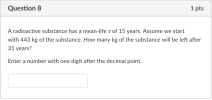 Question 8 1 pts A radioactive substance has a mean-life T of 15 years. Assume we start with 443 kg of the substance. How many kg of the substance will be left after 31 years? Enter a number with one digit after the decimal point.
h= half life a0 = original amount a(t) = amount present after t years t =...
 h= half life
a0 = original amount
a(t) = amount present after t years
t = time
What information do you need?
TH 100 - D100 Use equation : acca un Page 4 of 5 4. Suppose we have Xo amount of a certain radioactive substance. It has been observed that this substance losses 5% of its mass every 10 years. @ How much of the initial mass Xo remains after 10 years? What about 20 years? (b) Use the...
h= half life
a0 = original amount
a(t) = amount present after t years
t = time
What information do you need?
TH 100 - D100 Use equation : acca un Page 4 of 5 4. Suppose we have Xo amount of a certain radioactive substance. It has been observed that this substance losses 5% of its mass every 10 years. @ How much of the initial mass Xo remains after 10 years? What about 20 years? (b) Use the...
The number of grams A of a certain radioactive substance present at time, in years from...
The number of grams A of a certain radioactive substance present at time, in years from the present, t is given by the formula A=45e^-0.0045t What is initial amount of this substance What is half-life of this substance How much will be around in 2500 years
need help with these two questions. Question 5 (1 point) Willmonite-35 is a newly found radioactive substance with...
 need help with these two questions.
Question 5 (1 point) Willmonite-35 is a newly found radioactive substance with a half life of 450 years. How much of 14,000 grams of Willmonite-35 will be left after 180 years? Round to the nearest gram. Your Answer: Answer Question 6 (1 point) A 5.5-volt battery is connected to a series in which the inductance is 0.25 henry and the resistance is 8 ohms. Determine the current after 1 second if the initial current...
need help with these two questions.
Question 5 (1 point) Willmonite-35 is a newly found radioactive substance with a half life of 450 years. How much of 14,000 grams of Willmonite-35 will be left after 180 years? Round to the nearest gram. Your Answer: Answer Question 6 (1 point) A 5.5-volt battery is connected to a series in which the inductance is 0.25 henry and the resistance is 8 ohms. Determine the current after 1 second if the initial current...
Half-Life Complete the table shown to the right for the half-life of a certain radioactive substance....
 Half-Life Complete the table shown to the right for the half-life of a certain radioactive substance. Decay Rate, k 4.6% per year = -0.046 The half-life is years. (Round to one decimal place as needed.)
A 1.6 mg sample of radioactive Ho-166 has a half-life of 26.8 years. What mass remains...
A 1.6 mg sample of radioactive Ho-166 has a half-life of 26.8 years. What mass remains after 12 years? All radioactive decay processes are 1st order reactions. t1/2 = 0.693/k ln [A]t = -kt + ln [A
 A scientist begins with 250 grams of a radioactive substance. After 250 minutes, the sample has decayed to 36 grams. Write an exponential equation f(t) representing this situation. (Let f be the amount of radioactive substance in grams and t be the time in minutes.) f(t) 250e 0.0087t x To the nearest minute, what is the half-life of this substance? 89 min Use the model for continuous exponential decay, y = Ao e-kt, where y is the amount of radioactive...
 9. [-14 Points] DETAILS SPRECALC7 4.6.017. This exercise uses the radioactive decay model. The half-life of radium-226 is 1600 years. Suppose we have a 28-mg sample. (a) Find a function m(t) = moz-th that models the mass remaining after t years. m(t) = (b) Find a function m(t) = moet that models the mass remaining after t years. (Round your value to six decimal places.) m(L) = (c) How much of the sample will remain after 2500 years? (Round your...
 A specific radioactive substance follows a continuous exponential decay mode. It has a half-life of 16 days. At the start of the experiment, 61.7 g is present. Din (a) Lett be the time (in days) since the start of the experiment, and let y be the amount of the substance at time. Write a formula relating y toi. Use exact expressions to fill in the missing parts of the formula Do not use approximations X ? (b) How much will...
 Question 8 1 pts A radioactive substance has a mean-life T of 15 years. Assume we start with 443 kg of the substance. How many kg of the substance will be left after 31 years? Enter a number with one digit after the decimal point.
 h= half life
a0 = original amount
a(t) = amount present after t years
t = time
What information do you need?
TH 100 - D100 Use equation : acca un Page 4 of 5 4. Suppose we have Xo amount of a certain radioactive substance. It has been observed that this substance losses 5% of its mass every 10 years. @ How much of the initial mass Xo remains after 10 years? What about 20 years? (b) Use the...
h= half life
a0 = original amount
a(t) = amount present after t years
t = time
What information do you need?
TH 100 - D100 Use equation : acca un Page 4 of 5 4. Suppose we have Xo amount of a certain radioactive substance. It has been observed that this substance losses 5% of its mass every 10 years. @ How much of the initial mass Xo remains after 10 years? What about 20 years? (b) Use the...
 need help with these two questions.
Question 5 (1 point) Willmonite-35 is a newly found radioactive substance with a half life of 450 years. How much of 14,000 grams of Willmonite-35 will be left after 180 years? Round to the nearest gram. Your Answer: Answer Question 6 (1 point) A 5.5-volt battery is connected to a series in which the inductance is 0.25 henry and the resistance is 8 ohms. Determine the current after 1 second if the initial current...
need help with these two questions.
Question 5 (1 point) Willmonite-35 is a newly found radioactive substance with a half life of 450 years. How much of 14,000 grams of Willmonite-35 will be left after 180 years? Round to the nearest gram. Your Answer: Answer Question 6 (1 point) A 5.5-volt battery is connected to a series in which the inductance is 0.25 henry and the resistance is 8 ohms. Determine the current after 1 second if the initial current...
 Half-Life Complete the table shown to the right for the half-life of a certain radioactive substance. Decay Rate, k 4.6% per year = -0.046 The half-life is years. (Round to one decimal place as needed.)
Most questions answered within 3 hours.
-
Where is the error in this code sequence?
String s1 = "Hello";
String s2 = "ello";...
asked 11 months ago -
Financial data for Joel de Paris, Inc., for last year
follow:
Joel de Paris, Inc.
Balance...
asked 11 months ago -
Consider this reaction:
Al2(SO4)3 (aq)+ BaCl3
(aq) Al2Cl6 (aq)- +
3BaSO4(s) . What is the...
asked 11 months ago -
Suppose that Savneet is considering increasing her
recent random sample from 20 car rentals to 40...
asked 11 months ago -
Trucks arrive at an unloading terminal at an average rate of 120
per hour.
Trucks arrive...
asked 11 months ago -
Why are methanol and ethanol completely soluble in water while
octanol is not very little soluble....
asked 11 months ago -
A facilities manager at a university reads in a research report
that the mean amount of...
asked 11 months ago -
When the CuSO4 is rehydrated by adding water to the anhydrous
compound, is this an endothermic...
asked 11 months ago -
A ray of sunlight is passing from diamond into crown glass; the
angle of incidence is...
asked 11 months ago -
A block of mass 0.249 kg is placed on top of a light, vertical
spring of...
asked 11 months ago -
how do the kidneys compensate in the presences of acidosis
a) trigger hyperventilate
b) reserve acid...
asked 11 months ago -
Question 501 pts
The rental rate of capital to the firm increases. Which of the
following...
asked 11 months ago