
 (diagrams 2,3,4 are included here )
Homework Answers

Add Answer to:
help :(
(diagrams 2,3,4 are included here )
QUESTION 7 A box is at rest on...
8. Draw freebody diagrams if needed to solve both 8a and 8b. a. A 723 kg...
8. Draw freebody diagrams if needed to solve both 8a and 8b. a. A 723 kg elevator car is supported by two cables. Assume that the tension in each cable is the same. If the elevator is accelerating downward at 0.298 m/s2, find the magnitude of the tension in each cable, in N. 8b. A heavy rope of mass 6.44 kg is tied around a box of mass 10.7 sitting at rest on a horizontal, frictionless surface. If the rope...
Part A Assume: in the y (vertical) direction: up is positive; in the x (north-south) direction:...
Part A Assume: in the y (vertical) direction: up is positive; in the x (north-south) direction: north is positive. Henry drives his car north at velocity 21.1 m/s, passing Annabelle, the stationary observer, standing on a street corner. If Annabelle sees rain falling straight down at constant velocity -45.3 m/s, find the speed of the rain, in m/s, according to Henry. Part B In the 19th century, barges were pulled by rope through the Erie Canal. Suppose two ropes of...
The drawing shows box 1 resting on a table, with box 2 resting on top of...
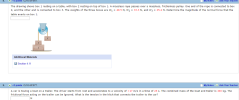 The drawing shows box 1 resting on a table, with box 2 resting on top of box 1. A massless rope passes over a massless, frictionless pulley. One end of the rope is connected to box 2, and the other end is connected to box 3. The weights of the three boxes are W_1 = 49.5 N, W_2 = 33.3 N, and W_3 = 25.4 N. Determine the magnitude of the normal force that the table exerts on box 1....
Question 13 13 pts A box of mass 0.8 kg is being pulled up a slope...
 Question 13 13 pts A box of mass 0.8 kg is being pulled up a slope that is inclined by 60° compared to the horizontal. The tension in the rope pulling the box is 40 N and the rope is parallel to the incline. The slope is NOT frictionless and the coefficient of kinetic friction between the box and the slope is 0.35. Round off your answers to two decimal places. (a) What is the magnitude of the weight of...
A 10 kg box resting on a horizontal, frictionless surface is attached to a 4 kg...
 A 10 kg box resting on a horizontal, frictionless surface is attached to a 4 kg block by a thin light rope that passes over a frictionless pulley. The pulley has a shape of a uniform solid disk of mass 4.5 kg and a radius of 0.55 m. After the system is released 10 kg box moves to the right, 4 kg block moves down and the pulley rotates clockwise. 7 Find: (a) the magnitude of the tension (in N)...
A mass of 7 kg is resting on a horizontal, frictionless surface. Force 1 is applied...
 A mass of 7 kg is resting on a horizontal, frictionless surface. Force 1 is applied to it at 23 degrees below the horizontal, force 2 has a magnitude of 19 N and is applied vertically downward, force 3 has a magnitude of 3 N and is applied vertically upwards, and force 4 has a magnitude of 21 N and is applied in the-x direction to the object. When these forces are applied to the object, the object moves 9...
A) A massless rope is tied to a 1.82 kg box sitting on a rough, horizontal...
A) A massless rope is tied to a 1.82 kg box sitting on a rough, horizontal surface. The rope is pulled with constant force F acting upward at an angle 15.8o to the horizontal. The coefficient of kinetic friction between the box and the surface is 0.217, and the box slides at constant speed along the table for a distance of 84.4 m. Find the total work done by F, in J. B)Josh, mass 143 kg, is racing against his...
I need answers for #5 and #7 2) m m2 ma Now, three masses (m, =...
 I need answers for #5 and #7
2) m m2 ma Now, three masses (m, = 4.4 kg, m2 = 13.2 kg and mz = 8.8) hang from three identical springs in a motionless elevator. The springs all have the same spring constant given above. What is the magnitude of the force the bottom spring exerts on the lower mass? 86.24 N Submit + 3) What is the distance the middle spring is stretched from its equilibrium length? 79.85 cm...
I need answers for #5 and #7
2) m m2 ma Now, three masses (m, = 4.4 kg, m2 = 13.2 kg and mz = 8.8) hang from three identical springs in a motionless elevator. The springs all have the same spring constant given above. What is the magnitude of the force the bottom spring exerts on the lower mass? 86.24 N Submit + 3) What is the distance the middle spring is stretched from its equilibrium length? 79.85 cm...
Question 1 く 1of8 Constants PartA A box rests on a frozen pond, which serves as...
 Question 1 く 1of8 Constants PartA A box rests on a frozen pond, which serves as a frictionless horizontal surface. If a fisherman applies a horizontal force with magnitude 41.5 N to the box and produces an acceleration of magnitude 3.20 m/s* , what is the mass of the box? Express your answer with the appropriate units. Value Units Submit Request Answer
A block of ice (m = 14.0 kg) with an attached rope is at rest on...
A block of ice (m = 14.0 kg) with an attached rope is at rest on a frictionless surface. You pull the block with a force of 91.0 N for 1.41 s at an angle of 18.0°. (The angle is above the horizontal.) (a) Determine the magnitude of each force acting on the block of ice while you are pulling. Fpull = N Fg = N FN = N (b) With what speed is the ice moving after you are...
 The drawing shows box 1 resting on a table, with box 2 resting on top of box 1. A massless rope passes over a massless, frictionless pulley. One end of the rope is connected to box 2, and the other end is connected to box 3. The weights of the three boxes are W_1 = 49.5 N, W_2 = 33.3 N, and W_3 = 25.4 N. Determine the magnitude of the normal force that the table exerts on box 1....
 Question 13 13 pts A box of mass 0.8 kg is being pulled up a slope that is inclined by 60° compared to the horizontal. The tension in the rope pulling the box is 40 N and the rope is parallel to the incline. The slope is NOT frictionless and the coefficient of kinetic friction between the box and the slope is 0.35. Round off your answers to two decimal places. (a) What is the magnitude of the weight of...
 A 10 kg box resting on a horizontal, frictionless surface is attached to a 4 kg block by a thin light rope that passes over a frictionless pulley. The pulley has a shape of a uniform solid disk of mass 4.5 kg and a radius of 0.55 m. After the system is released 10 kg box moves to the right, 4 kg block moves down and the pulley rotates clockwise. 7 Find: (a) the magnitude of the tension (in N)...
 A mass of 7 kg is resting on a horizontal, frictionless surface. Force 1 is applied to it at 23 degrees below the horizontal, force 2 has a magnitude of 19 N and is applied vertically downward, force 3 has a magnitude of 3 N and is applied vertically upwards, and force 4 has a magnitude of 21 N and is applied in the-x direction to the object. When these forces are applied to the object, the object moves 9...
 I need answers for #5 and #7
2) m m2 ma Now, three masses (m, = 4.4 kg, m2 = 13.2 kg and mz = 8.8) hang from three identical springs in a motionless elevator. The springs all have the same spring constant given above. What is the magnitude of the force the bottom spring exerts on the lower mass? 86.24 N Submit + 3) What is the distance the middle spring is stretched from its equilibrium length? 79.85 cm...
I need answers for #5 and #7
2) m m2 ma Now, three masses (m, = 4.4 kg, m2 = 13.2 kg and mz = 8.8) hang from three identical springs in a motionless elevator. The springs all have the same spring constant given above. What is the magnitude of the force the bottom spring exerts on the lower mass? 86.24 N Submit + 3) What is the distance the middle spring is stretched from its equilibrium length? 79.85 cm...
 Question 1 く 1of8 Constants PartA A box rests on a frozen pond, which serves as a frictionless horizontal surface. If a fisherman applies a horizontal force with magnitude 41.5 N to the box and produces an acceleration of magnitude 3.20 m/s* , what is the mass of the box? Express your answer with the appropriate units. Value Units Submit Request Answer
Most questions answered within 3 hours.
-
Where is the error in this code sequence?
String s1 = "Hello";
String s2 = "ello";...
asked 11 months ago -
Financial data for Joel de Paris, Inc., for last year
follow:
Joel de Paris, Inc.
Balance...
asked 11 months ago -
Consider this reaction:
Al2(SO4)3 (aq)+ BaCl3
(aq) Al2Cl6 (aq)- +
3BaSO4(s) . What is the...
asked 11 months ago -
Suppose that Savneet is considering increasing her
recent random sample from 20 car rentals to 40...
asked 11 months ago -
Trucks arrive at an unloading terminal at an average rate of 120
per hour.
Trucks arrive...
asked 11 months ago -
Why are methanol and ethanol completely soluble in water while
octanol is not very little soluble....
asked 11 months ago -
A facilities manager at a university reads in a research report
that the mean amount of...
asked 11 months ago -
When the CuSO4 is rehydrated by adding water to the anhydrous
compound, is this an endothermic...
asked 11 months ago -
A ray of sunlight is passing from diamond into crown glass; the
angle of incidence is...
asked 11 months ago -
A block of mass 0.249 kg is placed on top of a light, vertical
spring of...
asked 11 months ago -
how do the kidneys compensate in the presences of acidosis
a) trigger hyperventilate
b) reserve acid...
asked 11 months ago -
Question 501 pts
The rental rate of capital to the firm increases. Which of the
following...
asked 11 months ago