
Homework Answers

Add Answer to:
12,
18 thank you
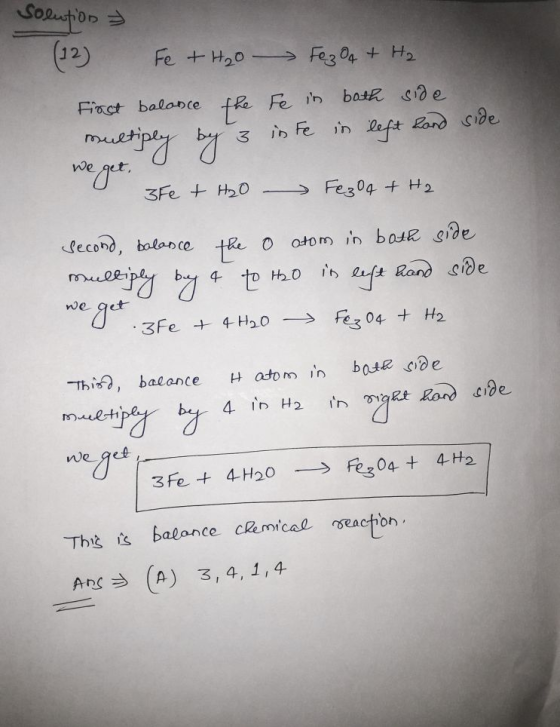
- - _12) Numerical coefficients that correctly balance the reaction, Fe +...
balance each of the following equations Fall 209 CHM 105.004 Exam 2 Answer all the question in order in the blue b...
 balance each of the following equations
Fall 209 CHM 105.004 Exam 2 Answer all the question in order in the blue book. Plesse leave at least two lines between question and show your calculations for full credit. N-6.023 x 10” particles per mol: R 0.08.205 L-atm/(mol-K) b) Al2(PO4) 3 e) CuSO4-5 H2O 1. Calculate the molar masses of: a) (NH4)2SO4 2. Calculate: a) the number of atoms of calcium in a 10.50 g sample of the metal b) the mass...
balance each of the following equations
Fall 209 CHM 105.004 Exam 2 Answer all the question in order in the blue book. Plesse leave at least two lines between question and show your calculations for full credit. N-6.023 x 10” particles per mol: R 0.08.205 L-atm/(mol-K) b) Al2(PO4) 3 e) CuSO4-5 H2O 1. Calculate the molar masses of: a) (NH4)2SO4 2. Calculate: a) the number of atoms of calcium in a 10.50 g sample of the metal b) the mass...
18) Which of the following is an acid-base reaction? A) Fe(s) + 2 AgNO3(aq) - 2...
 18) Which of the following is an acid-base reaction? A) Fe(s) + 2 AgNO3(aq) - 2 Ag(s) + Fe(NO3)2(aq) B) MgSO4(aq) + Ba(NO3)2(aq) -- Mg(NO3)2(aq) + Baso C) C(s) + O2(g) - CO2(g) (D) 2 HCIO 4(aq) + Ca(OH)2(aq) → 2 H2O(l) + Ca(C1O4)2 E) None of the above are acid base reactions. 1 Determine the oxidation state of P in PO 33-. A-3 B) 0 C) +6
Match Each reaction to its reaction type: 2 NaBr + Cl2 → 2 NaCl + Br2...
Match Each reaction to its reaction type: 2 NaBr + Cl2 → 2 NaCl + Br2 Na2SO4 + CaCl2 → CaSO4 + 2 NaCl CH4 + 2 O2 → CO2 + 2 H2O CaCO3 → CaO + CO2 MgO + H2O → Mg(OH)2 HCl + NaOH → NaCl + H2O A. Decomposition B. Double Replacement C. Combustion D. Acid/Base E. Explosion F. Combination G. Single Replacement
12) 12) As defined in the text, identify the "gas evolution" reactions among the following 1. 2HCl(aq) +K2CO3(aq) -...
 12) 12) As defined in the text, identify the "gas evolution" reactions among the following 1. 2HCl(aq) +K2CO3(aq) --H2O(l) + CO2(g) + 2Cl(aq) 2. CH4(g)+202(g) + CO2(g) + 2H2O(1) 3. 2HCl(aq) +K2S(aq) -- H2S(g)+2KCl(aq) A) 1 and 2 only B) 1 and 3 only C) 2 and 3 only D) All of 1, 2, and 3 E) None of 1, 2, and 3 13) 13) Identify the oxidation-reduction reactions among the following: 1. Zn(s)+Cu2(aq) -- Zn2+aq) + Cu(s) 2. 2...
4.) (20%) Which one of the following is an acid base reaction? a) C(s) + O2(g)...
 4.) (20%) Which one of the following is an acid base reaction? a) C(s) + O2(g) → CO2(g) b) 2 HCl(aq) + Ca(OH)2(aq) + 2 H2O(1) + CaCl2(aq) c) Fe(s) + 2 AgNO3(aq) — 2 Ag(s) + Fe(NO3)2(aq) d) MgSO4(aq) + Ba(NO3)2(aq) + Mg(NO3)2(aq) + BaSO4(s) e) None of the above are acid base reactions.
IU. AS is positive for the reaction A) CaO (s) + CO2 (g) CaCO3 (S) B)...
 IU. AS is positive for the reaction A) CaO (s) + CO2 (g) CaCO3 (S) B) N2 (g) + 3H2(g) → 2NH3 (g) C) 2503 (g) - 2802 (g) + O2 (g) D) Ag+ (aq) + Cl- (aq) → AgCl (s) E) H20 (1) + H20 (s) 11. AS is positive for the reaction A)2 Ca(s) + O2 (g) 2 Cao (s) B) 2 KClO3 (s) 2KCI(S) + 30 (g) C) HCl (8) + NH3 (8) ► NH4Cl (s) D)...
Which one of the following reactions is NOT a redox reaction? A. 3 Hg(l) + 2...
Which one of the following reactions is NOT a redox reaction? A. 3 Hg(l) + 2 Cr(NO3)3(aq) → 3 Hg(NO3)2(aq)+ 2 Cr(s) B. 2Ag(s) + 2HNO3(aq) → 2AgNO3 (aq) + H2 (g) C. 2 HClO4(aq) + CaCO3(s) → Ca(ClO4)2(aq) + H2O(l) + CO2(g) D. Fe2O3(s) + 3 CO(g) → 2 Fe(s) + 3 CO2(g) E. CH4(g) + 2 O2(g) → CO2(g) + 2 H2O(l)
8. Which of the following reactants, when mixed, would evolve a gas. a) Li2S(aq) + 2HCl(aq)...
 8. Which of the following reactants, when mixed, would evolve a gas. a) Li2S(aq) + 2HCl(aq) → b) Na2SO3(aq) + HNO3(aq) → c) K2CO3(aq) + 2HCl(aq) → d) All of the above. e) Only b and c. 9. Which of the following samples has the fewest moles of gas? a) 1.00 L of CH4 at 10°C and 1.00 atm b) 1.00 L of NH3 at 10°C and 1.00 atm 1.00 L of HCl at 20°C and 1.00 atm a) 1.00...
how many moles of lithium nitrate are theoretically produced if we start with 34 moles of...
 how many moles of lithium nitrate are theoretically produced if we start with 34 moles of Ca(NO3)2 and 24 moles of LigPO4? Reaction: 3Ca(NO3)2 + 2Li3PO4 -- LINO3 + Caz(PO4)2 A) 1.1 B) 6.8 C) 1.2 D) 7.2 E) not enough information 28) – 28) What is the limiting reactant for the following reaction given we have 2.6 moles of HCl and 1.4 moles of Ca(OH)2? Reaction: 2HCl + Ca(OH)2 + 2H2O +CaCl2 A) Ca(OH)2 B) HCI C) CaCl2 D)...
Balance each of the following skeletal equations: (a) Mg(s)+ O2(g) (b) Zn(s)+ AgNO3(aq) Zn(NO3)2(aq) + Ag(s)...
 Balance each of the following skeletal equations: (a) Mg(s)+ O2(g) (b) Zn(s)+ AgNO3(aq) Zn(NO3)2(aq) + Ag(s) (c) C2H2(g)+O2(g) CO2(g) + H20(g) 5.38 MgO(s) odm(d) C12H22O11(s) +KCIO3(I) Constder the foll CO2(g) +H20(g) + KCI(s)
 balance each of the following equations
Fall 209 CHM 105.004 Exam 2 Answer all the question in order in the blue book. Plesse leave at least two lines between question and show your calculations for full credit. N-6.023 x 10” particles per mol: R 0.08.205 L-atm/(mol-K) b) Al2(PO4) 3 e) CuSO4-5 H2O 1. Calculate the molar masses of: a) (NH4)2SO4 2. Calculate: a) the number of atoms of calcium in a 10.50 g sample of the metal b) the mass...
balance each of the following equations
Fall 209 CHM 105.004 Exam 2 Answer all the question in order in the blue book. Plesse leave at least two lines between question and show your calculations for full credit. N-6.023 x 10” particles per mol: R 0.08.205 L-atm/(mol-K) b) Al2(PO4) 3 e) CuSO4-5 H2O 1. Calculate the molar masses of: a) (NH4)2SO4 2. Calculate: a) the number of atoms of calcium in a 10.50 g sample of the metal b) the mass...
 18) Which of the following is an acid-base reaction? A) Fe(s) + 2 AgNO3(aq) - 2 Ag(s) + Fe(NO3)2(aq) B) MgSO4(aq) + Ba(NO3)2(aq) -- Mg(NO3)2(aq) + Baso C) C(s) + O2(g) - CO2(g) (D) 2 HCIO 4(aq) + Ca(OH)2(aq) → 2 H2O(l) + Ca(C1O4)2 E) None of the above are acid base reactions. 1 Determine the oxidation state of P in PO 33-. A-3 B) 0 C) +6
 12) 12) As defined in the text, identify the "gas evolution" reactions among the following 1. 2HCl(aq) +K2CO3(aq) --H2O(l) + CO2(g) + 2Cl(aq) 2. CH4(g)+202(g) + CO2(g) + 2H2O(1) 3. 2HCl(aq) +K2S(aq) -- H2S(g)+2KCl(aq) A) 1 and 2 only B) 1 and 3 only C) 2 and 3 only D) All of 1, 2, and 3 E) None of 1, 2, and 3 13) 13) Identify the oxidation-reduction reactions among the following: 1. Zn(s)+Cu2(aq) -- Zn2+aq) + Cu(s) 2. 2...
 4.) (20%) Which one of the following is an acid base reaction? a) C(s) + O2(g) → CO2(g) b) 2 HCl(aq) + Ca(OH)2(aq) + 2 H2O(1) + CaCl2(aq) c) Fe(s) + 2 AgNO3(aq) — 2 Ag(s) + Fe(NO3)2(aq) d) MgSO4(aq) + Ba(NO3)2(aq) + Mg(NO3)2(aq) + BaSO4(s) e) None of the above are acid base reactions.
 IU. AS is positive for the reaction A) CaO (s) + CO2 (g) CaCO3 (S) B) N2 (g) + 3H2(g) → 2NH3 (g) C) 2503 (g) - 2802 (g) + O2 (g) D) Ag+ (aq) + Cl- (aq) → AgCl (s) E) H20 (1) + H20 (s) 11. AS is positive for the reaction A)2 Ca(s) + O2 (g) 2 Cao (s) B) 2 KClO3 (s) 2KCI(S) + 30 (g) C) HCl (8) + NH3 (8) ► NH4Cl (s) D)...
 8. Which of the following reactants, when mixed, would evolve a gas. a) Li2S(aq) + 2HCl(aq) → b) Na2SO3(aq) + HNO3(aq) → c) K2CO3(aq) + 2HCl(aq) → d) All of the above. e) Only b and c. 9. Which of the following samples has the fewest moles of gas? a) 1.00 L of CH4 at 10°C and 1.00 atm b) 1.00 L of NH3 at 10°C and 1.00 atm 1.00 L of HCl at 20°C and 1.00 atm a) 1.00...
 how many moles of lithium nitrate are theoretically produced if we start with 34 moles of Ca(NO3)2 and 24 moles of LigPO4? Reaction: 3Ca(NO3)2 + 2Li3PO4 -- LINO3 + Caz(PO4)2 A) 1.1 B) 6.8 C) 1.2 D) 7.2 E) not enough information 28) – 28) What is the limiting reactant for the following reaction given we have 2.6 moles of HCl and 1.4 moles of Ca(OH)2? Reaction: 2HCl + Ca(OH)2 + 2H2O +CaCl2 A) Ca(OH)2 B) HCI C) CaCl2 D)...
 Balance each of the following skeletal equations: (a) Mg(s)+ O2(g) (b) Zn(s)+ AgNO3(aq) Zn(NO3)2(aq) + Ag(s) (c) C2H2(g)+O2(g) CO2(g) + H20(g) 5.38 MgO(s) odm(d) C12H22O11(s) +KCIO3(I) Constder the foll CO2(g) +H20(g) + KCI(s)
Most questions answered within 3 hours.
-
Where is the error in this code sequence?
String s1 = "Hello";
String s2 = "ello";...
asked 10 months ago -
Financial data for Joel de Paris, Inc., for last year
follow:
Joel de Paris, Inc.
Balance...
asked 10 months ago -
Consider this reaction:
Al2(SO4)3 (aq)+ BaCl3
(aq) Al2Cl6 (aq)- +
3BaSO4(s) . What is the...
asked 10 months ago -
Suppose that Savneet is considering increasing her
recent random sample from 20 car rentals to 40...
asked 10 months ago -
Trucks arrive at an unloading terminal at an average rate of 120
per hour.
Trucks arrive...
asked 10 months ago -
Why are methanol and ethanol completely soluble in water while
octanol is not very little soluble....
asked 10 months ago -
A facilities manager at a university reads in a research report
that the mean amount of...
asked 10 months ago -
When the CuSO4 is rehydrated by adding water to the anhydrous
compound, is this an endothermic...
asked 10 months ago -
A ray of sunlight is passing from diamond into crown glass; the
angle of incidence is...
asked 10 months ago -
A block of mass 0.249 kg is placed on top of a light, vertical
spring of...
asked 10 months ago -
how do the kidneys compensate in the presences of acidosis
a) trigger hyperventilate
b) reserve acid...
asked 10 months ago -
Question 501 pts
The rental rate of capital to the firm increases. Which of the
following...
asked 10 months ago