
Homework Answers

Add Answer to:
help with problems 1 & 2 please and explain
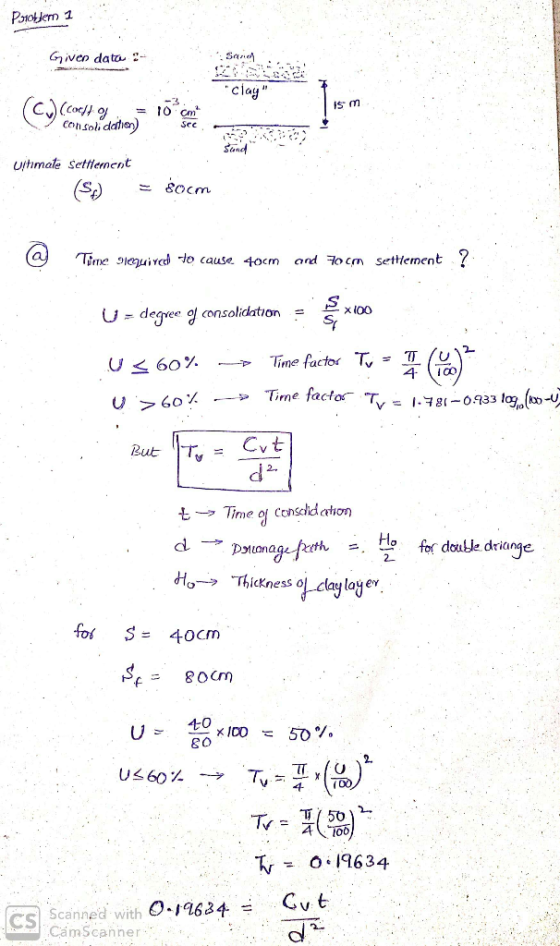
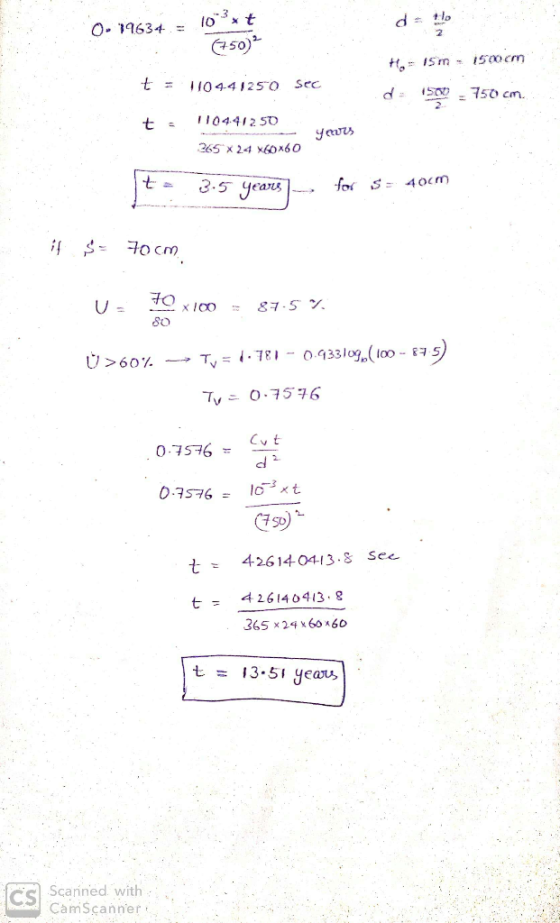
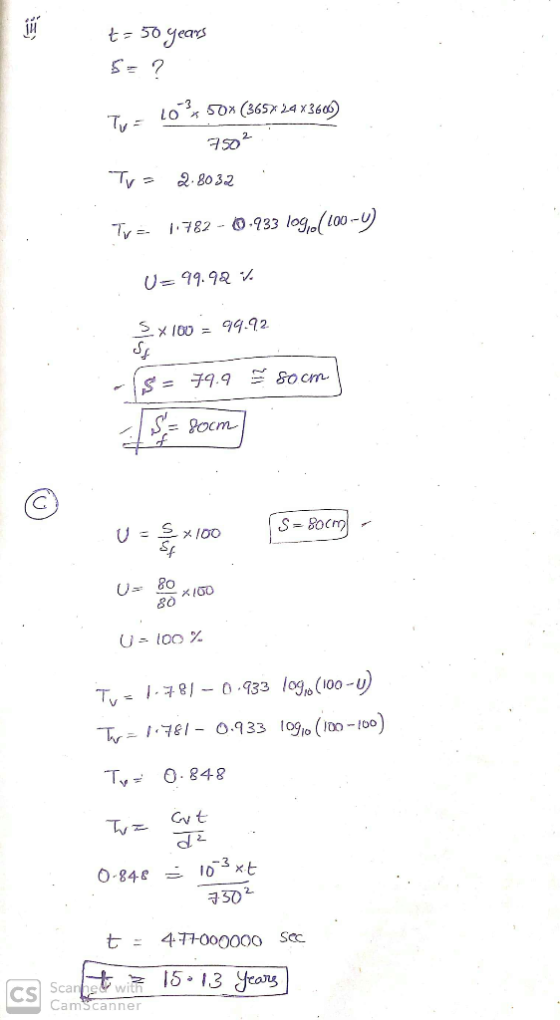
Problem 1 A deposit of Swedish clay...
6. (a) In piling technology, explain the difference between a "displacement pile" and (2 marks) a "non-displacement pile". (b) Using graph paper, sketch 3 curves illustrating typical...
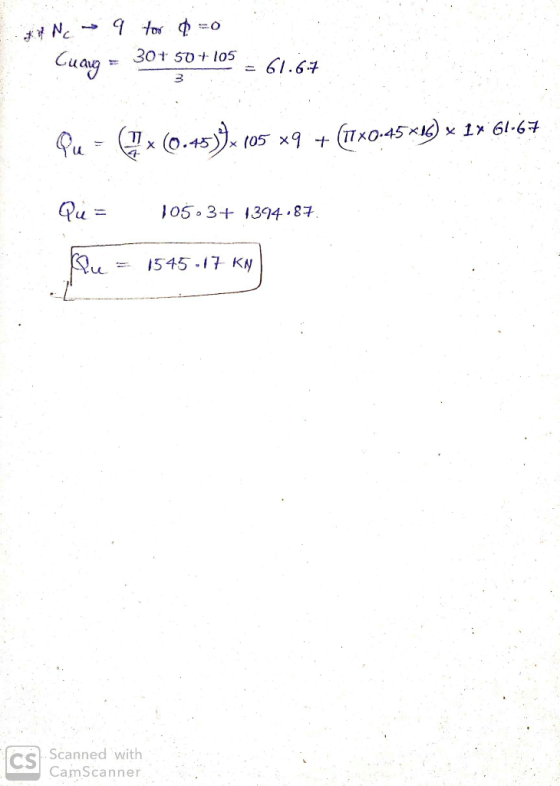
 6. (a) In piling technology, explain the difference between a "displacement pile" and (2 marks) a "non-displacement pile". (b) Using graph paper, sketch 3 curves illustrating typical trends of variation of pile head resistance, shaft resistance and base resistance with increasing settlement, as expected from load testing a CFA pile in clay. Explain the differences between the three curves (6 marks) (c) A bored cast in-situ pile of 0.6 m diameter by 10 m long is installed through a 6...
Geotechnical engineering 2 Q3. A double drained clay layer of 3.5 m thickness is subjected to...
 Geotechnical engineering 2
Q3. A double drained clay layer of 3.5 m thickness is subjected to loading that increases the average effective vertical stress from 250 kN/m2 to 390 kN/m2, assuming my 1.7 x 10 m2/kN and Cy-0.75 m2year, determine i. The ultimate consolidation settlement ii. The settlement at the end of 1.5 years, The time in days for 30% consolidation,
Geotechnical engineering 2
Q3. A double drained clay layer of 3.5 m thickness is subjected to loading that increases the average effective vertical stress from 250 kN/m2 to 390 kN/m2, assuming my 1.7 x 10 m2/kN and Cy-0.75 m2year, determine i. The ultimate consolidation settlement ii. The settlement at the end of 1.5 years, The time in days for 30% consolidation,
A group pile in clay is shown in the figure below. Determine the maximum vertical load...
 A group pile in clay is shown in the figure below. Determine the maximum vertical load Qg can be applied if the allowable consolidation settlement of the pile group is set to be 0.2 m. Use the 2: 1 stress distribution method to estimate the average effective stress in the clay layer. Qg 3 m Sand Groundwater ? table 15.72 kN/m3 Sand 3 m Ysat 18.55 kN/m2 2.5 m x 3 m Group plan 15 mNormally consolidated clay 185 nn...
The time for 50% consolidation of a 25 mm thick clay specimen (drained at top and bottom) in the laboratory is 1...
 The time for 50% consolidation of a 25 mm thick clay specimen (drained at top and bottom) in the laboratory is 150 sec. How long (in days) will it take for a 3 m thick layer of the same clay in the field under the same pressure increment to reach 75% consolidation? There is an impermeable shale layer at the bottom of the clay layer in the field I. 2. Use Figure 1 for the following Compute the vertical effective...
1. An 8-m thick normally consolidated clay layer is doubly drained as shown below. (This means...
 1. An 8-m thick normally consolidated clay layer is doubly drained as shown below. (This means that a very pervious layer compared to the clay exists on top of and under the clay layer) The embankment applied an average vertical stress increase of 100 kPa to the clay layer. The water table is located at the mid depth of the sand layer. Assume the sand above the water table is dry 0 Pore water pressure, u (kPa) 20 40 60...
Q1) An oedometer test was performed on a 2 cm thick clay sample drained on both...
 Q1) An oedometer test was performed on a 2 cm thick clay sample drained on both sides taken from the mid clay layer shown below , after 10 minutes 50% consolidation is reached. a) How long time in days would the same degree of consolidation(50%) be reached in the field ?. b) How much the Final settlement would be reached in the clay layer.? c) How much the preconsolidation pressure of a specimen. ? 3m 2m Sand surcharge Y= 17...
soil Q1) An oedometer test was performed on a 2 cm thick clay sample drained on...
 soil
Q1) An oedometer test was performed on a 2 cm thick clay sample drained on both sides taken from the mid clay layer shown below, after 10 minutes 50% consolidation is reached . a) How long time in days would the same degree of consolidation(50%) be reached in the field ?. b) How much the Final settlement would be reached in the clay layer.? c) How much the preconsolidation pressure of a specimen. ? 3m 2m Sand surcharge Y...
soil
Q1) An oedometer test was performed on a 2 cm thick clay sample drained on both sides taken from the mid clay layer shown below, after 10 minutes 50% consolidation is reached . a) How long time in days would the same degree of consolidation(50%) be reached in the field ?. b) How much the Final settlement would be reached in the clay layer.? c) How much the preconsolidation pressure of a specimen. ? 3m 2m Sand surcharge Y...
Could someone please help with this problem parts a-f 2. Use Figure 1 and Table 1...
 Could someone
please help with this problem parts a-f
2. Use Figure 1 and Table 1 for the following a) Compute the vertical effective stress (o) in kN/m2 at the center of the clay layer prior to the construction of the footing. [Note: To compute c., you will first have to use the weight-volume relationships to compute the unit weight of the clay.] b) Assuming B 15 m, L 2.5 m, and Q-120 kN, use the Boussinesq procedure to determine...
Could someone
please help with this problem parts a-f
2. Use Figure 1 and Table 1 for the following a) Compute the vertical effective stress (o) in kN/m2 at the center of the clay layer prior to the construction of the footing. [Note: To compute c., you will first have to use the weight-volume relationships to compute the unit weight of the clay.] b) Assuming B 15 m, L 2.5 m, and Q-120 kN, use the Boussinesq procedure to determine...
Question 5 (20 marks) A I-m thick, c applied on the top surface of the clay using Sheepsfoot rollers t Ily-saturate...
 Question 5 (20 marks) A I-m thick, c applied on the top surface of the clay using Sheepsfoot rollers t Ily-saturated clay is resting on a dry sand when a uniform load of 200 kN/m2 is expedite consolidation process For the saturated clay layer, the initial void ratio of 5.0, specific gravity of 2.65, pre-consolidation ression index of 0.2, and the stress of 20 kN/m2: the compression index of 0.5, the recomp coefficient of consolidation of 0.001 cm2 s" a)...
Two undisturbed clay samples were taken from the middle of the overconsolidated and normally consolidated clay layers in the soil profile shown. The water table is at the top of the overconsolidated c...
 Two undisturbed clay samples were taken from the middle of the
overconsolidated and normally consolidated clay layers in the soil
profile shown. The water table is at the top of the
overconsolidated clay layer. Consolidation tests were carried out
on the two samples and the results are summarized in the table
below. Assume that the bulk, dry, and saturated unit weights of the
sand are 16 kN/m3, 16 kN/m3 and 19
kN/m3, respectively. The specific gravity of the clay
soil...
Two undisturbed clay samples were taken from the middle of the
overconsolidated and normally consolidated clay layers in the soil
profile shown. The water table is at the top of the
overconsolidated clay layer. Consolidation tests were carried out
on the two samples and the results are summarized in the table
below. Assume that the bulk, dry, and saturated unit weights of the
sand are 16 kN/m3, 16 kN/m3 and 19
kN/m3, respectively. The specific gravity of the clay
soil...
 6. (a) In piling technology, explain the difference between a "displacement pile" and (2 marks) a "non-displacement pile". (b) Using graph paper, sketch 3 curves illustrating typical trends of variation of pile head resistance, shaft resistance and base resistance with increasing settlement, as expected from load testing a CFA pile in clay. Explain the differences between the three curves (6 marks) (c) A bored cast in-situ pile of 0.6 m diameter by 10 m long is installed through a 6...
 Geotechnical engineering 2
Q3. A double drained clay layer of 3.5 m thickness is subjected to loading that increases the average effective vertical stress from 250 kN/m2 to 390 kN/m2, assuming my 1.7 x 10 m2/kN and Cy-0.75 m2year, determine i. The ultimate consolidation settlement ii. The settlement at the end of 1.5 years, The time in days for 30% consolidation,
Geotechnical engineering 2
Q3. A double drained clay layer of 3.5 m thickness is subjected to loading that increases the average effective vertical stress from 250 kN/m2 to 390 kN/m2, assuming my 1.7 x 10 m2/kN and Cy-0.75 m2year, determine i. The ultimate consolidation settlement ii. The settlement at the end of 1.5 years, The time in days for 30% consolidation,
 A group pile in clay is shown in the figure below. Determine the maximum vertical load Qg can be applied if the allowable consolidation settlement of the pile group is set to be 0.2 m. Use the 2: 1 stress distribution method to estimate the average effective stress in the clay layer. Qg 3 m Sand Groundwater ? table 15.72 kN/m3 Sand 3 m Ysat 18.55 kN/m2 2.5 m x 3 m Group plan 15 mNormally consolidated clay 185 nn...
 The time for 50% consolidation of a 25 mm thick clay specimen (drained at top and bottom) in the laboratory is 150 sec. How long (in days) will it take for a 3 m thick layer of the same clay in the field under the same pressure increment to reach 75% consolidation? There is an impermeable shale layer at the bottom of the clay layer in the field I. 2. Use Figure 1 for the following Compute the vertical effective...
 1. An 8-m thick normally consolidated clay layer is doubly drained as shown below. (This means that a very pervious layer compared to the clay exists on top of and under the clay layer) The embankment applied an average vertical stress increase of 100 kPa to the clay layer. The water table is located at the mid depth of the sand layer. Assume the sand above the water table is dry 0 Pore water pressure, u (kPa) 20 40 60...
 Q1) An oedometer test was performed on a 2 cm thick clay sample drained on both sides taken from the mid clay layer shown below , after 10 minutes 50% consolidation is reached. a) How long time in days would the same degree of consolidation(50%) be reached in the field ?. b) How much the Final settlement would be reached in the clay layer.? c) How much the preconsolidation pressure of a specimen. ? 3m 2m Sand surcharge Y= 17...
 soil
Q1) An oedometer test was performed on a 2 cm thick clay sample drained on both sides taken from the mid clay layer shown below, after 10 minutes 50% consolidation is reached . a) How long time in days would the same degree of consolidation(50%) be reached in the field ?. b) How much the Final settlement would be reached in the clay layer.? c) How much the preconsolidation pressure of a specimen. ? 3m 2m Sand surcharge Y...
soil
Q1) An oedometer test was performed on a 2 cm thick clay sample drained on both sides taken from the mid clay layer shown below, after 10 minutes 50% consolidation is reached . a) How long time in days would the same degree of consolidation(50%) be reached in the field ?. b) How much the Final settlement would be reached in the clay layer.? c) How much the preconsolidation pressure of a specimen. ? 3m 2m Sand surcharge Y...
 Could someone
please help with this problem parts a-f
2. Use Figure 1 and Table 1 for the following a) Compute the vertical effective stress (o) in kN/m2 at the center of the clay layer prior to the construction of the footing. [Note: To compute c., you will first have to use the weight-volume relationships to compute the unit weight of the clay.] b) Assuming B 15 m, L 2.5 m, and Q-120 kN, use the Boussinesq procedure to determine...
Could someone
please help with this problem parts a-f
2. Use Figure 1 and Table 1 for the following a) Compute the vertical effective stress (o) in kN/m2 at the center of the clay layer prior to the construction of the footing. [Note: To compute c., you will first have to use the weight-volume relationships to compute the unit weight of the clay.] b) Assuming B 15 m, L 2.5 m, and Q-120 kN, use the Boussinesq procedure to determine...
 Question 5 (20 marks) A I-m thick, c applied on the top surface of the clay using Sheepsfoot rollers t Ily-saturated clay is resting on a dry sand when a uniform load of 200 kN/m2 is expedite consolidation process For the saturated clay layer, the initial void ratio of 5.0, specific gravity of 2.65, pre-consolidation ression index of 0.2, and the stress of 20 kN/m2: the compression index of 0.5, the recomp coefficient of consolidation of 0.001 cm2 s" a)...
 Two undisturbed clay samples were taken from the middle of the
overconsolidated and normally consolidated clay layers in the soil
profile shown. The water table is at the top of the
overconsolidated clay layer. Consolidation tests were carried out
on the two samples and the results are summarized in the table
below. Assume that the bulk, dry, and saturated unit weights of the
sand are 16 kN/m3, 16 kN/m3 and 19
kN/m3, respectively. The specific gravity of the clay
soil...
Two undisturbed clay samples were taken from the middle of the
overconsolidated and normally consolidated clay layers in the soil
profile shown. The water table is at the top of the
overconsolidated clay layer. Consolidation tests were carried out
on the two samples and the results are summarized in the table
below. Assume that the bulk, dry, and saturated unit weights of the
sand are 16 kN/m3, 16 kN/m3 and 19
kN/m3, respectively. The specific gravity of the clay
soil...
Most questions answered within 3 hours.
-
Where is the error in this code sequence?
String s1 = "Hello";
String s2 = "ello";...
asked 11 months ago -
Financial data for Joel de Paris, Inc., for last year
follow:
Joel de Paris, Inc.
Balance...
asked 11 months ago -
Consider this reaction:
Al2(SO4)3 (aq)+ BaCl3
(aq) Al2Cl6 (aq)- +
3BaSO4(s) . What is the...
asked 11 months ago -
Suppose that Savneet is considering increasing her
recent random sample from 20 car rentals to 40...
asked 11 months ago -
Trucks arrive at an unloading terminal at an average rate of 120
per hour.
Trucks arrive...
asked 11 months ago -
Why are methanol and ethanol completely soluble in water while
octanol is not very little soluble....
asked 11 months ago -
A facilities manager at a university reads in a research report
that the mean amount of...
asked 11 months ago -
When the CuSO4 is rehydrated by adding water to the anhydrous
compound, is this an endothermic...
asked 11 months ago -
A ray of sunlight is passing from diamond into crown glass; the
angle of incidence is...
asked 11 months ago -
A block of mass 0.249 kg is placed on top of a light, vertical
spring of...
asked 11 months ago -
how do the kidneys compensate in the presences of acidosis
a) trigger hyperventilate
b) reserve acid...
asked 11 months ago -
Question 501 pts
The rental rate of capital to the firm increases. Which of the
following...
asked 11 months ago