Diels-alder reaction lab Reaction: anthracene+ maleic anhydride <---> 9,10-Dihydroanthracene-9,10-α,β-succinic acid anhydride How would raising the temperature...
Diels-alder reaction lab
Reaction: anthracene+ maleic anhydride <---> 9,10-Dihydroanthracene-9,10-α,β-succinic acid anhydride
How would raising the temperature of the experiment affect product isolation? Would more or less product be expected, and why?
Homework Answers
The reaction when run at high temperature would increase the rate of the reaction thus producing higher product.
Add Answer to:
Diels-alder reaction lab
Reaction: anthracene+ maleic anhydride <--->
9,10-Dihydroanthracene-9,10-α,β-succinic acid anhydride
How would raising the temperature...
What is the complete Infrared Spectrum of 9,10-dihydroanthracene-9,10-α,β-succinic anhydride, in the diels-alder reaction of Anthracene With...
What is the complete Infrared Spectrum of 9,10-dihydroanthracene-9,10-α,β-succinic anhydride, in the diels-alder reaction of Anthracene With Maleic Anhydride?
What is the theoretical yield of 9,10-dihydroanthracene-9,10-α,β-succinic anhydride in your synthesis? 0.113 g maleic anhydride (98.06...
What is the theoretical yield of 9,10-dihydroanthracene-9,10-α,β-succinic anhydride in your synthesis? 0.113 g maleic anhydride (98.06 g/mol) 0.209 g Anthracene (178.23g/mol) 9,10-dihydroanthracene-9,10-α,β-succinic anhydride (276.29g/mol)
Reaction is Diels-Alder Reaction: 0.6 g (Anthracene) + 0.3 g (maleic anhydride) --> product [9,10-dihydroanthreceno-9,10-endo- α,...
Reaction is Diels-Alder Reaction: 0.6 g (Anthracene) + 0.3 g (maleic anhydride) --> product [9,10-dihydroanthreceno-9,10-endo- α, β-succinic anhydride] 0.70 grams obtained. When vacuumed, xylened and isolated, the product yielded 0.70 grams product. Please show how to calculate % yield with the weights above (Theoretical + Actual).
Which is more polar anthracene or 9,10-dihydroanthracene-9,10-α,β-succinic anhydride?
Which is more polar anthracene or 9,10-dihydroanthracene-9,10-α,β-succinic anhydride?
I am writing my chem lab report for the Diels Alder reaction, using 80mg of anthracene...
I am writing my chem lab report for the Diels Alder reaction, using 80mg of anthracene and 40mg of maleic anhydride to form 9,10-dihydroanthracene-9,10-a,B-succinic acid anhydride. The question I'm stuck on is why does the yellow color disappear from the reaction by refluxing the two compounds together?
Full assign the IR spectra for 9,10-dihydroanthracene-9,10-α,β-succinic anhydride and indicate specific peaks correlating to the molecule...
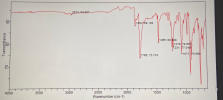 Full assign the IR spectra for
9,10-dihydroanthracene-9,10-α,β-succinic anhydride and indicate
specific peaks correlating to the molecule
2974, 33.0&- ( 1484188.100 Transmitance [1485; 80 28 1216.78.ed/ 1231:F7.0481 11788; 73.710 ເ–1071\\55.eco| 70 40ທດ TT_T 20 " " " " ທາດ' 3000 ' ່2500 " " "່ zoo " " " Wavenumber (cm-1) 1500 1000
Full assign the IR spectra for
9,10-dihydroanthracene-9,10-α,β-succinic anhydride and indicate
specific peaks correlating to the molecule
2974, 33.0&- ( 1484188.100 Transmitance [1485; 80 28 1216.78.ed/ 1231:F7.0481 11788; 73.710 ເ–1071\\55.eco| 70 40ທດ TT_T 20 " " " " ທາດ' 3000 ' ່2500 " " "່ zoo " " " Wavenumber (cm-1) 1500 1000
Draw the complete reaction mechanism for the below. (R groups are not acceptable, please draw the...
Draw the complete reaction mechanism for the below. (R groups are not acceptable, please draw the complete structure for every step.) Diels Alder reaction between one mole of anthracene (molecular weight = 178.23g/mol) and one mole maleic anhydride (molecular weight = 98.06g/mol) forms one mole of 9,10-dihydroanthracene-9,10-α,β-succinic anhydride (molecular weight = 276.29g/mol).
Draw the complete reaction mechanism for the below. (R groups are not acceptable, please draw the...
Draw the complete reaction mechanism for the below. (R groups are not acceptable, please draw the complete structure for every step.) Diels Alder reaction between one mole of anthracene (molecular weight = 178.23g/mol) and one mole maleic anhydride (molecular weight = 98.06g/mol) forms one mole of 9,10-dihydroanthracene-9,10-α,β-succinic anhydride (molecular weight = 276.29g/mol).
How many g of anthracene would you need to react with 9.8 g of maleic anhydride...
How many g of anthracene would you need to react with 9.8 g of maleic anhydride in a Diels-Alder reaction? (Assume a 1:1 molar ration of anthracene to maleic anhydride.) 2 - If you started lab using 0.221 g of anthracene and 0.652 g of maleic anhydride, and obtained 0.182 g of product, what is the percent yield?
The Diels-Alder reaction you will conduct in this experiment is between cyclopentadiene and maleic anhydride (the...
 The Diels-Alder reaction you will conduct in this experiment is between cyclopentadiene and maleic anhydride (the anhydride of cis-2-butendioic acid): diene dienophile The glassware is predried and a drying tube is used to prevent the hydrolysis of maleic anhydride to maleic acid (cis-2-butendioic acid): On heating, maleic acid isomerizes to fumaric acid (trans-2-butendioic acid). Show the mixture of products that would be formed if a small amount of moisture was present in the Diels-Alder reaction you have performed.
 Full assign the IR spectra for
9,10-dihydroanthracene-9,10-α,β-succinic anhydride and indicate
specific peaks correlating to the molecule
2974, 33.0&- ( 1484188.100 Transmitance [1485; 80 28 1216.78.ed/ 1231:F7.0481 11788; 73.710 ເ–1071\\55.eco| 70 40ທດ TT_T 20 " " " " ທາດ' 3000 ' ່2500 " " "່ zoo " " " Wavenumber (cm-1) 1500 1000
Full assign the IR spectra for
9,10-dihydroanthracene-9,10-α,β-succinic anhydride and indicate
specific peaks correlating to the molecule
2974, 33.0&- ( 1484188.100 Transmitance [1485; 80 28 1216.78.ed/ 1231:F7.0481 11788; 73.710 ເ–1071\\55.eco| 70 40ທດ TT_T 20 " " " " ທາດ' 3000 ' ່2500 " " "່ zoo " " " Wavenumber (cm-1) 1500 1000
 The Diels-Alder reaction you will conduct in this experiment is between cyclopentadiene and maleic anhydride (the anhydride of cis-2-butendioic acid): diene dienophile The glassware is predried and a drying tube is used to prevent the hydrolysis of maleic anhydride to maleic acid (cis-2-butendioic acid): On heating, maleic acid isomerizes to fumaric acid (trans-2-butendioic acid). Show the mixture of products that would be formed if a small amount of moisture was present in the Diels-Alder reaction you have performed.
Most questions answered within 3 hours.
-
Where is the error in this code sequence?
String s1 = "Hello";
String s2 = "ello";...
asked 10 months ago -
Financial data for Joel de Paris, Inc., for last year
follow:
Joel de Paris, Inc.
Balance...
asked 10 months ago -
Consider this reaction:
Al2(SO4)3 (aq)+ BaCl3
(aq) Al2Cl6 (aq)- +
3BaSO4(s) . What is the...
asked 10 months ago -
Suppose that Savneet is considering increasing her
recent random sample from 20 car rentals to 40...
asked 10 months ago -
Trucks arrive at an unloading terminal at an average rate of 120
per hour.
Trucks arrive...
asked 10 months ago -
Why are methanol and ethanol completely soluble in water while
octanol is not very little soluble....
asked 10 months ago -
A facilities manager at a university reads in a research report
that the mean amount of...
asked 10 months ago -
When the CuSO4 is rehydrated by adding water to the anhydrous
compound, is this an endothermic...
asked 10 months ago -
A ray of sunlight is passing from diamond into crown glass; the
angle of incidence is...
asked 10 months ago -
A block of mass 0.249 kg is placed on top of a light, vertical
spring of...
asked 10 months ago -
how do the kidneys compensate in the presences of acidosis
a) trigger hyperventilate
b) reserve acid...
asked 10 months ago -
Question 501 pts
The rental rate of capital to the firm increases. Which of the
following...
asked 10 months ago