
Homework Answers
Dear student,
Find this solution, and RATE IT ,If you find it is helpful .your
rating is very important to me.If any incorrectness ,kindly let me
know I will rectify them soon.
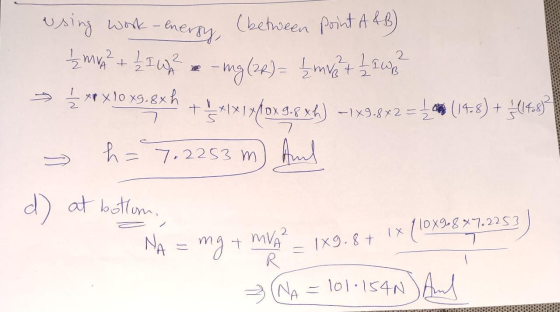
Thanks for asking ..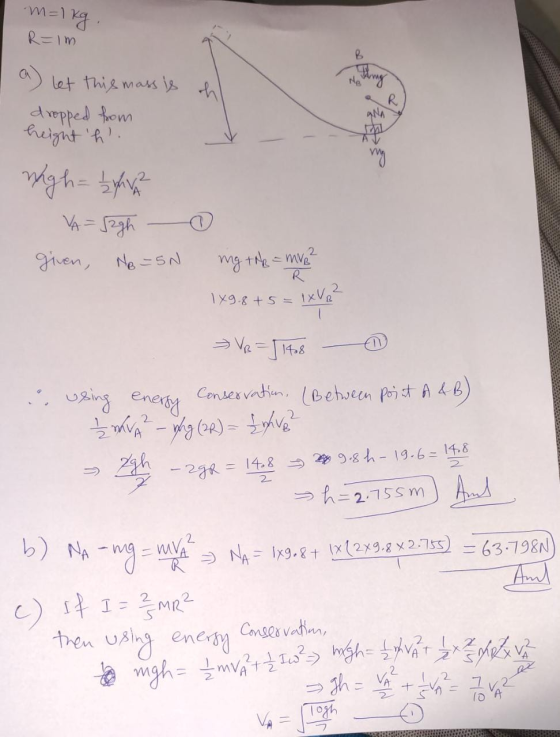
Add Answer to:
14. A 1kg mass goes down a slide which then puts it into a loop-the-loop of...
As part of an experiment in physics lab, small metal ball of radius r = 2.4...
 As part of an experiment in physics lab, small metal ball of
radius r = 2.4 cm rolls without slipping down a ramp and around a
loop-the-loop of radius R = 3.7 m. The ball is solid with a uniform
density and a mass M = 396 g.
1)
How high above the top of the loop must it be released in order
that the ball just makes it around the loop?
m
2)
Now instead of a sphere, what...
As part of an experiment in physics lab, small metal ball of
radius r = 2.4 cm rolls without slipping down a ramp and around a
loop-the-loop of radius R = 3.7 m. The ball is solid with a uniform
density and a mass M = 396 g.
1)
How high above the top of the loop must it be released in order
that the ball just makes it around the loop?
m
2)
Now instead of a sphere, what...
1) A solid ball of mass M and radius R rolls without slipping down a hill...
1) A solid ball of mass M and radius R rolls without slipping down a hill with slope tan θ. (That is θ is the angle of the hill relative to the horizontal direction.) What is the static frictional force acting on it? It is possible to solve this question in a fairly simple way using two ingredients: a) As derived in the worksheet when an object of moment of inertia I, mass M and radius R starts at rest...
Problem 9 m,r A solid ball of mass m and radius r sits at rest at the top of a hill of height H l...
 Problem 9 m,r A solid ball of mass m and radius r sits at rest at the top of a hill of height H leading to a circular loop-the loop. The center of mass of the ball will move in a circle of radius R if it goes around the loop. The moment of inertia of a solid ball is Ibull--mr. (a) Find an expression for the minimum height H for which the ball barely goes around the loop, staying...
In a loop-the-loop ride a car goes around a vertical, circular loop at a constant speed....
In a loop-the-loop ride a car goes around a vertical, circular loop at a constant speed. The car has a mass m = 238 kg and moves with speed v = 14.35 m/s. The loop-the-loop has a radius of R = 8.1 m. A)What is the magnitude of the normal force on the care when it is at the bottom of the circle? (But as the car is accelerating upward.) B)What is the magnitude of the normal force on the...
In a loop-the-loop ride a car goes around a vertical, circular loop at a constant speed....
In a loop-the-loop ride a car goes around a vertical, circular loop at a constant speed. The car has a mass m = 286 kg and moves with speed v = 13.82 m/s. The loop-the-loop has a radius of R = 8 m. 1) What is the magnitude of the normal force on the care when it is at the bottom of the circle? (But as the car is accelerating upward.) 2) What is the magnitude of the normal force...
In a loop-the-loop ride a car goes around a vertical, circular loop at a constant speed....
 In a loop-the-loop ride a car goes around a vertical, circular loop at a constant speed. The car has a mass m = 296 kg and moves with speed v = 14.77 m/s. The loop-the-loop has a radius of R = 8.8 m. 1) What is the magnitude of the normal force on the care when it is at the bottom of the circle? (But as the car is accelerating upward.) N Submit 2) What is the magnitude of the...
A child of mass 45 kg goes down a playground slide of length 3.0 m that...
A child of mass 45 kg goes down a playground slide of length 3.0 m that is inclined at an angle of 30° with respect to the horizontal. Find the speed of the child at the bottom given that the coefficient of kinetic friction between the child and the slide is 0.15 My main problem is reasoning through this type of problem. I solved for the components x-component=2.81m and y-component= 1.02 m. Then solved for fg=mg and its 441N. I...
1 Loop-the-Loop 1 23 45 6 In a loop the loop ride a car goes around...
 1 Loop-the-Loop 1 23 45 6 In a loop the loop ride a car goes around a vertical circular loop at a constant speed. The car has a mass m = 248 kg and moves with speed v- 14.48 m/s. The loop-the-loop has a radius of R -8.9 m. 1) What is the magnitude of the normal force on the care when it is at the bottom of the circle? (But as the car is accelerating upward.) Nnii 2) What...
A cart of mass m1 = 13 kg slides down a frictionless ramp and is made...
A cart of mass m1 = 13 kg slides down a frictionless ramp and is made to collide with a second cart of mass m2 = 27 kg which then heads into a vertical loop of radius 0.26 m as shown in Figure P7.66. (a) Determine the minimum height h at which cart #1 would need to start from to make sure that cart #2 completes the loop without leaving the track. Assume an elastic collision. (b) Find the height...
The figure below shows a bowling ball (uniform filled sphere) of mass M=2.4 kg and radius...
 The figure below shows a bowling ball (uniform filled sphere) of mass M=2.4 kg and radius r (not required in final answer) which begins at rest at a height h=8.6 m and rolls without slipping down a ramp and around a circular loop of radius R=2.7 m. What is the magnitude of the normal force on the ball when it reaches the point Q? h R Q
 As part of an experiment in physics lab, small metal ball of
radius r = 2.4 cm rolls without slipping down a ramp and around a
loop-the-loop of radius R = 3.7 m. The ball is solid with a uniform
density and a mass M = 396 g.
1)
How high above the top of the loop must it be released in order
that the ball just makes it around the loop?
m
2)
Now instead of a sphere, what...
As part of an experiment in physics lab, small metal ball of
radius r = 2.4 cm rolls without slipping down a ramp and around a
loop-the-loop of radius R = 3.7 m. The ball is solid with a uniform
density and a mass M = 396 g.
1)
How high above the top of the loop must it be released in order
that the ball just makes it around the loop?
m
2)
Now instead of a sphere, what...
 Problem 9 m,r A solid ball of mass m and radius r sits at rest at the top of a hill of height H leading to a circular loop-the loop. The center of mass of the ball will move in a circle of radius R if it goes around the loop. The moment of inertia of a solid ball is Ibull--mr. (a) Find an expression for the minimum height H for which the ball barely goes around the loop, staying...
 In a loop-the-loop ride a car goes around a vertical, circular loop at a constant speed. The car has a mass m = 296 kg and moves with speed v = 14.77 m/s. The loop-the-loop has a radius of R = 8.8 m. 1) What is the magnitude of the normal force on the care when it is at the bottom of the circle? (But as the car is accelerating upward.) N Submit 2) What is the magnitude of the...
 1 Loop-the-Loop 1 23 45 6 In a loop the loop ride a car goes around a vertical circular loop at a constant speed. The car has a mass m = 248 kg and moves with speed v- 14.48 m/s. The loop-the-loop has a radius of R -8.9 m. 1) What is the magnitude of the normal force on the care when it is at the bottom of the circle? (But as the car is accelerating upward.) Nnii 2) What...
 The figure below shows a bowling ball (uniform filled sphere) of mass M=2.4 kg and radius r (not required in final answer) which begins at rest at a height h=8.6 m and rolls without slipping down a ramp and around a circular loop of radius R=2.7 m. What is the magnitude of the normal force on the ball when it reaches the point Q? h R Q
Most questions answered within 3 hours.
-
Where is the error in this code sequence?
String s1 = "Hello";
String s2 = "ello";...
asked 10 months ago -
Financial data for Joel de Paris, Inc., for last year
follow:
Joel de Paris, Inc.
Balance...
asked 10 months ago -
Consider this reaction:
Al2(SO4)3 (aq)+ BaCl3
(aq) Al2Cl6 (aq)- +
3BaSO4(s) . What is the...
asked 10 months ago -
Suppose that Savneet is considering increasing her
recent random sample from 20 car rentals to 40...
asked 10 months ago -
Trucks arrive at an unloading terminal at an average rate of 120
per hour.
Trucks arrive...
asked 10 months ago -
Why are methanol and ethanol completely soluble in water while
octanol is not very little soluble....
asked 10 months ago -
A facilities manager at a university reads in a research report
that the mean amount of...
asked 10 months ago -
When the CuSO4 is rehydrated by adding water to the anhydrous
compound, is this an endothermic...
asked 10 months ago -
A ray of sunlight is passing from diamond into crown glass; the
angle of incidence is...
asked 10 months ago -
A block of mass 0.249 kg is placed on top of a light, vertical
spring of...
asked 10 months ago -
how do the kidneys compensate in the presences of acidosis
a) trigger hyperventilate
b) reserve acid...
asked 10 months ago -
Question 501 pts
The rental rate of capital to the firm increases. Which of the
following...
asked 10 months ago