
Homework Answers

Add Answer to:
Question1 17 pts Consider the equation pV- kTN, where k is a constant. Select all of...
Consider the equation PT = kVN, where k is a constant. Select all of the correct...
 Consider the equation PT = kVN, where k is a constant. Select all of the correct answers that describe the variation between variables. Nvaries inversely with V Tvaries inversely with V p varies inversely with T Tvaries directly with N Op varies directly with V Dp varies inversely with N
Is the answers correct? his Question: 1 pt 19 Find the variation constant and an equation...
 Is the answers correct?
his Question: 1 pt 19 Find the variation constant and an equation of variation if y varies directly as x and the following conditions apply 7 = 63 when x =-. The variation constant is k = 1441 The equation of variation is y= 1441자
Is the answers correct?
his Question: 1 pt 19 Find the variation constant and an equation of variation if y varies directly as x and the following conditions apply 7 = 63 when x =-. The variation constant is k = 1441 The equation of variation is y= 1441자
02) Consider a hydrostatic system represented by the thermodynamic variables volume V, pressure P and temperature...
 02) Consider a hydrostatic system represented by the thermodynamic variables volume V, pressure P and temperature T. a) Consider entropy S = S(T, V) and derive the equation TdS. Tas = Cvat +T (1) dV. V Show that this equation can be written as follows BT TdS = CydT + PDV where Cv is the thermal capacity at constant volume, B is the isobaric expansiveness and K is isothermal compressibility: b) Consider a gas described by the equation of state...
Question 17 1 pts Consider a competitive market where demand is described by the equation P...
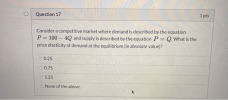 Question 17 1 pts Consider a competitive market where demand is described by the equation P = 100 - 4Q and supply is described by the equation P=Q. What is the price elasticity of demand at the equilibrium (in absolute value)? 0.25 0.75 1.25 None of the above.
7. (4 ptš) Co equation of state, PV- n(RT+ BP) where B is a constant. nsider...
 7. (4 ptš) Co equation of state, PV- n(RT+ BP) where B is a constant. nsider the adiabatic reversible compression of n moles of a gas with th (a) Write the equation of state as P = ? (b) What is (ou av (c) What is AU for the process?
3. A gas obeys the equation of state PV = nRT - an'/V, where n is the number of moles of gas and a is constant. Sub...
 3. A gas obeys the equation of state PV = nRT - an'/V, where n is the number of moles of gas and a is constant. Substitute with rearrangement into the differential equation for work, and integrate from Vito V2 to find an equation for the work done by this gas as the result of a reversible isothermal process. Show algebraically that the work is proportional to n to the first power.
Problem 5.8 Consider the motion xi = (1 t/k)X where k is a constant. From the...
 Problem 5.8 Consider the motion xi = (1 t/k)X where k is a constant. From the conservation of mass and the initial condition p = po at t = 0, determine p as a function of po, t, and k
Consider the nonlinear second-order differential equation where k > 0 is a constant. Answer to the following questio...
 Consider the nonlinear second-order differential equation where k > 0 is a constant. Answer to the following questions (a) Derive a plane autonomous system from the given equation and find all the critical points (b) Classify(discriminate/categorize) all the critical points into one of the three cat- egories: {stable / saddle / unstable(not saddle)) (c) Show that there is no periodic solution in a simply connected region (Hint: Use the corollary to Theorem 11.5.1)
Consider the nonlinear second-order differential equation where...
Consider the nonlinear second-order differential equation where k > 0 is a constant. Answer to the following questions (a) Derive a plane autonomous system from the given equation and find all the critical points (b) Classify(discriminate/categorize) all the critical points into one of the three cat- egories: {stable / saddle / unstable(not saddle)) (c) Show that there is no periodic solution in a simply connected region (Hint: Use the corollary to Theorem 11.5.1)
Consider the nonlinear second-order differential equation where...
The ideal gas law (PV=nRT) describes the relationship among pressure P, volume V, temperature T, and...
The ideal gas law (PV=nRT) describes the relationship among pressure P, volume V, temperature T, and molar amount n. Fix n and V When n and V are fixed, the equation can be rearranged to take the following form where k is a constant: PT=nRV=k or (PT)initial=(PT)final This demonstrates that for a container of gas held at constant volume, the pressure and temperature are directly proportional.The relationship is also called Gay-Lussac's law after the French chemist Joseph-Louis Gay-Lussac, one of...
8. 10 Point Bonus! The Ideal Gas Equation of State is pV = nRT, where n=...
 8. 10 Point Bonus! The Ideal Gas Equation of State is pV = nRT, where n= number of moles of gas & R is the ideal the gas constant. The Van der Waals Equation of State is briefly discussed in Ch. 5 of the book by Reif. It is an empirical, crude attempt to improve on the Ideal Gas Model by allowing gas molecules to interact with each other. For one mole of non-ideal gas this equation of state is...
 Consider the equation PT = kVN, where k is a constant. Select all of the correct answers that describe the variation between variables. Nvaries inversely with V Tvaries inversely with V p varies inversely with T Tvaries directly with N Op varies directly with V Dp varies inversely with N
 Is the answers correct?
his Question: 1 pt 19 Find the variation constant and an equation of variation if y varies directly as x and the following conditions apply 7 = 63 when x =-. The variation constant is k = 1441 The equation of variation is y= 1441자
Is the answers correct?
his Question: 1 pt 19 Find the variation constant and an equation of variation if y varies directly as x and the following conditions apply 7 = 63 when x =-. The variation constant is k = 1441 The equation of variation is y= 1441자
 02) Consider a hydrostatic system represented by the thermodynamic variables volume V, pressure P and temperature T. a) Consider entropy S = S(T, V) and derive the equation TdS. Tas = Cvat +T (1) dV. V Show that this equation can be written as follows BT TdS = CydT + PDV where Cv is the thermal capacity at constant volume, B is the isobaric expansiveness and K is isothermal compressibility: b) Consider a gas described by the equation of state...
 Question 17 1 pts Consider a competitive market where demand is described by the equation P = 100 - 4Q and supply is described by the equation P=Q. What is the price elasticity of demand at the equilibrium (in absolute value)? 0.25 0.75 1.25 None of the above.
 7. (4 ptš) Co equation of state, PV- n(RT+ BP) where B is a constant. nsider the adiabatic reversible compression of n moles of a gas with th (a) Write the equation of state as P = ? (b) What is (ou av (c) What is AU for the process?
 3. A gas obeys the equation of state PV = nRT - an'/V, where n is the number of moles of gas and a is constant. Substitute with rearrangement into the differential equation for work, and integrate from Vito V2 to find an equation for the work done by this gas as the result of a reversible isothermal process. Show algebraically that the work is proportional to n to the first power.
 Problem 5.8 Consider the motion xi = (1 t/k)X where k is a constant. From the conservation of mass and the initial condition p = po at t = 0, determine p as a function of po, t, and k
 Consider the nonlinear second-order differential equation where k > 0 is a constant. Answer to the following questions (a) Derive a plane autonomous system from the given equation and find all the critical points (b) Classify(discriminate/categorize) all the critical points into one of the three cat- egories: {stable / saddle / unstable(not saddle)) (c) Show that there is no periodic solution in a simply connected region (Hint: Use the corollary to Theorem 11.5.1)
Consider the nonlinear second-order differential equation where...
Consider the nonlinear second-order differential equation where k > 0 is a constant. Answer to the following questions (a) Derive a plane autonomous system from the given equation and find all the critical points (b) Classify(discriminate/categorize) all the critical points into one of the three cat- egories: {stable / saddle / unstable(not saddle)) (c) Show that there is no periodic solution in a simply connected region (Hint: Use the corollary to Theorem 11.5.1)
Consider the nonlinear second-order differential equation where...
 8. 10 Point Bonus! The Ideal Gas Equation of State is pV = nRT, where n= number of moles of gas & R is the ideal the gas constant. The Van der Waals Equation of State is briefly discussed in Ch. 5 of the book by Reif. It is an empirical, crude attempt to improve on the Ideal Gas Model by allowing gas molecules to interact with each other. For one mole of non-ideal gas this equation of state is...
Most questions answered within 3 hours.
-
Where is the error in this code sequence?
String s1 = "Hello";
String s2 = "ello";...
asked 10 months ago -
Financial data for Joel de Paris, Inc., for last year
follow:
Joel de Paris, Inc.
Balance...
asked 10 months ago -
Consider this reaction:
Al2(SO4)3 (aq)+ BaCl3
(aq) Al2Cl6 (aq)- +
3BaSO4(s) . What is the...
asked 10 months ago -
Suppose that Savneet is considering increasing her
recent random sample from 20 car rentals to 40...
asked 10 months ago -
Trucks arrive at an unloading terminal at an average rate of 120
per hour.
Trucks arrive...
asked 10 months ago -
Why are methanol and ethanol completely soluble in water while
octanol is not very little soluble....
asked 10 months ago -
A facilities manager at a university reads in a research report
that the mean amount of...
asked 10 months ago -
When the CuSO4 is rehydrated by adding water to the anhydrous
compound, is this an endothermic...
asked 10 months ago -
A ray of sunlight is passing from diamond into crown glass; the
angle of incidence is...
asked 10 months ago -
A block of mass 0.249 kg is placed on top of a light, vertical
spring of...
asked 10 months ago -
how do the kidneys compensate in the presences of acidosis
a) trigger hyperventilate
b) reserve acid...
asked 10 months ago -
Question 501 pts
The rental rate of capital to the firm increases. Which of the
following...
asked 10 months ago