
Homework Answers
Sound is the longitudinal wave whereas light waves are transverse in nature, sound wave need material medium for its propagation but light waves don't require any material medium, there is a huge difference between the speed of light waves and sound waves speed of light is about 3×10⁸ m/s whereas speed of sound in air is about 344 m/s.
Hence in given options only 2nd option is correct i.e., both are the means of transmitting energy.
According to Chegg guidelines, we need to answer only 1st question if no particular question number mentioned to solve, but let me give you hint for the second question-
The angle between the the emergent Ray's of any two colours is called 'angular dispersion' between those colours-
Angular dispersion = (nB - nR)A
Where, nB is the refractive index for blue light
nA is the refractive index for red light
A is the Angle of the Prism.
Add Answer to:
A light wave is like a sound wave in that both are longitudinal waves. are means...
In terms of the propagation of light and sound waves. When a wave interacts with other...
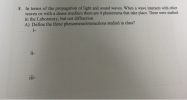 In terms of the propagation of light and sound waves. When a wave interacts with other waves or with a dense medium there are 4 phenomena that take place. Three were studied in the Laboratory, but not diffraction. A) Define the three phenomenalinteractions studied in class? 8. 1-
In which of the following ways are sound waves different from light waves? Select the correct...
 In which of the following ways are sound waves different from light waves? Select the correct answer Sound waves must propagate through some medium, while light waves can propagate in a vacuum Audible sound waves have much lower frequencies than visible light waves Sound waves are longitudinal while light wavesY are transverse Your Answe O All of the listed options are valid. Audible sound waves have much longer wavelengths than visible light waves
1) How would you describe thunder and the light from lightening as waves? -A) Thunder longitudinal,...
1) How would you describe thunder and the light from lightening as waves? -A) Thunder longitudinal, lightening transverse -B) Thunder transverse, lightening transverse -C) Thunder transverse, lightening longitudinal -D) Thunder longitudinal, lightening longitudinal 2) Suppose the longitudinal component of a wave created by an earthquake is travelling from east to west. As it passes through your position, how would you expect to move? -A) Both up and down, and north and south -B) east and west -C) north and south...
5. The longitudinal displacements of air molecules in a sound wave are described by: y-32x 10"...
 5. The longitudinal displacements of air molecules in a sound wave are described by: y-32x 10" sin (3x-15000 mn where x is in meters and t is in seconds. (a) By comparing to the general form of the functions describing sound waves in Equation 1.6 and in Exercise 1.4, determine the amplitude of the longitudinal displacements, the angular wave number, the angular frequency, and the phase angle, giving the correct units for each. Find (b) the propagation speed of the...
10.A narrow beam of white light is incident normally on the surface of a triangular silicate...
 10.A narrow beam of white light is incident normally on the surface of a triangular silicate flint glass prism with one angle of 90. The index of refraction for violet light is 1.66 and for red light is 1.61. The angle in the prism is equal to 30° of glass. a. On the diagram below show an approximate sketch for the refracted light from the opposite face of the prism Air @ White light 7800 Glass Calculate angular separation between...
A sound wave has a much greater wavelength than a light wave. If both waves pass...
A sound wave has a much greater wavelength than a light wave. If both waves pass through an open doorway, which one, if either, will diffract to a greater extent.
PHET Sound Simulation Purpose - To explore sound (a longitudinal wave) and how it can be modeled ...
 PHET Sound Simulation Purpose - To explore sound (a longitudinal wave) and how it can be modeled as a transverse wave Obtain com puter with PHET software on it. Get headphones if possible and plug into sound port. Open PHET simulations and find Sound and Waves simulations. Open the simulation called "Sound". There are 5 tabs. Listen to a Measure Two Source Interference Listen with Interference by Reflection Varying Air Pressure Single Source Open the one called listen to a...
10.A narrow beam of white light is incident normally on the surface of a triangular silicate...
 10.A narrow beam of white light is incident normally on the surface of a triangular silicate flint glass prism with one angle of 90. The index of refraction for violet light is 1.66 and for red light is 1.61. The angle in the prism is equal to 30° of glass. a. On the diagram below show an approximate sketch for the refracted light from the opposite face of the prism. Air B White light 780° Glass Calculate angular separation between...
Version 1 0.) Red light propagates through window glass at a speed of 2.0 x 10 m/s. This means that bli light must...
 Version 1 0.) Red light propagates through window glass at a speed of 2.0 x 10 m/s. This means that bli light must propagate through vacuum at a speed of: A) 1.5 x 10 m/s B) 2.0 x 10 m/s C) 2.5 x 10 m/s D) 3.0 x 10 m/s E) No way to know with the information given, but it must be <3.0 x 10 m/s A screen red, yellow, blue glass 7.) Red, yellow, and blue light along...
Which is a longitudinal wave? Question 22 options: sound ocean x-ray light Question 23 (1 point)...
Which is a longitudinal wave? Question 22 options: sound ocean x-ray light Question 23 (1 point) We see frequency as Question 23 options: amplitude color speed brightness Question 24 (1 point) A wave pulse is transmitted down a slinky. What actually travels down the slinky? Question 24 options: period energy amplitude displacement Question 25 (1 point) The shift in observed frequency due to movement of the source is called ___. (i.e. The horn sound notes going up and...
 In terms of the propagation of light and sound waves. When a wave interacts with other waves or with a dense medium there are 4 phenomena that take place. Three were studied in the Laboratory, but not diffraction. A) Define the three phenomenalinteractions studied in class? 8. 1-
 In which of the following ways are sound waves different from light waves? Select the correct answer Sound waves must propagate through some medium, while light waves can propagate in a vacuum Audible sound waves have much lower frequencies than visible light waves Sound waves are longitudinal while light wavesY are transverse Your Answe O All of the listed options are valid. Audible sound waves have much longer wavelengths than visible light waves
 5. The longitudinal displacements of air molecules in a sound wave are described by: y-32x 10" sin (3x-15000 mn where x is in meters and t is in seconds. (a) By comparing to the general form of the functions describing sound waves in Equation 1.6 and in Exercise 1.4, determine the amplitude of the longitudinal displacements, the angular wave number, the angular frequency, and the phase angle, giving the correct units for each. Find (b) the propagation speed of the...
 10.A narrow beam of white light is incident normally on the surface of a triangular silicate flint glass prism with one angle of 90. The index of refraction for violet light is 1.66 and for red light is 1.61. The angle in the prism is equal to 30° of glass. a. On the diagram below show an approximate sketch for the refracted light from the opposite face of the prism Air @ White light 7800 Glass Calculate angular separation between...
 PHET Sound Simulation Purpose - To explore sound (a longitudinal wave) and how it can be modeled as a transverse wave Obtain com puter with PHET software on it. Get headphones if possible and plug into sound port. Open PHET simulations and find Sound and Waves simulations. Open the simulation called "Sound". There are 5 tabs. Listen to a Measure Two Source Interference Listen with Interference by Reflection Varying Air Pressure Single Source Open the one called listen to a...
 10.A narrow beam of white light is incident normally on the surface of a triangular silicate flint glass prism with one angle of 90. The index of refraction for violet light is 1.66 and for red light is 1.61. The angle in the prism is equal to 30° of glass. a. On the diagram below show an approximate sketch for the refracted light from the opposite face of the prism. Air B White light 780° Glass Calculate angular separation between...
 Version 1 0.) Red light propagates through window glass at a speed of 2.0 x 10 m/s. This means that bli light must propagate through vacuum at a speed of: A) 1.5 x 10 m/s B) 2.0 x 10 m/s C) 2.5 x 10 m/s D) 3.0 x 10 m/s E) No way to know with the information given, but it must be <3.0 x 10 m/s A screen red, yellow, blue glass 7.) Red, yellow, and blue light along...
Most questions answered within 3 hours.
-
Where is the error in this code sequence?
String s1 = "Hello";
String s2 = "ello";...
asked 10 months ago -
Financial data for Joel de Paris, Inc., for last year
follow:
Joel de Paris, Inc.
Balance...
asked 10 months ago -
Consider this reaction:
Al2(SO4)3 (aq)+ BaCl3
(aq) Al2Cl6 (aq)- +
3BaSO4(s) . What is the...
asked 10 months ago -
Suppose that Savneet is considering increasing her
recent random sample from 20 car rentals to 40...
asked 10 months ago -
Trucks arrive at an unloading terminal at an average rate of 120
per hour.
Trucks arrive...
asked 10 months ago -
Why are methanol and ethanol completely soluble in water while
octanol is not very little soluble....
asked 10 months ago -
A facilities manager at a university reads in a research report
that the mean amount of...
asked 10 months ago -
When the CuSO4 is rehydrated by adding water to the anhydrous
compound, is this an endothermic...
asked 10 months ago -
A ray of sunlight is passing from diamond into crown glass; the
angle of incidence is...
asked 10 months ago -
A block of mass 0.249 kg is placed on top of a light, vertical
spring of...
asked 10 months ago -
how do the kidneys compensate in the presences of acidosis
a) trigger hyperventilate
b) reserve acid...
asked 10 months ago -
Question 501 pts
The rental rate of capital to the firm increases. Which of the
following...
asked 10 months ago