
Homework Answers
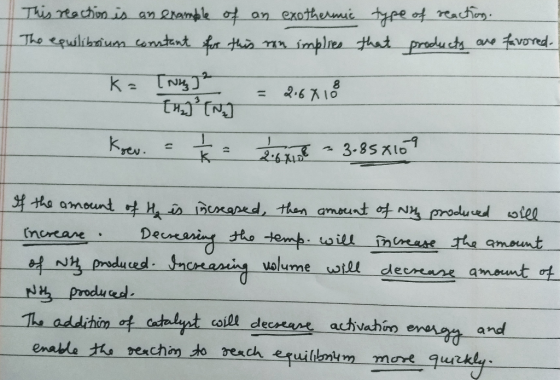
Since ∆H is negative , the reaction would be exothermic in nature .
If equilibrium is disturbed , equilibrium would shift in that direction which would oppose the applied stress .
Add Answer to:
Nitrogen gas and hydrogen gas can ve converted into ammonia
gas as shown in the reaction...
6. (2 points) Nitrogen gas and hydrogen gas react to produce ammonia and release heat as...
 6. (2 points) Nitrogen gas and hydrogen gas react to produce ammonia and release heat as shown in the thermochemical equation below. a. If 25,356 J of heat were released in the reaction, what is the mass of ammonia that was produced? b. Is the reaction exothermic or endothermic? ) + 3 H2(g) → 2 NH3(g) Hrxn = -92.2 kJ
1. Hydrogen gas, H2, reacts with nitrogen gas, N2, to form ammonia gas, NH3, according to...
 1. Hydrogen gas, H2, reacts with nitrogen gas, N2, to form ammonia gas, NH3, according to the equation: 3 H2(g) + N2(g) → 2 NH3(2) - How many grams of H2 are needed to produce 14.43 g of NH3? 2. When propane (C2H8) burns, it reacts with oxygen gas to produce carbon dioxide and water. The unbalanced equation for this reaction is... CzHz (g) + O2(g) → CO2(g) + H2O(g) This type of reaction is referred to as a complete...
Hydrogen gas, H2, reacts with nitrogen gas, N2, to form ammonia gas, NH3, according to the...
Hydrogen gas, H2, reacts with nitrogen gas, N2, to form ammonia gas, NH3, according to the equation 3H2(g)+N2(g)→2NH3(g) NOTE: Throughout this tutorial use molar masses expressed to five significant figures. How many molecules (not moles) of NH3 are produced from 4.21×10⁻⁴ g of H2?
QUESTION 24 The Born-Haber process is used to manufacture ammonia (NH3) from nitrogen gas and hydrogen...
 QUESTION 24 The Born-Haber process is used to manufacture ammonia (NH3) from nitrogen gas and hydrogen gas at STP according to the following reaction: 3 H2(g) + N2(g) → 2 NH3(g) a. What is the volume of ammonia in the reaction vesselif 2.253 moles are produced? b. How many liters of nitrogen are needed to react with 50.2 g of hydrogen?
1. The cartoon below represents the reaction of nitrogen gas (N2) with hydrogen gas (H2) to synthesize ammonia (NHs). Industrially, this che pro mical process is called the Haber-Bosch cess...
 1. The cartoon below represents the reaction of nitrogen gas (N2) with hydrogen gas (H2) to synthesize ammonia (NHs). Industrially, this che pro mical process is called the Haber-Bosch cess, and is still a very important reaction in the manufacture of fertilizers. The ability to fix every day). It has been estimated that use of nitrogen-based fertilizers has doubled the world's a. The cartoon below shows 6 molecules of hydrogen gas and 2 molecules of nitrogen nitrogen and manufacture fertilizers...
Ammonia (NH3) is formed via the following reaction between hydrogen (H2) and nitrogen (N2): 3H2(g) +...
 Ammonia (NH3) is formed via the following reaction between hydrogen (H2) and nitrogen (N2): 3H2(g) + N2(g) 22 NH3(g) For a particular experiment at equilibrium, it was found that the molar concentrations of the three species were as follows: [H2(g)] = 0.162 M, [N2(g)] = 0.100 M. and [NH3(g)] = 0.0100 M. What is the equilibrium constant (K) for this experiment? 4.25 0.617 1.622 0.412 0.235
9. When nitrogen gas reacts with hydrogen gas to form ammonia, 92.38 kJ of heat are...
 9. When nitrogen gas reacts with hydrogen gas to form ammonia, 92.38 kJ of heat are givern off for each mole of nitrogen gas consumed, under constant pressure and standard conditions. What is the correct value for the standard enthalpy of reaction in the thermo- chemical equation below when 0.750 mol of hydrogen reacts? N2(g) + 3H2(s) → 2 NH3(g) 10. How many grams of copper can be cooled from 50.0 oC to 32.3 oC by the heat gain by...
Ammonia is produced by the reaction of hydrogen and nitrogen as follows:
Ammonia is produced by the reaction of hydrogen and nitrogen as follows: N2(g) + 3H2(g) → 2NH3(g) ammonia You may want to reference (Page) Section 7.6 while completing this problem. Part A How many moles of H2 are needed to react with 0.70 mol of N2? Part B How many moles of N2 reacted if 0.75 mol of NH3 is produced? EPart How many moles of NH3 are produced when 13 mol of H2 reacts ?
Write the equilibrium constant expression for the reaction of nitrogen and hydrogen to give ammonia, NH3....
Write the equilibrium constant expression for the reaction of nitrogen and hydrogen to give ammonia, NH3. Express your answer in terms of concentrations [N2], [H2], and [NH3].
Ammonia can be produced by the Haber process form hydrogen and nitrogen: 3 H2 (g) +...
Ammonia can be produced by the Haber process form hydrogen and nitrogen: 3 H2 (g) + N2 (g) ↔2 NH3 (g) N2] M [H2] M Rate of reaction (M/sec) Temp (K) 0.0040 0.25 0.048 298 0.0020 0.25 0.025 298 0.0020 0.50 0.099 298 0.0020 0.50 0.150 350 What is the rate constant at 500 K?
 6. (2 points) Nitrogen gas and hydrogen gas react to produce ammonia and release heat as shown in the thermochemical equation below. a. If 25,356 J of heat were released in the reaction, what is the mass of ammonia that was produced? b. Is the reaction exothermic or endothermic? ) + 3 H2(g) → 2 NH3(g) Hrxn = -92.2 kJ
 1. Hydrogen gas, H2, reacts with nitrogen gas, N2, to form ammonia gas, NH3, according to the equation: 3 H2(g) + N2(g) → 2 NH3(2) - How many grams of H2 are needed to produce 14.43 g of NH3? 2. When propane (C2H8) burns, it reacts with oxygen gas to produce carbon dioxide and water. The unbalanced equation for this reaction is... CzHz (g) + O2(g) → CO2(g) + H2O(g) This type of reaction is referred to as a complete...
 QUESTION 24 The Born-Haber process is used to manufacture ammonia (NH3) from nitrogen gas and hydrogen gas at STP according to the following reaction: 3 H2(g) + N2(g) → 2 NH3(g) a. What is the volume of ammonia in the reaction vesselif 2.253 moles are produced? b. How many liters of nitrogen are needed to react with 50.2 g of hydrogen?
 1. The cartoon below represents the reaction of nitrogen gas (N2) with hydrogen gas (H2) to synthesize ammonia (NHs). Industrially, this che pro mical process is called the Haber-Bosch cess, and is still a very important reaction in the manufacture of fertilizers. The ability to fix every day). It has been estimated that use of nitrogen-based fertilizers has doubled the world's a. The cartoon below shows 6 molecules of hydrogen gas and 2 molecules of nitrogen nitrogen and manufacture fertilizers...
 Ammonia (NH3) is formed via the following reaction between hydrogen (H2) and nitrogen (N2): 3H2(g) + N2(g) 22 NH3(g) For a particular experiment at equilibrium, it was found that the molar concentrations of the three species were as follows: [H2(g)] = 0.162 M, [N2(g)] = 0.100 M. and [NH3(g)] = 0.0100 M. What is the equilibrium constant (K) for this experiment? 4.25 0.617 1.622 0.412 0.235
 9. When nitrogen gas reacts with hydrogen gas to form ammonia, 92.38 kJ of heat are givern off for each mole of nitrogen gas consumed, under constant pressure and standard conditions. What is the correct value for the standard enthalpy of reaction in the thermo- chemical equation below when 0.750 mol of hydrogen reacts? N2(g) + 3H2(s) → 2 NH3(g) 10. How many grams of copper can be cooled from 50.0 oC to 32.3 oC by the heat gain by...
Most questions answered within 3 hours.
-
Where is the error in this code sequence?
String s1 = "Hello";
String s2 = "ello";...
asked 10 months ago -
Financial data for Joel de Paris, Inc., for last year
follow:
Joel de Paris, Inc.
Balance...
asked 10 months ago -
Consider this reaction:
Al2(SO4)3 (aq)+ BaCl3
(aq) Al2Cl6 (aq)- +
3BaSO4(s) . What is the...
asked 10 months ago -
Suppose that Savneet is considering increasing her
recent random sample from 20 car rentals to 40...
asked 10 months ago -
Trucks arrive at an unloading terminal at an average rate of 120
per hour.
Trucks arrive...
asked 10 months ago -
Why are methanol and ethanol completely soluble in water while
octanol is not very little soluble....
asked 10 months ago -
A facilities manager at a university reads in a research report
that the mean amount of...
asked 10 months ago -
When the CuSO4 is rehydrated by adding water to the anhydrous
compound, is this an endothermic...
asked 10 months ago -
A ray of sunlight is passing from diamond into crown glass; the
angle of incidence is...
asked 10 months ago -
A block of mass 0.249 kg is placed on top of a light, vertical
spring of...
asked 10 months ago -
how do the kidneys compensate in the presences of acidosis
a) trigger hyperventilate
b) reserve acid...
asked 10 months ago -
Question 501 pts
The rental rate of capital to the firm increases. Which of the
following...
asked 10 months ago