
Homework Answers
6)
b)

c)Along x direction there is no force hence no acceleration, so position is

Along y direction acceleration is a, so position is

So (x,y)=(120,71.5)m
7)

Let braking force be B
So 
A 6.27-kg object passes through the origin at time t = 0 such that its x...
A 6.27-kg object passes through the origin at time t = 0 such that its x component of velocity is 5.05 m/s and its y component of velocity is −2.7 m/s. (a) What is the kinetic energy of the object at this time? J (b) At a later time t = 2.00 s, the particle is located at x = 8.50 m and y = 5.00 m. What constant force acted on the object during this time interval? magnitude N...
A 5.77-kg object passes through the origin at time t = 0 such that its x...
A 5.77-kg object passes through the origin at time t = 0 such that its x component of velocity is 5.50 m/s and its y component of velocity is −3.15 m/s. (a) What is the kinetic energy of the object at this time? J (b) At a later time t = 2.00 s, the particle is located at x = 8.50 m and y = 5.00 m. What constant force acted on the object during this time interval? magnitude N...
A truck of mass m slows from speed v0 to speed v in a time t....
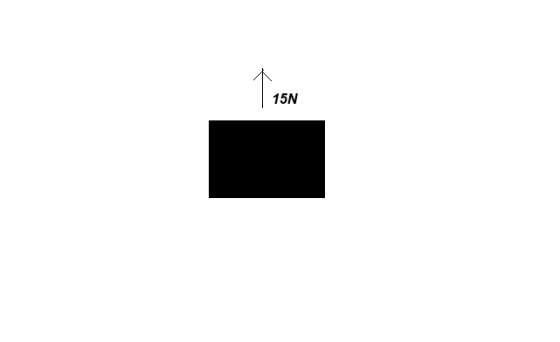
A truck of mass m slows from speed v0 to speed v in a time t. a) draw a force diagram for the truck. b) write an equation for the applied braking force. c) calculate the braking force if the mass of the truck is 3.0 x 10^3 kg and it is slowed from 32 m/s to 12 m/s in 6.0 seconds.
Position Graph Velocity Graph time (s) time (s) (a) On the coordinate axis below, draw a...
 Position Graph Velocity Graph time (s) time (s) (a) On the coordinate axis below, draw a motion diagram for this object moving from t-0 to 3 second Show 4 events using one-second intervals. A motion diagram includes position dots, time, and velocity vectors -5 m -3 m 2 m -l m r 0 Im (b) On the coordinate axis below, draw a motion diagram for this object moving from t-3 to 5 second Show 3 events using one-second intervals. A...
3. (25 points) A small object of mass m slides around in a horizontal, frictionless, circular...
 3. (25 points) A small object of mass m slides around in a horizontal, frictionless, circular tube of radius R. The object is given an initial velocity vo at the point shown. At somc later timc, defined to be t = 0, some strange force starts to act on the object The force is always directed opposite to the object's velocity and has known constant magnitude c as long as the object is moving. Consider only the time while the...
An object with mass m is initially at rest at the origin z-0. At time t-0...
 An object with mass m is initially at rest at the origin z-0. At time t-0 it starts to accelerate with a changing acceleration along the +z direction. At time t = T it is at the point z=:T and its speed is measured as e(T) = vr 6. Find the for tr and τ in terms of F. m, and T
Three forces act on a 15-kg object. Force 1 is 12 N directed along the positive...
Three forces act on a 15-kg object. Force 1 is 12 N directed along the positive x-axis. Force 2 is 18 N directed along the -y-axis. And Force 3 is 22 N directed exactly midway between the +x=axis and -y-axis. a) Draw a free body diagram clearly labeling the forces. b) Find the net force on the object in both unit vector and polar notation. c) Draw this force on your diagram.
An object is at x at t and moves along the x axis according to the...
 An object is at x at t and moves along the x axis according to the velocity-time graph shown below v (m/s) 20 10 -10 (a) What is the object's acceleration between 0 and 4.0 s? m/s2 (b) What is the object's acceleration between 4.0 s and 9.0 s? m/s2 (C) What is the object's acceleration between 13.0 s and 18.0 s? m/s2 (d) At what time(s) is the object moving with the lowest speed? (If there is more than...
A 2.5-kg object experiences a single, time-dependent force Fx(t) = (18 N/s )t - (36 N...
A 2.5-kg object experiences a single, time-dependent force Fx(t) = (18 N/s )t - (36 N ). 1.What is the object's acceleration at t = 0? 2.What is the object's acceleration at t = 2.0 s? 3.What is the object's acceleration at t = 4.0 s?
A 8.07 kg object has the following acceleration components: a_x = (0.67 m/s^2) + (0.65 m/s^3)t...
 A 8.07 kg object has the following acceleration components: a_x = (0.67 m/s^2) + (0.65 m/s^3)t a_y = (10.9 m/s^2) - (0.79 m/s^3)t What is the magnitude of the net force acting on the object at time t = 5.27 s? What is the direction of the net force at this same time? Give your answer as a number of degrees counter-clockwise from the +X axis.
 Position Graph Velocity Graph time (s) time (s) (a) On the coordinate axis below, draw a motion diagram for this object moving from t-0 to 3 second Show 4 events using one-second intervals. A motion diagram includes position dots, time, and velocity vectors -5 m -3 m 2 m -l m r 0 Im (b) On the coordinate axis below, draw a motion diagram for this object moving from t-3 to 5 second Show 3 events using one-second intervals. A...
 3. (25 points) A small object of mass m slides around in a horizontal, frictionless, circular tube of radius R. The object is given an initial velocity vo at the point shown. At somc later timc, defined to be t = 0, some strange force starts to act on the object The force is always directed opposite to the object's velocity and has known constant magnitude c as long as the object is moving. Consider only the time while the...
 An object with mass m is initially at rest at the origin z-0. At time t-0 it starts to accelerate with a changing acceleration along the +z direction. At time t = T it is at the point z=:T and its speed is measured as e(T) = vr 6. Find the for tr and τ in terms of F. m, and T
 An object is at x at t and moves along the x axis according to the velocity-time graph shown below v (m/s) 20 10 -10 (a) What is the object's acceleration between 0 and 4.0 s? m/s2 (b) What is the object's acceleration between 4.0 s and 9.0 s? m/s2 (C) What is the object's acceleration between 13.0 s and 18.0 s? m/s2 (d) At what time(s) is the object moving with the lowest speed? (If there is more than...
 A 8.07 kg object has the following acceleration components: a_x = (0.67 m/s^2) + (0.65 m/s^3)t a_y = (10.9 m/s^2) - (0.79 m/s^3)t What is the magnitude of the net force acting on the object at time t = 5.27 s? What is the direction of the net force at this same time? Give your answer as a number of degrees counter-clockwise from the +X axis.
Most questions answered within 3 hours.
-
Where is the error in this code sequence?
String s1 = "Hello";
String s2 = "ello";...
asked 11 months ago -
Financial data for Joel de Paris, Inc., for last year
follow:
Joel de Paris, Inc.
Balance...
asked 11 months ago -
Consider this reaction:
Al2(SO4)3 (aq)+ BaCl3
(aq) Al2Cl6 (aq)- +
3BaSO4(s) . What is the...
asked 11 months ago -
Suppose that Savneet is considering increasing her
recent random sample from 20 car rentals to 40...
asked 11 months ago -
Trucks arrive at an unloading terminal at an average rate of 120
per hour.
Trucks arrive...
asked 11 months ago -
Why are methanol and ethanol completely soluble in water while
octanol is not very little soluble....
asked 11 months ago -
A facilities manager at a university reads in a research report
that the mean amount of...
asked 11 months ago -
When the CuSO4 is rehydrated by adding water to the anhydrous
compound, is this an endothermic...
asked 11 months ago -
A ray of sunlight is passing from diamond into crown glass; the
angle of incidence is...
asked 11 months ago -
A block of mass 0.249 kg is placed on top of a light, vertical
spring of...
asked 11 months ago -
how do the kidneys compensate in the presences of acidosis
a) trigger hyperventilate
b) reserve acid...
asked 11 months ago -
Question 501 pts
The rental rate of capital to the firm increases. Which of the
following...
asked 11 months ago