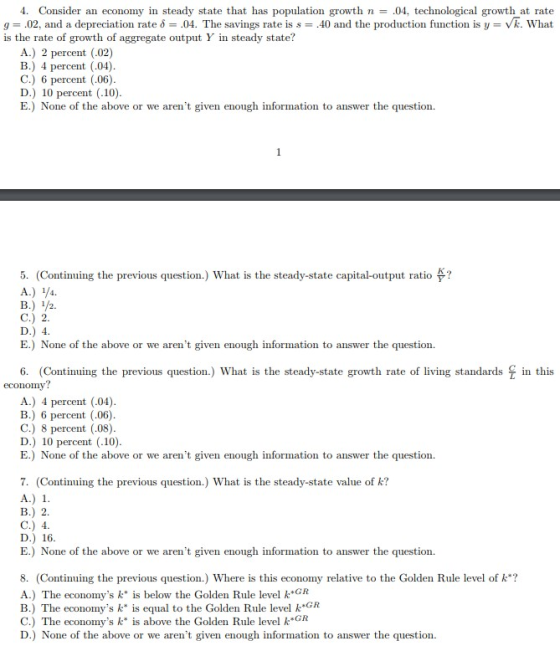
Please answer these questions (they are all connected):
Homework Answers

Add Answer to:
Please answer these questions (they are all connected):
4. Consider an economy in steady state that...
Consider an economy in a steady state with population growth rate η, a rate of capital depreciati...
Consider an economy in a steady state with population growth rate η, a rate of capital depreciation δ , and a rate of technological progress g. a) At the steady state Δk = 0, where k equals capital per effective worker. What condition must be met for this to hold? Describe the condition in words as well as mathematical expressions. b) Describe in words what is maximized at the Golden Rule level of k. c) What mathematical condition must be...
Steady state question
The capital share of GDP is about 40 percent, the average growth in output is about2 percent per year, the depreciation rate is about 3 percent per year, and the capital–output ratiois about 1.5. Suppose that the production function is Cobb–Douglas andin a steady state.a. What must the saving rate be in the initial steady state? [Hint: Use the steady-staterelationship, sy = (δ + n + g)k.]b. What is the marginal product of capital in the initial steady state?c. Suppose...
In the Solow growth model without population growth, if an economy has a steady-state value of...
 In the Solow growth model without population growth, if an economy has a steady-state value of the marginal product of capital (MPK) of 0.125, a depreciation rate of 0.1, and a saving rate of 0.225, then the steady-state capital stock per worker: Select one: a. is less than the Golden Rule level. O b. is greater than the Golden Rule level. c. could be either above or below the Golden Rule level. d. equals the Golden Rule level.
Please use the equations provided to solve for all parts of question B. Please be detailed,...
 Please use the equations provided to solve for all parts of
question B. Please be detailed, and show all steps with the
formulas and why they occur. I need to understand and see the work
with the solutions for each part so that I can understand how you
got the solution. Use the math to explain what is happening showing
work with the equations, and why. Thank you so much! Correct
answers will get a thumbs up! You must show...
Please use the equations provided to solve for all parts of
question B. Please be detailed, and show all steps with the
formulas and why they occur. I need to understand and see the work
with the solutions for each part so that I can understand how you
got the solution. Use the math to explain what is happening showing
work with the equations, and why. Thank you so much! Correct
answers will get a thumbs up! You must show...
all but part a 2. (Population growth and technology growth) Consider an economy that is described...
 all but part a
2. (Population growth and technology growth) Consider an economy that is described by the production function Y depreciation rate of capital is 6 n 0.05 and the technology growth rate is g = 0.1 K (LE). Moreover the 0.15, the population growth rate is (a) What is the per effective worker production function, that is y ? What is the marginal product of capital, that is ? (b) If the saving rate is s 0.3, find...
all but part a
2. (Population growth and technology growth) Consider an economy that is described by the production function Y depreciation rate of capital is 6 n 0.05 and the technology growth rate is g = 0.1 K (LE). Moreover the 0.15, the population growth rate is (a) What is the per effective worker production function, that is y ? What is the marginal product of capital, that is ? (b) If the saving rate is s 0.3, find...
Problem set 4 The steady-state per capita consumption is written as
 Problem set 4
The steady-state per capita consumption is written as
c=Aka -(n+)k
where c is the steady-state per capita consumption.
A: productivity
k: per capita capital stock
δ: capital depreciation rate
n: population growth rate
Question : Compute the Golden rule kGR that maximizes
the steady-state per capita consumption level?
Problem set 4
The steady-state per capita consumption is written as
c=Aka -(n+)k
where c is the steady-state per capita consumption.
A: productivity
k: per capita capital stock
δ: capital depreciation rate
n: population growth rate
Question : Compute the Golden rule kGR that maximizes
the steady-state per capita consumption level?
the domestic interest rate would leduction in E C) an increase in E D) an increase...
 the domestic interest rate would leduction in E C) an increase in E D) an increase in investment E) none of the above Answer Questions (30 points, 20 questions, 1.5 points for cach question) 1. For this question this question, assume that the economy is initially operating at the natural level of output. A monetary expansion will cause in the real wage in the medium run. con will cause (increase/decrease/no change) 2. Use the following information to answer the questions...
1. Solow growth model: a. Draw the steady-state equilibrium by drawing the savings line and the...
 1. Solow growth model: a. Draw the steady-state equilibrium by drawing the savings line and the investment line. Show the steady-state values of savings, investment and capital per worker. b. On the same graph, also draw the output per worker (or per-worker production function) line. At the steady-state, mark the level of consumption per worker and savings per worker. c. What is the growth rate of yt, Ct, kt (per-worker variables, represented with an "upperbar" in class) in the steady-state?...
Solow growth model: 1. a. Draw the steady-state equilibrium by drawing the savings line and the...
 Solow growth model: 1. a. Draw the steady-state equilibrium by drawing the savings line and the investment line. Show the steady-state values of savings, investment and capital per worker. b. On the same graph, also draw the output per worker (or per-worker production function) line. At the steady-state, mark the level of consumption per worker and savings per worker. c. What is the growth rate of yYt, Ct, kt (per-worker variables, represented with an "upperbar" in class) in the steady-state?...
In the nation of Wiknam, the capital share of GDP is 40 percent, the average growth...
 In the nation of Wiknam, the capital share of GDP is 40 percent,
the average growth in output is 4 percent per year, the
depreciation rate is 6 percent per year, and the capital–output
ratio is 5. Suppose that the production function is Cobb–Douglas
and that Wiknam has been in a steady state. (For a discussion of
the Cobb–Douglas production function, see Chapter 3.)
c. Suppose that public policy alters the saving rate so
that the economy reaches the Golden...
In the nation of Wiknam, the capital share of GDP is 40 percent,
the average growth in output is 4 percent per year, the
depreciation rate is 6 percent per year, and the capital–output
ratio is 5. Suppose that the production function is Cobb–Douglas
and that Wiknam has been in a steady state. (For a discussion of
the Cobb–Douglas production function, see Chapter 3.)
c. Suppose that public policy alters the saving rate so
that the economy reaches the Golden...
 In the Solow growth model without population growth, if an economy has a steady-state value of the marginal product of capital (MPK) of 0.125, a depreciation rate of 0.1, and a saving rate of 0.225, then the steady-state capital stock per worker: Select one: a. is less than the Golden Rule level. O b. is greater than the Golden Rule level. c. could be either above or below the Golden Rule level. d. equals the Golden Rule level.
 Please use the equations provided to solve for all parts of
question B. Please be detailed, and show all steps with the
formulas and why they occur. I need to understand and see the work
with the solutions for each part so that I can understand how you
got the solution. Use the math to explain what is happening showing
work with the equations, and why. Thank you so much! Correct
answers will get a thumbs up! You must show...
Please use the equations provided to solve for all parts of
question B. Please be detailed, and show all steps with the
formulas and why they occur. I need to understand and see the work
with the solutions for each part so that I can understand how you
got the solution. Use the math to explain what is happening showing
work with the equations, and why. Thank you so much! Correct
answers will get a thumbs up! You must show...
 all but part a
2. (Population growth and technology growth) Consider an economy that is described by the production function Y depreciation rate of capital is 6 n 0.05 and the technology growth rate is g = 0.1 K (LE). Moreover the 0.15, the population growth rate is (a) What is the per effective worker production function, that is y ? What is the marginal product of capital, that is ? (b) If the saving rate is s 0.3, find...
all but part a
2. (Population growth and technology growth) Consider an economy that is described by the production function Y depreciation rate of capital is 6 n 0.05 and the technology growth rate is g = 0.1 K (LE). Moreover the 0.15, the population growth rate is (a) What is the per effective worker production function, that is y ? What is the marginal product of capital, that is ? (b) If the saving rate is s 0.3, find...
 Problem set 4
The steady-state per capita consumption is written as
c=Aka -(n+)k
where c is the steady-state per capita consumption.
A: productivity
k: per capita capital stock
δ: capital depreciation rate
n: population growth rate
Question : Compute the Golden rule kGR that maximizes
the steady-state per capita consumption level?
Problem set 4
The steady-state per capita consumption is written as
c=Aka -(n+)k
where c is the steady-state per capita consumption.
A: productivity
k: per capita capital stock
δ: capital depreciation rate
n: population growth rate
Question : Compute the Golden rule kGR that maximizes
the steady-state per capita consumption level?
 the domestic interest rate would leduction in E C) an increase in E D) an increase in investment E) none of the above Answer Questions (30 points, 20 questions, 1.5 points for cach question) 1. For this question this question, assume that the economy is initially operating at the natural level of output. A monetary expansion will cause in the real wage in the medium run. con will cause (increase/decrease/no change) 2. Use the following information to answer the questions...
 1. Solow growth model: a. Draw the steady-state equilibrium by drawing the savings line and the investment line. Show the steady-state values of savings, investment and capital per worker. b. On the same graph, also draw the output per worker (or per-worker production function) line. At the steady-state, mark the level of consumption per worker and savings per worker. c. What is the growth rate of yt, Ct, kt (per-worker variables, represented with an "upperbar" in class) in the steady-state?...
 Solow growth model: 1. a. Draw the steady-state equilibrium by drawing the savings line and the investment line. Show the steady-state values of savings, investment and capital per worker. b. On the same graph, also draw the output per worker (or per-worker production function) line. At the steady-state, mark the level of consumption per worker and savings per worker. c. What is the growth rate of yYt, Ct, kt (per-worker variables, represented with an "upperbar" in class) in the steady-state?...
 In the nation of Wiknam, the capital share of GDP is 40 percent,
the average growth in output is 4 percent per year, the
depreciation rate is 6 percent per year, and the capital–output
ratio is 5. Suppose that the production function is Cobb–Douglas
and that Wiknam has been in a steady state. (For a discussion of
the Cobb–Douglas production function, see Chapter 3.)
c. Suppose that public policy alters the saving rate so
that the economy reaches the Golden...
In the nation of Wiknam, the capital share of GDP is 40 percent,
the average growth in output is 4 percent per year, the
depreciation rate is 6 percent per year, and the capital–output
ratio is 5. Suppose that the production function is Cobb–Douglas
and that Wiknam has been in a steady state. (For a discussion of
the Cobb–Douglas production function, see Chapter 3.)
c. Suppose that public policy alters the saving rate so
that the economy reaches the Golden...
Most questions answered within 3 hours.
-
Where is the error in this code sequence?
String s1 = "Hello";
String s2 = "ello";...
asked 10 months ago -
Financial data for Joel de Paris, Inc., for last year
follow:
Joel de Paris, Inc.
Balance...
asked 10 months ago -
Consider this reaction:
Al2(SO4)3 (aq)+ BaCl3
(aq) Al2Cl6 (aq)- +
3BaSO4(s) . What is the...
asked 10 months ago -
Suppose that Savneet is considering increasing her
recent random sample from 20 car rentals to 40...
asked 10 months ago -
Trucks arrive at an unloading terminal at an average rate of 120
per hour.
Trucks arrive...
asked 10 months ago -
Why are methanol and ethanol completely soluble in water while
octanol is not very little soluble....
asked 10 months ago -
A facilities manager at a university reads in a research report
that the mean amount of...
asked 10 months ago -
When the CuSO4 is rehydrated by adding water to the anhydrous
compound, is this an endothermic...
asked 10 months ago -
A ray of sunlight is passing from diamond into crown glass; the
angle of incidence is...
asked 10 months ago -
A block of mass 0.249 kg is placed on top of a light, vertical
spring of...
asked 10 months ago -
how do the kidneys compensate in the presences of acidosis
a) trigger hyperventilate
b) reserve acid...
asked 10 months ago -
Question 501 pts
The rental rate of capital to the firm increases. Which of the
following...
asked 10 months ago