
Homework Answers
1.
function A = sq()
A = [];
for i = 1: 10
A = [A i*i];
end
end
![= sq.m RUN Vars [1x10] ans 1 function Asq() for i-1:10 end 6 end 10 octave: 12> sq() ans = 4 91625 3649 64 8110e](http://img.homeworklib.com/questions/0fca04e0-b0e5-11eb-b28b-79b1b6cc1c7c.png?x-oss-process=image/resize,w_560)
2.
function terms = sumterms()
sum = 0;
terms = 0;
i = 1;
while true
sum = sum + i;
if sum <= 100
terms = terms + 1;
i = i+1;
else
break;
end
end
end

3.
function X = matrixop(n)
X = zeros(n)
for row = 1:n
for col = 1:n
X(row,col) = sin (1/(row+col-1));
end
end
end
![matrixop.m RUN Vars octave: 16> matrixop (5) [5x5] ans 1 function Xmatrixop (n) x-zeros (n) for row1:n 4 for col-1:n X(row, c](http://img.homeworklib.com/questions/10967100-b0e5-11eb-895d-25c4faa2bc19.png?x-oss-process=image/resize,w_560)
Add Answer to:
Solve using Matlab
Write a simple loop to list the squares of the first 10 integers....
3. [20 points] Write a simple Matlab for-loop that adds up the squares of the elements...
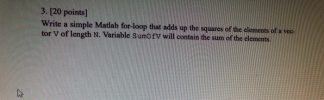 3. [20 points] Write a simple Matlab for-loop that adds up the squares of the elements of a vec tor V of length N. Variable Sumofy will contain the sum of the elements.
MATLAB homework assignment (HW6), but this time using a "vectorized" approach. Write a script that prompts...
 MATLAB
homework assignment (HW6), but this time using a "vectorized" approach. Write a script that prompts the user for N integers (set N-6), one at a time, using a while loop. Error-check to ensure that each number entered is an integer, displaying an error message if it is not. If it is an integer, store it in an array variable nums. Continue prompting until N integers have been successfully entered. (You may copy and paste your code from the previous...
MATLAB
homework assignment (HW6), but this time using a "vectorized" approach. Write a script that prompts the user for N integers (set N-6), one at a time, using a while loop. Error-check to ensure that each number entered is an integer, displaying an error message if it is not. If it is an integer, store it in an array variable nums. Continue prompting until N integers have been successfully entered. (You may copy and paste your code from the previous...
In MATLAB Write a script to determine the number of terms required for the sum of...
 In MATLAB
Write a script to determine the number of terms required for the sum of the series (5k? – 2k) not to exceed 100,000 using the while loop. Display the number of terms and the calculated sum using fprint () command as follow: The number of terms is 38 and its sum is 93613
In MATLAB
Write a script to determine the number of terms required for the sum of the series (5k? – 2k) not to exceed 100,000 using the while loop. Display the number of terms and the calculated sum using fprint () command as follow: The number of terms is 38 and its sum is 93613
Write a MATLAB script, using either a single or nested for-loop, that will print the factorials...
Write a MATLAB script, using either a single or nested for-loop, that will print the factorials for the numbers between 1 and 100 (inclusive). The factorial of n (n!) is the product of the positive integers less than or equal to n. For example: 3! = 3 * 2 * 1. For this question you cannot use the built-in MATLAB factorial function, but you can use other MATLAB functions if you wish. MATLAB code!MATLAB code!MATLAB code!MATLAB code!
answer 4, 5, 6, 7 using matlab Homework 10 1. Write the correct first-line syntax for...
 answer 4, 5, 6, 7 using matlab
Homework 10 1. Write the correct first-line syntax for a user defined function that is named Feynman and has input variables q and e, and outputs L and M. (Comment out of this line). 2. Using zeros, ones, and eye commands write the one line syntax to create the following matrix: 00000 01100 01010 01001 3. Write the syntax for the user defined function that calculates the surface area and volume of a...
answer 4, 5, 6, 7 using matlab
Homework 10 1. Write the correct first-line syntax for a user defined function that is named Feynman and has input variables q and e, and outputs L and M. (Comment out of this line). 2. Using zeros, ones, and eye commands write the one line syntax to create the following matrix: 00000 01100 01010 01001 3. Write the syntax for the user defined function that calculates the surface area and volume of a...
MATLAB Write a script without using any loops to calculate e^5 for N = 10 using...
 MATLAB
Write a script without using any loops to calculate e^5 for N =
10 using only array operations and sum() function.
- rn n-0
MATLAB
Write a script without using any loops to calculate e^5 for N =
10 using only array operations and sum() function.
- rn n-0
(+30) Provide a python program which will Populate an array(list) of size 25 with integers in...
(+30) Provide a python program which will Populate an array(list) of size 25 with integers in the range -100 (negative 100) to +100 inclusive Display the array and its length (use the len function) Display the average of all the integers in the array Display the number of even integers (how many) Display the number of odd integers (how many) Display the number of integers > 0 (how many) Display the number of integers < 0 (how many) Display the...
run/call tle un/cd to compute the sum of the first 15 terms of the series: th (b) It is desired 14 n3 - 20 n2 + 5n, 110) 1,2,..15 n Develop a pseudocode of the required program. roposed algorithm in...
 run/call tle un/cd to compute the sum of the first 15 terms of the series: th (b) It is desired 14 n3 - 20 n2 + 5n, 110) 1,2,..15 n Develop a pseudocode of the required program. roposed algorithm in a flow chart if it is solved using a for loop ow the p () Write a MATLAB script file using for loop
run/call tle un/cd to compute the sum of the first 15 terms of the series: th (b)...
run/call tle un/cd to compute the sum of the first 15 terms of the series: th (b) It is desired 14 n3 - 20 n2 + 5n, 110) 1,2,..15 n Develop a pseudocode of the required program. roposed algorithm in a flow chart if it is solved using a for loop ow the p () Write a MATLAB script file using for loop
run/call tle un/cd to compute the sum of the first 15 terms of the series: th (b)...
17. (2 points) C++ Using a while loop, write the code statements to sum 10 integers...
17. (2 points) C++ Using a while loop, write the code statements to sum 10 integers entered by a user. Display the sum. Hint: Be sure to declare, initialize, and use appropriate variables to count the repetitions and accumulate the sum.
Flowcharts & for loops 1. Using a for loop, write a MatLab script to convert ounces...
Flowcharts & for loops 1. Using a for loop, write a MatLab script to convert ounces to grams for 0 to 16 ounces, in 1-ounce increments. Present output in a table; label columns appropriately. 2. A Fibonacci sequence is composed of elements created by adding the previous 2 elements. The simplest Fibonacci sequence starts with 1, 1 and proceeds as follows: 1,1,2,3,5,8… Element 3 is the sum of elements 1 and 2 (1+1=2) Element 4 is the sum of elements...
 3. [20 points] Write a simple Matlab for-loop that adds up the squares of the elements of a vec tor V of length N. Variable Sumofy will contain the sum of the elements.
 MATLAB
homework assignment (HW6), but this time using a "vectorized" approach. Write a script that prompts the user for N integers (set N-6), one at a time, using a while loop. Error-check to ensure that each number entered is an integer, displaying an error message if it is not. If it is an integer, store it in an array variable nums. Continue prompting until N integers have been successfully entered. (You may copy and paste your code from the previous...
MATLAB
homework assignment (HW6), but this time using a "vectorized" approach. Write a script that prompts the user for N integers (set N-6), one at a time, using a while loop. Error-check to ensure that each number entered is an integer, displaying an error message if it is not. If it is an integer, store it in an array variable nums. Continue prompting until N integers have been successfully entered. (You may copy and paste your code from the previous...
 In MATLAB
Write a script to determine the number of terms required for the sum of the series (5k? – 2k) not to exceed 100,000 using the while loop. Display the number of terms and the calculated sum using fprint () command as follow: The number of terms is 38 and its sum is 93613
In MATLAB
Write a script to determine the number of terms required for the sum of the series (5k? – 2k) not to exceed 100,000 using the while loop. Display the number of terms and the calculated sum using fprint () command as follow: The number of terms is 38 and its sum is 93613
 answer 4, 5, 6, 7 using matlab
Homework 10 1. Write the correct first-line syntax for a user defined function that is named Feynman and has input variables q and e, and outputs L and M. (Comment out of this line). 2. Using zeros, ones, and eye commands write the one line syntax to create the following matrix: 00000 01100 01010 01001 3. Write the syntax for the user defined function that calculates the surface area and volume of a...
answer 4, 5, 6, 7 using matlab
Homework 10 1. Write the correct first-line syntax for a user defined function that is named Feynman and has input variables q and e, and outputs L and M. (Comment out of this line). 2. Using zeros, ones, and eye commands write the one line syntax to create the following matrix: 00000 01100 01010 01001 3. Write the syntax for the user defined function that calculates the surface area and volume of a...
 MATLAB
Write a script without using any loops to calculate e^5 for N =
10 using only array operations and sum() function.
- rn n-0
MATLAB
Write a script without using any loops to calculate e^5 for N =
10 using only array operations and sum() function.
- rn n-0
 run/call tle un/cd to compute the sum of the first 15 terms of the series: th (b) It is desired 14 n3 - 20 n2 + 5n, 110) 1,2,..15 n Develop a pseudocode of the required program. roposed algorithm in a flow chart if it is solved using a for loop ow the p () Write a MATLAB script file using for loop
run/call tle un/cd to compute the sum of the first 15 terms of the series: th (b)...
run/call tle un/cd to compute the sum of the first 15 terms of the series: th (b) It is desired 14 n3 - 20 n2 + 5n, 110) 1,2,..15 n Develop a pseudocode of the required program. roposed algorithm in a flow chart if it is solved using a for loop ow the p () Write a MATLAB script file using for loop
run/call tle un/cd to compute the sum of the first 15 terms of the series: th (b)...
Most questions answered within 3 hours.
-
Where is the error in this code sequence?
String s1 = "Hello";
String s2 = "ello";...
asked 11 months ago -
Financial data for Joel de Paris, Inc., for last year
follow:
Joel de Paris, Inc.
Balance...
asked 11 months ago -
Consider this reaction:
Al2(SO4)3 (aq)+ BaCl3
(aq) Al2Cl6 (aq)- +
3BaSO4(s) . What is the...
asked 11 months ago -
Suppose that Savneet is considering increasing her
recent random sample from 20 car rentals to 40...
asked 11 months ago -
Trucks arrive at an unloading terminal at an average rate of 120
per hour.
Trucks arrive...
asked 11 months ago -
Why are methanol and ethanol completely soluble in water while
octanol is not very little soluble....
asked 11 months ago -
A facilities manager at a university reads in a research report
that the mean amount of...
asked 11 months ago -
When the CuSO4 is rehydrated by adding water to the anhydrous
compound, is this an endothermic...
asked 11 months ago -
A ray of sunlight is passing from diamond into crown glass; the
angle of incidence is...
asked 11 months ago -
A block of mass 0.249 kg is placed on top of a light, vertical
spring of...
asked 11 months ago -
how do the kidneys compensate in the presences of acidosis
a) trigger hyperventilate
b) reserve acid...
asked 11 months ago -
Question 501 pts
The rental rate of capital to the firm increases. Which of the
following...
asked 11 months ago