A student studying the photoelectric effect for two different metals records the following information. (i) the...
A student studying the photoelectric effect for two different metals records the following information.
(i) the stopping potential for photoelectrons released from
metal 1 is 1.24 V larger than that for metal 2
(ii) the threshold frequency for metal 1 is 50.0% smaller than that
for metal 2.
Determine the work function for each metal.
ϕ1 =
ϕ2 =
Homework Answers
here V01 = -1.24 V02
V01 = -0.5 v02
eV0 = hf - hvo
hvp = evo1 + hvo1 for metal 1
hvo = evo2 + hv02 for metal 2
from frist two equations
evo1 + hv01 = evo2 + hvo2
e(1.24 v02) + h(0.5 v02) = ev02 + hv02
e(0.24 vo2) + h(0.5 vo2)
hv02 = 24/50 ev02
phi = hv0 = 24/50 ev02
phi1 = 0.50 * 24/50 = 0.24 * 1.6 e -19 V02 = 0.384 Vo2
phi 2 = phi1/0.5 = 0.768 Vo2
Add Answer to:
A student studying the photoelectric effect for two different
metals records the following information.
(i) the...
A biology student carried out four photoelectric experiments using four different metals I, II, III, and...
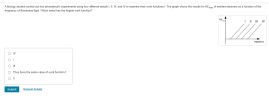 A biology student carried out four photoelectric experiments using four different metals I, II, III, and IV to examine their work functions f. The graph shows the results for KEmax of emitted electrons as a function of the frequency of illuminated light. Which metal has the largest work function? KE III III IV frequency O IV OOOOO O They have the same value of work function f Submit Request Answer
Which of the following statements is correct for photoelectric effect? (A) In order to eject electrons...
Which of the following statements is correct for photoelectric effect? (A) In order to eject electrons from a metal surface, the wavelength of photon must be shorter than the threshold wavelength. (B) In order to eject electrons from a metal surface, the frequency of photon must be lower than the cut-off frequency. (C) The work function increases with increasing the frequency of photons. (D) The work function increases with increasing the wavelength of photons. (E) The kinetic energy of ejected...
In his explanation of the threshold frequency in the photoelectric effect
 In his explanation of the threshold frequency in the photoelectric effect, Einstein reasoned that the absorbed photon must have the minimum energy required to dislodge an electron from the metal surface. This energy is called the work function (Φ) of that metal. What is the longest wavelength of radiation (in nm) that could cause the photoelectric effect in each of the following metals?
The work function for cesium is 1.9eV. A) Find the threshold frequency for the photoelectric effect....
The work function for cesium is 1.9eV. A) Find the threshold frequency for the photoelectric effect. B) Find the stopping potential if the wavelength of the incident light is 400nm.
6. Photoelectric effect. You perform a photoelectric experiment on an unknown material and get the following...
 6. Photoelectric effect. You perform a photoelectric experiment on an unknown material and get the following data: Stopping potential (V) 0.4 Frequency (THz) 560 700 780 830 1010 1210 1.3 1.7 2.4 From this data, and using Excel or an equivalent data tool, find a. the work function (in eV). b. the cutoff (threshold) wavelength for this material, c. the slope, d, an estimate of h e. What is your percent error in your h calculation? Include the Excel graph...
Data for the stopping potential 56 for the photoelectric effect of an unknown metal are given...
Data for the stopping potential 56 for the photoelectric effect of an unknown metal are given in the table. Using graph paper (or Excel), plot0 the kinetic energy eV0 of the electrons vs. the incoming photon energy (hc/l). From the linear fit of this graph, find the slope value, work function j and threshold photon energy. V0 l (nm) hc/l (eV) 0.49 1250 0.99 0.74 1000 1.24 1.15 750 1.65 1.98 500 2.48 4.46 250 4.96
In a photoelectric effect experiment in which monochromatic light of wave- length, X, falls on a...
 In a photoelectric effect experiment in which monochromatic light of wave- length, X, falls on a potassium surface, it is found the stopping potential is 1.91 V for λ-3000 and 0.88 V for λ-: 4000 Á. For these data, calcu- late: a) Planck's constant using e-1.69 × 10⁻¹⁹ C, b) the work function. W, for potassium, and c) the threshold frequency, vT for potassium.
Thanks! 5. (10 pts) (a) Einstein's explanation of the photoelectric effect launched the study of quantum...
 Thanks!
5. (10 pts) (a) Einstein's explanation of the photoelectric effect launched the study of quantum mechanics. A minimum frequency of UV light shining on a metal is necessary to create a current. Explain in your own words, how Einstein explained this particular observation. Be to the point. Points will be deducted for answers that do not have enough detail, or if there is irrelevant information. (b) You discover a new metal. You conduct a photoelectric experiment on the metal...
Thanks!
5. (10 pts) (a) Einstein's explanation of the photoelectric effect launched the study of quantum mechanics. A minimum frequency of UV light shining on a metal is necessary to create a current. Explain in your own words, how Einstein explained this particular observation. Be to the point. Points will be deducted for answers that do not have enough detail, or if there is irrelevant information. (b) You discover a new metal. You conduct a photoelectric experiment on the metal...
In the photoelectric effect, you got familiar with threshold frequency, stopping potential, and how they are...
 In the photoelectric effect, you got familiar with threshold frequency, stopping potential, and how they are inter-related. The wavelength() corresponding to the threshold frequency of potassium is 558 nm. What is the work function for potassium? What is the maximum kinetic energy of e- when light of 400 nm is incident on potassium? If the intensity of light is 10-2W/m², how many photons are incident per second per square meter? (4 points)
In a photoelectric eect experiment, the stopping potential is observed to drop from 5 V to...
In a photoelectric eect experiment, the stopping potential is observed to drop from 5 V to 1 V when the wavelength of incident light is doubled. Determine the work function of the irradiated metal and the frequency of the light in the initial setup.
 A biology student carried out four photoelectric experiments using four different metals I, II, III, and IV to examine their work functions f. The graph shows the results for KEmax of emitted electrons as a function of the frequency of illuminated light. Which metal has the largest work function? KE III III IV frequency O IV OOOOO O They have the same value of work function f Submit Request Answer
 6. Photoelectric effect. You perform a photoelectric experiment on an unknown material and get the following data: Stopping potential (V) 0.4 Frequency (THz) 560 700 780 830 1010 1210 1.3 1.7 2.4 From this data, and using Excel or an equivalent data tool, find a. the work function (in eV). b. the cutoff (threshold) wavelength for this material, c. the slope, d, an estimate of h e. What is your percent error in your h calculation? Include the Excel graph...
 In a photoelectric effect experiment in which monochromatic light of wave- length, X, falls on a potassium surface, it is found the stopping potential is 1.91 V for λ-3000 and 0.88 V for λ-: 4000 Á. For these data, calcu- late: a) Planck's constant using e-1.69 × 10⁻¹⁹ C, b) the work function. W, for potassium, and c) the threshold frequency, vT for potassium.
 Thanks!
5. (10 pts) (a) Einstein's explanation of the photoelectric effect launched the study of quantum mechanics. A minimum frequency of UV light shining on a metal is necessary to create a current. Explain in your own words, how Einstein explained this particular observation. Be to the point. Points will be deducted for answers that do not have enough detail, or if there is irrelevant information. (b) You discover a new metal. You conduct a photoelectric experiment on the metal...
Thanks!
5. (10 pts) (a) Einstein's explanation of the photoelectric effect launched the study of quantum mechanics. A minimum frequency of UV light shining on a metal is necessary to create a current. Explain in your own words, how Einstein explained this particular observation. Be to the point. Points will be deducted for answers that do not have enough detail, or if there is irrelevant information. (b) You discover a new metal. You conduct a photoelectric experiment on the metal...
 In the photoelectric effect, you got familiar with threshold frequency, stopping potential, and how they are inter-related. The wavelength() corresponding to the threshold frequency of potassium is 558 nm. What is the work function for potassium? What is the maximum kinetic energy of e- when light of 400 nm is incident on potassium? If the intensity of light is 10-2W/m², how many photons are incident per second per square meter? (4 points)
Most questions answered within 3 hours.
-
Where is the error in this code sequence?
String s1 = "Hello";
String s2 = "ello";...
asked 10 months ago -
Financial data for Joel de Paris, Inc., for last year
follow:
Joel de Paris, Inc.
Balance...
asked 10 months ago -
Consider this reaction:
Al2(SO4)3 (aq)+ BaCl3
(aq) Al2Cl6 (aq)- +
3BaSO4(s) . What is the...
asked 10 months ago -
Suppose that Savneet is considering increasing her
recent random sample from 20 car rentals to 40...
asked 10 months ago -
Trucks arrive at an unloading terminal at an average rate of 120
per hour.
Trucks arrive...
asked 10 months ago -
Why are methanol and ethanol completely soluble in water while
octanol is not very little soluble....
asked 10 months ago -
A facilities manager at a university reads in a research report
that the mean amount of...
asked 10 months ago -
When the CuSO4 is rehydrated by adding water to the anhydrous
compound, is this an endothermic...
asked 10 months ago -
A ray of sunlight is passing from diamond into crown glass; the
angle of incidence is...
asked 10 months ago -
A block of mass 0.249 kg is placed on top of a light, vertical
spring of...
asked 10 months ago -
how do the kidneys compensate in the presences of acidosis
a) trigger hyperventilate
b) reserve acid...
asked 10 months ago -
Question 501 pts
The rental rate of capital to the firm increases. Which of the
following...
asked 10 months ago