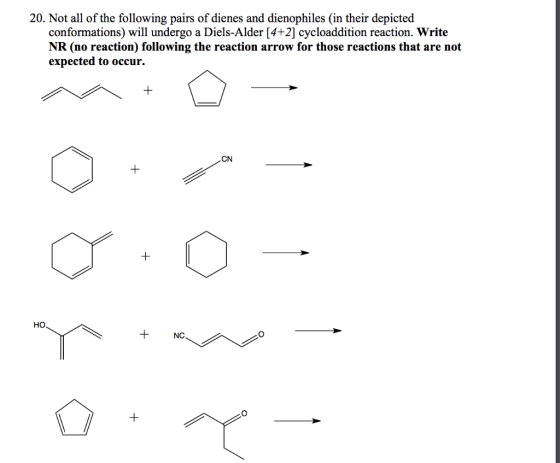
20. Not all of the following pairs of dienes and dienophiles (in their depicted conformations) will undergo a Diels-Alder [4+2] cycloaddition reaction. Write NR (no reaction) following the reaction arrow for those reactions that are not expected to occur.
Homework Answers
Add Answer to:
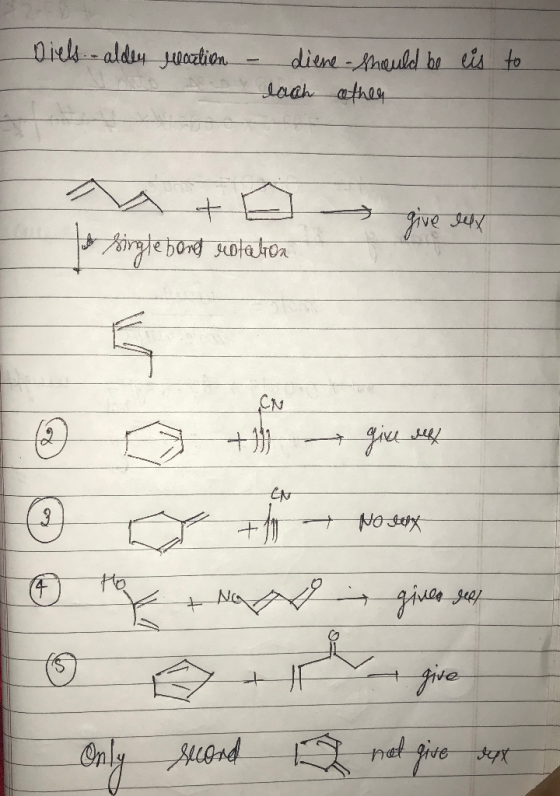
20. Not all of the following pairs of dienes and dienophiles (in
their depicted conformations) will...
4. What dienes and dienophiles would react to give the following Diels-Alder products 18 pts) 5....
 4. What dienes and dienophiles would react to give the following Diels-Alder products 18 pts) 5. Predict the products of the following Diels-Alder reactions. (10 pts) 6. Explain why each compound or ion should be aromatic, antiaromatic, or nonaromatic. (10 pts)
Can you please write the structure of the Diels-Alder products you would expect to isolate from each of the following re...
 Can you please write the structure of the Diels-Alder products
you would expect to isolate from each of the following reactions
and explain it step by step so that I can solve
problems similar to these. Thank you so much.
-- If there are arrows and/or tricks to remember when solving
this type of problem, please include.
Practice problems: Cyclobutadiene is an extremely unstable compound whose isolation is impossible even at the lowest temperatures routinely accessible in the organic laboratory....
Can you please write the structure of the Diels-Alder products
you would expect to isolate from each of the following reactions
and explain it step by step so that I can solve
problems similar to these. Thank you so much.
-- If there are arrows and/or tricks to remember when solving
this type of problem, please include.
Practice problems: Cyclobutadiene is an extremely unstable compound whose isolation is impossible even at the lowest temperatures routinely accessible in the organic laboratory....
4. Disnes undergo 1.2-addition OR 1,4-addition with FIX and X: The major product is determined by...
 4. Disnes undergo 1.2-addition OR 1,4-addition with FIX and X: The major product is determined by the temperature of the reaction notice how alkene shifted OR AB 1,2-addition 1.4.ddition when heated A) Drew mechanisms to account for all possible products (hox all final products). Explain which products will be favored at low temperatures, which at high temperatures H-C B) Draw the major product of the following reactions. 1 Bry -78 °C HCI 40 °C 65 5. Only s-cis dienes can...
this the pre lab questions for The Diels - Alder Cycloaddition Reactio expirment please answer all...
 this the pre lab questions for The Diels -
Alder Cycloaddition Reactio expirment please answer all the
question
If the Diels-Alder reaction is classified as a [4 + 2] cycloaddition reaction, how would you classify the cycloaddition reactions shown below? You are instructed to use 140 mg of cyclopentadiene (d = 0.80 g/mL). It is typically more convenient to measure out a volume of liquid. What volume of cyclopentadiene should be used? In the Diels-Alder reaction that you will be...
this the pre lab questions for The Diels -
Alder Cycloaddition Reactio expirment please answer all the
question
If the Diels-Alder reaction is classified as a [4 + 2] cycloaddition reaction, how would you classify the cycloaddition reactions shown below? You are instructed to use 140 mg of cyclopentadiene (d = 0.80 g/mL). It is typically more convenient to measure out a volume of liquid. What volume of cyclopentadiene should be used? In the Diels-Alder reaction that you will be...
I. Conjugated dienes undergo Diels-Alder reaction and form 6-membered rings. In order for this reaction to...
 I. Conjugated dienes undergo Diels-Alder reaction and form 6-membered rings. In order for this reaction to occur, the diene must be in the S-cis conformation and an alkene (dienophile) preferably with an electron-withdrawing group. EW EW U +U Diene S-cis conformation Dienophile racemic product Indicate which of the following compounds can function as the diene in Diels- Alder reaction and why: Cli) The rates of Diels-Alder reaction of the compounds below are compare with that of 1,3butadiene. Please explain the...
18, 22, 23 16) What diene and dienophile would react to give the product below? diere...
 18, 22, 23
16) What diene and dienophile would react to give the product below? diere 17) Which of the following compounds is the most reactive dienophile in a Diels-Alder reaction with 1,3-butadiene? A) CH-CHOCH B) CH2-CHCHO C) CH3CHCHCH3 D) (CH3CH2 5) C .CH 18) Using resonance structures, explain the regiochemistry observed in this reaction OCH H.CO heat 19) Provide the major organic product of the following reaction H.CO ÇOCH H.COM 20) Provide the major organic product of the following...
18, 22, 23
16) What diene and dienophile would react to give the product below? diere 17) Which of the following compounds is the most reactive dienophile in a Diels-Alder reaction with 1,3-butadiene? A) CH-CHOCH B) CH2-CHCHO C) CH3CHCHCH3 D) (CH3CH2 5) C .CH 18) Using resonance structures, explain the regiochemistry observed in this reaction OCH H.CO heat 19) Provide the major organic product of the following reaction H.CO ÇOCH H.COM 20) Provide the major organic product of the following...
Multiple Choice, T/F Questions 1. Which of the following are TRUE (T) or FALSE (F) regarding...
 Multiple Choice, T/F Questions 1. Which of the following are TRUE (T) or FALSE (F) regarding Diels-Alder reactions? a) The reaction involves syn addition. _b) The reaction occurs in multiple steps. c) The reaction is a [4+2] A cycloaddition. d) The adduct formed fasted is the exo isomer. e) Electron donating groups activate the diene. f) Electron withdrawing groups activate the dienophile. 2. The compound at the right does not undergo Diels-Alder reaction because: a) ring systems cannot function as...
Question 21 (2 points) Which of the following dienes can undergo the Diels-Alder reaction? III IV...
 Question 21 (2 points) Which of the following dienes can undergo the Diels-Alder reaction? III IV Oa) III ob) 11 Oc) od) IV Question 22 (2 points) Predict the product(s) of the following reaction. нег ROOR Oa) HBr addition at the alkene position following Markonikov's rule Ob) HBr addition at the alkene position following Anti-Markonikov's rule Oc) H20 addition at the alkene position following Anti-Markonikov's rule od) H20 addition at the alkene position following Markonikov's rule
Question 1 Identify all compounds below that CANNOT be made by the electrophilic aromatic substitution reactions...
 Question 1 Identify all compounds below that CANNOT be made by the electrophilic aromatic substitution reactions introduced in Sections 18.1-18.6 SOH Question 2. Match each pair of structures with the appropriate term. KEY 1 = Constitutional isomers 2 - Diastereomers 0 000 3 = Different conformations 4 = Resonance structures 5 = Bond-shift isomers Question 3. In this reaction, FeBrz is acting as a and the complex that is formed will react with benzene as a/n :Br: : Br-Br: Br-Br-Fe-Br:...
please explain as well, thank you. (8) 1. Draw all the molecular orbitals for the X-system of the allyl anion. Indic...
 please explain as well, thank you.
(8) 1. Draw all the molecular orbitals for the X-system of the allyl anion. Indicate which orbital is the HOMO. (20) 2. Provide reasonable product structures for the following reactions. Indicate clearly if you expect one isomer to predominate. NBS/ROOH D-Br (1 mg) +25°C (1g) -40 °C ) Br (1 e -78 "C (12) 3. Provide product structures for the following Diels-Alder reactions. The second Diels-Alder product eliminates a neutral substance upon further heating....
please explain as well, thank you.
(8) 1. Draw all the molecular orbitals for the X-system of the allyl anion. Indicate which orbital is the HOMO. (20) 2. Provide reasonable product structures for the following reactions. Indicate clearly if you expect one isomer to predominate. NBS/ROOH D-Br (1 mg) +25°C (1g) -40 °C ) Br (1 e -78 "C (12) 3. Provide product structures for the following Diels-Alder reactions. The second Diels-Alder product eliminates a neutral substance upon further heating....
 4. What dienes and dienophiles would react to give the following Diels-Alder products 18 pts) 5. Predict the products of the following Diels-Alder reactions. (10 pts) 6. Explain why each compound or ion should be aromatic, antiaromatic, or nonaromatic. (10 pts)
 Can you please write the structure of the Diels-Alder products
you would expect to isolate from each of the following reactions
and explain it step by step so that I can solve
problems similar to these. Thank you so much.
-- If there are arrows and/or tricks to remember when solving
this type of problem, please include.
Practice problems: Cyclobutadiene is an extremely unstable compound whose isolation is impossible even at the lowest temperatures routinely accessible in the organic laboratory....
Can you please write the structure of the Diels-Alder products
you would expect to isolate from each of the following reactions
and explain it step by step so that I can solve
problems similar to these. Thank you so much.
-- If there are arrows and/or tricks to remember when solving
this type of problem, please include.
Practice problems: Cyclobutadiene is an extremely unstable compound whose isolation is impossible even at the lowest temperatures routinely accessible in the organic laboratory....
 4. Disnes undergo 1.2-addition OR 1,4-addition with FIX and X: The major product is determined by the temperature of the reaction notice how alkene shifted OR AB 1,2-addition 1.4.ddition when heated A) Drew mechanisms to account for all possible products (hox all final products). Explain which products will be favored at low temperatures, which at high temperatures H-C B) Draw the major product of the following reactions. 1 Bry -78 °C HCI 40 °C 65 5. Only s-cis dienes can...
 this the pre lab questions for The Diels -
Alder Cycloaddition Reactio expirment please answer all the
question
If the Diels-Alder reaction is classified as a [4 + 2] cycloaddition reaction, how would you classify the cycloaddition reactions shown below? You are instructed to use 140 mg of cyclopentadiene (d = 0.80 g/mL). It is typically more convenient to measure out a volume of liquid. What volume of cyclopentadiene should be used? In the Diels-Alder reaction that you will be...
this the pre lab questions for The Diels -
Alder Cycloaddition Reactio expirment please answer all the
question
If the Diels-Alder reaction is classified as a [4 + 2] cycloaddition reaction, how would you classify the cycloaddition reactions shown below? You are instructed to use 140 mg of cyclopentadiene (d = 0.80 g/mL). It is typically more convenient to measure out a volume of liquid. What volume of cyclopentadiene should be used? In the Diels-Alder reaction that you will be...
 I. Conjugated dienes undergo Diels-Alder reaction and form 6-membered rings. In order for this reaction to occur, the diene must be in the S-cis conformation and an alkene (dienophile) preferably with an electron-withdrawing group. EW EW U +U Diene S-cis conformation Dienophile racemic product Indicate which of the following compounds can function as the diene in Diels- Alder reaction and why: Cli) The rates of Diels-Alder reaction of the compounds below are compare with that of 1,3butadiene. Please explain the...
 18, 22, 23
16) What diene and dienophile would react to give the product below? diere 17) Which of the following compounds is the most reactive dienophile in a Diels-Alder reaction with 1,3-butadiene? A) CH-CHOCH B) CH2-CHCHO C) CH3CHCHCH3 D) (CH3CH2 5) C .CH 18) Using resonance structures, explain the regiochemistry observed in this reaction OCH H.CO heat 19) Provide the major organic product of the following reaction H.CO ÇOCH H.COM 20) Provide the major organic product of the following...
18, 22, 23
16) What diene and dienophile would react to give the product below? diere 17) Which of the following compounds is the most reactive dienophile in a Diels-Alder reaction with 1,3-butadiene? A) CH-CHOCH B) CH2-CHCHO C) CH3CHCHCH3 D) (CH3CH2 5) C .CH 18) Using resonance structures, explain the regiochemistry observed in this reaction OCH H.CO heat 19) Provide the major organic product of the following reaction H.CO ÇOCH H.COM 20) Provide the major organic product of the following...
 Multiple Choice, T/F Questions 1. Which of the following are TRUE (T) or FALSE (F) regarding Diels-Alder reactions? a) The reaction involves syn addition. _b) The reaction occurs in multiple steps. c) The reaction is a [4+2] A cycloaddition. d) The adduct formed fasted is the exo isomer. e) Electron donating groups activate the diene. f) Electron withdrawing groups activate the dienophile. 2. The compound at the right does not undergo Diels-Alder reaction because: a) ring systems cannot function as...
 Question 21 (2 points) Which of the following dienes can undergo the Diels-Alder reaction? III IV Oa) III ob) 11 Oc) od) IV Question 22 (2 points) Predict the product(s) of the following reaction. нег ROOR Oa) HBr addition at the alkene position following Markonikov's rule Ob) HBr addition at the alkene position following Anti-Markonikov's rule Oc) H20 addition at the alkene position following Anti-Markonikov's rule od) H20 addition at the alkene position following Markonikov's rule
 Question 1 Identify all compounds below that CANNOT be made by the electrophilic aromatic substitution reactions introduced in Sections 18.1-18.6 SOH Question 2. Match each pair of structures with the appropriate term. KEY 1 = Constitutional isomers 2 - Diastereomers 0 000 3 = Different conformations 4 = Resonance structures 5 = Bond-shift isomers Question 3. In this reaction, FeBrz is acting as a and the complex that is formed will react with benzene as a/n :Br: : Br-Br: Br-Br-Fe-Br:...
 please explain as well, thank you.
(8) 1. Draw all the molecular orbitals for the X-system of the allyl anion. Indicate which orbital is the HOMO. (20) 2. Provide reasonable product structures for the following reactions. Indicate clearly if you expect one isomer to predominate. NBS/ROOH D-Br (1 mg) +25°C (1g) -40 °C ) Br (1 e -78 "C (12) 3. Provide product structures for the following Diels-Alder reactions. The second Diels-Alder product eliminates a neutral substance upon further heating....
please explain as well, thank you.
(8) 1. Draw all the molecular orbitals for the X-system of the allyl anion. Indicate which orbital is the HOMO. (20) 2. Provide reasonable product structures for the following reactions. Indicate clearly if you expect one isomer to predominate. NBS/ROOH D-Br (1 mg) +25°C (1g) -40 °C ) Br (1 e -78 "C (12) 3. Provide product structures for the following Diels-Alder reactions. The second Diels-Alder product eliminates a neutral substance upon further heating....
Most questions answered within 3 hours.
-
Where is the error in this code sequence?
String s1 = "Hello";
String s2 = "ello";...
asked 11 months ago -
Financial data for Joel de Paris, Inc., for last year
follow:
Joel de Paris, Inc.
Balance...
asked 11 months ago -
Consider this reaction:
Al2(SO4)3 (aq)+ BaCl3
(aq) Al2Cl6 (aq)- +
3BaSO4(s) . What is the...
asked 11 months ago -
Suppose that Savneet is considering increasing her
recent random sample from 20 car rentals to 40...
asked 11 months ago -
Trucks arrive at an unloading terminal at an average rate of 120
per hour.
Trucks arrive...
asked 11 months ago -
Why are methanol and ethanol completely soluble in water while
octanol is not very little soluble....
asked 11 months ago -
A facilities manager at a university reads in a research report
that the mean amount of...
asked 11 months ago -
When the CuSO4 is rehydrated by adding water to the anhydrous
compound, is this an endothermic...
asked 11 months ago -
A ray of sunlight is passing from diamond into crown glass; the
angle of incidence is...
asked 11 months ago -
A block of mass 0.249 kg is placed on top of a light, vertical
spring of...
asked 11 months ago -
how do the kidneys compensate in the presences of acidosis
a) trigger hyperventilate
b) reserve acid...
asked 11 months ago -
Question 501 pts
The rental rate of capital to the firm increases. Which of the
following...
asked 11 months ago