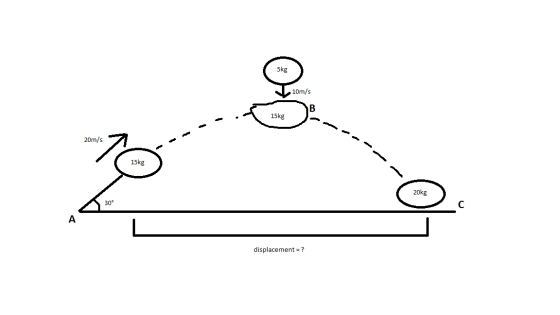
A 15kg object is shot 30 degrees above the horizontal at 20m/s.
When the object is at the top of its flight path, it has a
perfectly inelastic collision with a 5kg object
going 10m/s in the negative y-direction. What is the
total displacement in the x-direction from the objects initial
position? (As much details as possible in the solution please! (: I
know this is an energy, collision and projectile motion
problem.)
Homework Answers
Let M be the mass of object 1 = 15 kg
 be the angle =
300
be the angle =
300
u be the initial velocity of object 1 = 20 m/s
h be the maximum height of object 1
d be the net displacement
d1 be the displacemet from A to B
d2 be the displacement from B to C
d = d1 + d2
m be the mass of object 2 which collide with object 1 = 5 kg
(M+m) is the mass of object 3 (After collision of object 1 and object 2) = 20 kg
Let the horizontal velocity of object 1 before collision be uMx
and the vertical velocity of object 1 before collision be uMy
During Projectile motion at maximum height there will be only horizontal component of velocity
so
uMx = ucos() = 17.321
m\s
uMy = 0
Let the horizontal velocity of object 1 before collision be umx = 0m/s
the vertical velocity of object 1 before collision be umy = 10 m/s
Let the horizontal velocity of object 3 before collision be vx
and the vertical velocity of object 1 before collision be vy
By conservation of Momentum in horizontal direction at maximum height of object 1



By conservation of Momentum in vertical direction at maximum height of object 1



Let v be the Net velocity of object 3 just after collision


Maximum height of object 1


The displacement from A to B


Let t be time taken by object 3 to reach from maximum height to point C

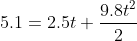




Net displacement will be


Add Answer to:
A 15kg object is shot 30 degrees above the horizontal at 20m/s.
When the object is...
A projectile is shot at 53 degrees above the horizontal with a speed of 100 m/s,...
A projectile is shot at 53 degrees above the horizontal with a speed of 100 m/s, how far away must a wall be if the projectile is to hit 75 m above the level at which the projectile was shot?
1. A firework (small rocket) whose shell has a mass of m 12kg was initially on the ground before being launched to a height of 100m above the ground at which point its horizontal displacement from it...
 1. A firework (small rocket) whose shell has a mass of m 12kg was initially on the ground before being launched to a height of 100m above the ground at which point its horizontal displacement from its starting position is 17.6m. At this location its speed is 68m/s and it's at an angle relative to (and above) the horizontal of 80 as depicted in the diagram below. Once it reaches this height it goes off and its shell splits into...
EXPLORE A projectile is launched with a launch angle of 30° with respect to the horizontal...
 EXPLORE A projectile is launched with a launch angle of 30° with respect to the horizontal direction and with an initial speed of 10 m/s. s0 (A) How do the vertical and horizontal components of the projectile's velocity vary with time? 40 35 (B) How long does it remain in flight? 25 (C) For a given launch speed, what launch angle produces the longest time of flight? 15 10 toy CONCEPTUALIZE Consider the projectile to be a point mass that...
Problem 4: A projectile is fired with an initial velocity of 54.1 m/s, at an initial...
 Problem 4: A projectile is fired with an initial velocity of 54.1 m/s, at an initial inclination of 33.7 degrees with the horizontal r-axis. All initial variables (displacement and time) start at 0. You are asked to consider two cases of motion for the projectile, one without drag, and one with drag, with both the cases including effects of gravity. a) For motion with no drag, acceleration vector is given as а -g, where g 9.8 m/s. b) For motion...
18 19 When objects stick together after colliding. A momentum is not conserved. B momentum is...
 18 19 When objects stick together after colliding. A momentum is not conserved. B momentum is zero. the collision is inelastic. D. the collision is elastic. Work is done A any time a force is applied. B by all components of force. c. when an object moves in the direction of the net force. D by an applied force perpendicular to the direction of the motion A heavy truck has more momentum than a passenger car moving at the same...
2. General Motion with Unit Vectors and Components An object undergoes the following consecutive displacements: s...
 2.
General Motion with Unit Vectors and Components An object undergoes the following consecutive displacements: s (2i +3j +5k)m,s2 (6i-91+ 2krn, and s,-(10i + 8j-km a) Find the resultant displacement in terms of unit vectors and components. b) State the magnitude of the resultant displacement. 2. Suppose a hiker travels 5 km southwest from their camp. Then, the hiker travels 2 km 75° north of east. a) Find the displacement of the hiker form their camp. b) If the hiker...
2.
General Motion with Unit Vectors and Components An object undergoes the following consecutive displacements: s (2i +3j +5k)m,s2 (6i-91+ 2krn, and s,-(10i + 8j-km a) Find the resultant displacement in terms of unit vectors and components. b) State the magnitude of the resultant displacement. 2. Suppose a hiker travels 5 km southwest from their camp. Then, the hiker travels 2 km 75° north of east. a) Find the displacement of the hiker form their camp. b) If the hiker...
7. General Motion with Unit Vectors and Components An object undergoes the following consecutive displacements: s...
 7.
General Motion with Unit Vectors and Components An object undergoes the following consecutive displacements: s (2i +3j +5k)m,s2 (6i- 9j + 2k)m, and s3 (10i 8j -k)m. a) Find the resultant displacement in terms of unit vectors and components. b) State the magnitude of the resultant displacement. 2. Suppose a hiker travels 5 km southwest from their camp. Then, the hiker travels 2 km 75° north of east. a) Find the displacement of the hiker form their camp. b)...
7.
General Motion with Unit Vectors and Components An object undergoes the following consecutive displacements: s (2i +3j +5k)m,s2 (6i- 9j + 2k)m, and s3 (10i 8j -k)m. a) Find the resultant displacement in terms of unit vectors and components. b) State the magnitude of the resultant displacement. 2. Suppose a hiker travels 5 km southwest from their camp. Then, the hiker travels 2 km 75° north of east. a) Find the displacement of the hiker form their camp. b)...
6. General Motion with Unit Vectors and Components An object undergoes the following consecutive displacements: s...
 6.
General Motion with Unit Vectors and Components An object undergoes the following consecutive displacements: s (2i +3j +5k)m,s2 (6i- 9j + 2k)m, and s3 (10i 8j -k)m. a) Find the resultant displacement in terms of unit vectors and components. b) State the magnitude of the resultant displacement. 2. Suppose a hiker travels 5 km southwest from their camp. Then, the hiker travels 2 km 75° north of east. a) Find the displacement of the hiker form their camp. b)...
6.
General Motion with Unit Vectors and Components An object undergoes the following consecutive displacements: s (2i +3j +5k)m,s2 (6i- 9j + 2k)m, and s3 (10i 8j -k)m. a) Find the resultant displacement in terms of unit vectors and components. b) State the magnitude of the resultant displacement. 2. Suppose a hiker travels 5 km southwest from their camp. Then, the hiker travels 2 km 75° north of east. a) Find the displacement of the hiker form their camp. b)...
5. General Motion with Unit Vectors and Components An object undergoes the following consecutive displacements: s...
 5.
General Motion with Unit Vectors and Components An object undergoes the following consecutive displacements: s (2i +3j +5k)m,s2 (6i- 9j + 2k)m, and s3 (10i 8j -k)m. a) Find the resultant displacement in terms of unit vectors and components. b) State the magnitude of the resultant displacement. 2. Suppose a hiker travels 5 km southwest from their camp. Then, the hiker travels 2 km 75° north of east. a) Find the displacement of the hiker form their camp. b)...
5.
General Motion with Unit Vectors and Components An object undergoes the following consecutive displacements: s (2i +3j +5k)m,s2 (6i- 9j + 2k)m, and s3 (10i 8j -k)m. a) Find the resultant displacement in terms of unit vectors and components. b) State the magnitude of the resultant displacement. 2. Suppose a hiker travels 5 km southwest from their camp. Then, the hiker travels 2 km 75° north of east. a) Find the displacement of the hiker form their camp. b)...
4. General Motion with Unit Vectors and Components An object undergoes the following consecutive displacements: s...
 4.
General Motion with Unit Vectors and Components An object undergoes the following consecutive displacements: s (2i +3j +5k)m,s2 (6i- 9j + 2k)m, and s3 (10i 8j -k)m. a) Find the resultant displacement in terms of unit vectors and components. b) State the magnitude of the resultant displacement. 2. Suppose a hiker travels 5 km southwest from their camp. Then, the hiker travels 2 km 75° north of east. a) Find the displacement of the hiker form their camp. b)...
4.
General Motion with Unit Vectors and Components An object undergoes the following consecutive displacements: s (2i +3j +5k)m,s2 (6i- 9j + 2k)m, and s3 (10i 8j -k)m. a) Find the resultant displacement in terms of unit vectors and components. b) State the magnitude of the resultant displacement. 2. Suppose a hiker travels 5 km southwest from their camp. Then, the hiker travels 2 km 75° north of east. a) Find the displacement of the hiker form their camp. b)...
 1. A firework (small rocket) whose shell has a mass of m 12kg was initially on the ground before being launched to a height of 100m above the ground at which point its horizontal displacement from its starting position is 17.6m. At this location its speed is 68m/s and it's at an angle relative to (and above) the horizontal of 80 as depicted in the diagram below. Once it reaches this height it goes off and its shell splits into...
 EXPLORE A projectile is launched with a launch angle of 30° with respect to the horizontal direction and with an initial speed of 10 m/s. s0 (A) How do the vertical and horizontal components of the projectile's velocity vary with time? 40 35 (B) How long does it remain in flight? 25 (C) For a given launch speed, what launch angle produces the longest time of flight? 15 10 toy CONCEPTUALIZE Consider the projectile to be a point mass that...
 Problem 4: A projectile is fired with an initial velocity of 54.1 m/s, at an initial inclination of 33.7 degrees with the horizontal r-axis. All initial variables (displacement and time) start at 0. You are asked to consider two cases of motion for the projectile, one without drag, and one with drag, with both the cases including effects of gravity. a) For motion with no drag, acceleration vector is given as а -g, where g 9.8 m/s. b) For motion...
 18 19 When objects stick together after colliding. A momentum is not conserved. B momentum is zero. the collision is inelastic. D. the collision is elastic. Work is done A any time a force is applied. B by all components of force. c. when an object moves in the direction of the net force. D by an applied force perpendicular to the direction of the motion A heavy truck has more momentum than a passenger car moving at the same...
 2.
General Motion with Unit Vectors and Components An object undergoes the following consecutive displacements: s (2i +3j +5k)m,s2 (6i-91+ 2krn, and s,-(10i + 8j-km a) Find the resultant displacement in terms of unit vectors and components. b) State the magnitude of the resultant displacement. 2. Suppose a hiker travels 5 km southwest from their camp. Then, the hiker travels 2 km 75° north of east. a) Find the displacement of the hiker form their camp. b) If the hiker...
2.
General Motion with Unit Vectors and Components An object undergoes the following consecutive displacements: s (2i +3j +5k)m,s2 (6i-91+ 2krn, and s,-(10i + 8j-km a) Find the resultant displacement in terms of unit vectors and components. b) State the magnitude of the resultant displacement. 2. Suppose a hiker travels 5 km southwest from their camp. Then, the hiker travels 2 km 75° north of east. a) Find the displacement of the hiker form their camp. b) If the hiker...
 7.
General Motion with Unit Vectors and Components An object undergoes the following consecutive displacements: s (2i +3j +5k)m,s2 (6i- 9j + 2k)m, and s3 (10i 8j -k)m. a) Find the resultant displacement in terms of unit vectors and components. b) State the magnitude of the resultant displacement. 2. Suppose a hiker travels 5 km southwest from their camp. Then, the hiker travels 2 km 75° north of east. a) Find the displacement of the hiker form their camp. b)...
7.
General Motion with Unit Vectors and Components An object undergoes the following consecutive displacements: s (2i +3j +5k)m,s2 (6i- 9j + 2k)m, and s3 (10i 8j -k)m. a) Find the resultant displacement in terms of unit vectors and components. b) State the magnitude of the resultant displacement. 2. Suppose a hiker travels 5 km southwest from their camp. Then, the hiker travels 2 km 75° north of east. a) Find the displacement of the hiker form their camp. b)...
 6.
General Motion with Unit Vectors and Components An object undergoes the following consecutive displacements: s (2i +3j +5k)m,s2 (6i- 9j + 2k)m, and s3 (10i 8j -k)m. a) Find the resultant displacement in terms of unit vectors and components. b) State the magnitude of the resultant displacement. 2. Suppose a hiker travels 5 km southwest from their camp. Then, the hiker travels 2 km 75° north of east. a) Find the displacement of the hiker form their camp. b)...
6.
General Motion with Unit Vectors and Components An object undergoes the following consecutive displacements: s (2i +3j +5k)m,s2 (6i- 9j + 2k)m, and s3 (10i 8j -k)m. a) Find the resultant displacement in terms of unit vectors and components. b) State the magnitude of the resultant displacement. 2. Suppose a hiker travels 5 km southwest from their camp. Then, the hiker travels 2 km 75° north of east. a) Find the displacement of the hiker form their camp. b)...
 5.
General Motion with Unit Vectors and Components An object undergoes the following consecutive displacements: s (2i +3j +5k)m,s2 (6i- 9j + 2k)m, and s3 (10i 8j -k)m. a) Find the resultant displacement in terms of unit vectors and components. b) State the magnitude of the resultant displacement. 2. Suppose a hiker travels 5 km southwest from their camp. Then, the hiker travels 2 km 75° north of east. a) Find the displacement of the hiker form their camp. b)...
5.
General Motion with Unit Vectors and Components An object undergoes the following consecutive displacements: s (2i +3j +5k)m,s2 (6i- 9j + 2k)m, and s3 (10i 8j -k)m. a) Find the resultant displacement in terms of unit vectors and components. b) State the magnitude of the resultant displacement. 2. Suppose a hiker travels 5 km southwest from their camp. Then, the hiker travels 2 km 75° north of east. a) Find the displacement of the hiker form their camp. b)...
 4.
General Motion with Unit Vectors and Components An object undergoes the following consecutive displacements: s (2i +3j +5k)m,s2 (6i- 9j + 2k)m, and s3 (10i 8j -k)m. a) Find the resultant displacement in terms of unit vectors and components. b) State the magnitude of the resultant displacement. 2. Suppose a hiker travels 5 km southwest from their camp. Then, the hiker travels 2 km 75° north of east. a) Find the displacement of the hiker form their camp. b)...
4.
General Motion with Unit Vectors and Components An object undergoes the following consecutive displacements: s (2i +3j +5k)m,s2 (6i- 9j + 2k)m, and s3 (10i 8j -k)m. a) Find the resultant displacement in terms of unit vectors and components. b) State the magnitude of the resultant displacement. 2. Suppose a hiker travels 5 km southwest from their camp. Then, the hiker travels 2 km 75° north of east. a) Find the displacement of the hiker form their camp. b)...
Most questions answered within 3 hours.
-
Where is the error in this code sequence?
String s1 = "Hello";
String s2 = "ello";...
asked 10 months ago -
Financial data for Joel de Paris, Inc., for last year
follow:
Joel de Paris, Inc.
Balance...
asked 10 months ago -
Consider this reaction:
Al2(SO4)3 (aq)+ BaCl3
(aq) Al2Cl6 (aq)- +
3BaSO4(s) . What is the...
asked 10 months ago -
Suppose that Savneet is considering increasing her
recent random sample from 20 car rentals to 40...
asked 10 months ago -
Trucks arrive at an unloading terminal at an average rate of 120
per hour.
Trucks arrive...
asked 10 months ago -
Why are methanol and ethanol completely soluble in water while
octanol is not very little soluble....
asked 10 months ago -
A facilities manager at a university reads in a research report
that the mean amount of...
asked 10 months ago -
When the CuSO4 is rehydrated by adding water to the anhydrous
compound, is this an endothermic...
asked 10 months ago -
A ray of sunlight is passing from diamond into crown glass; the
angle of incidence is...
asked 10 months ago -
A block of mass 0.249 kg is placed on top of a light, vertical
spring of...
asked 10 months ago -
how do the kidneys compensate in the presences of acidosis
a) trigger hyperventilate
b) reserve acid...
asked 10 months ago -
Question 501 pts
The rental rate of capital to the firm increases. Which of the
following...
asked 10 months ago